Ever since September 11th, the US government has engaged in harsh tactics against suspected terrorists. While toughness is clearly in order here, the Bush administration goes too far. They are suspending basic human rights in their "war on terror".
This is not only bad in itself - it's ultimately counterproductive. When a powerful country discards its sense of decency to fight its enemies, it loses its best weapon: the general perception that its battle is a righteous one.
The Bush administration clearly disagrees. They're going ahead with indefinite detentions of people who haven't been charged with any offense. They feel free to hide the identity of these people: we can only guess who they are, or how many. In prisons such as Abu Ghraib and Guantanamo Bay, even torture has become routine. Bush's new choice for Attorney General, Alberto Gonzales, has called the Geneva Convention "obsolete".
America has entered on a course of action which we are bound to look back on with shame. Here are a few examples of what's going on - very incomplete, since keeping up with the news would be a full-time job.
What can you do? If you're a US citizen, ask your Senator to tell the Bush administration to release all torture-related documents. It's easy to do.
November 8, 2002
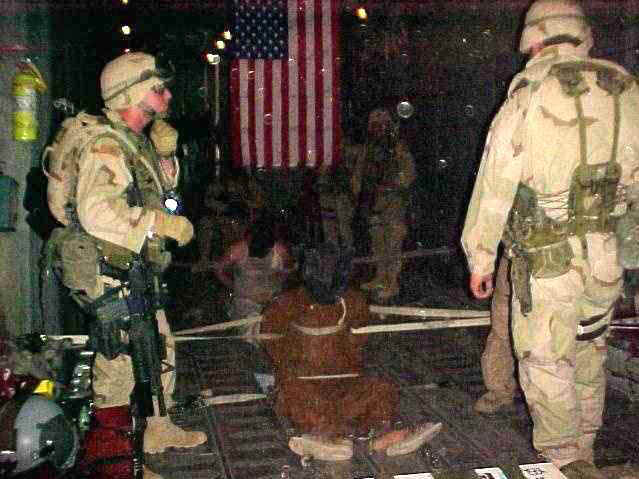
Art Bell posted photos of prisoners of war being transported in
violation of the Geneva convention; later the Pentagon admitted
that these photos are genuine.
For example:
These were just the beginning....
"She could," replied Deputy Associate Atty. Gen. Brian Boyle.
"Someone's intention is clearly not a factor that would disable
detention".
Late April, 2004
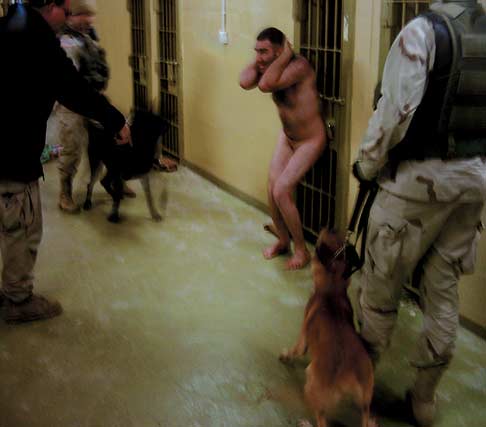
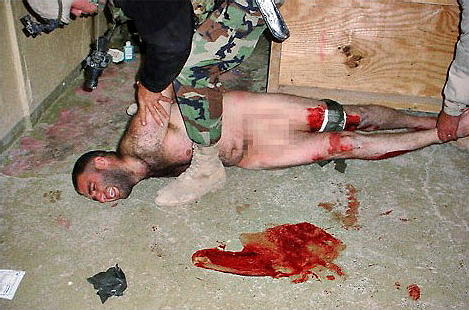
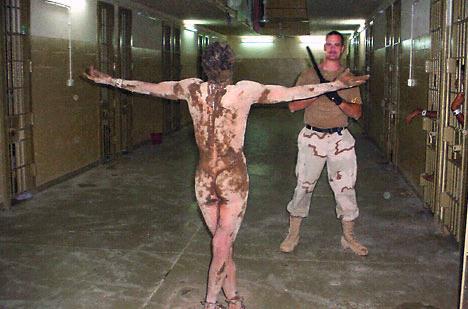
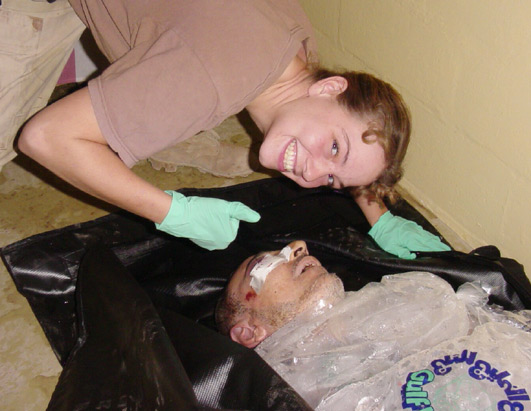
The television new-magazine "60 Minutes II" broke
a story involving abuse and humiliation of Iraqi prisoners in
Abu Ghraib. Photographs like these begin to spread worldwide:
 >
>
 >
>
 >
>
 >
>
For more on this whole story, see the Wikipedia
article on
Abu Ghraib prisoner abuse.
December 2, 2004
Deputy Associate Attorney General Brian Boyle
told a federal court that the military can hold foreigners
indefinitely as enemy combatants in
Guantanamo Bay even if they
aided terrorists unintentionally. Quoting the LA Times:
Could a "little old lady in Switzerland"
who sent a check to an orphanage
be taken into custody if, unbeknownst to her, some of her donation
was passed to Al Qaeda terrorists? asked U.S. District Judge Joyce
Hens Green.
In the
same case, Boyle also said that U.S. military panels could use
evidence gained through torture to decide whether to keep people
detained in Guantanamo Bay. Quoting the Washington Post:
U.S. District Judge Richard J. Leon asked if a detention would be illegal if it were based solely on evidence gathered by torture, because "torture is illegal. We all know that."Boyle replied that if the military's combatant status review tribunals "determine that evidence of questionable provenance were reliable, nothing in the due process clause [of the Constitution] prohibits them from relying on it."
These are not just hypothetical questions! Torture is indeed going on at Guantanamo, according to a memo written in July by the Deputy Assistant Director for Counterterrorism, Thomas Harrington. Quoting CNN:
... the Marine who had been in the room came out, and the FBI agent asked what had happened."The Marine said Sgt. Lacey had grabbed the detainee's thumbs and bent them backwards and indicated that she also grabbed his genitals. The Marine also implied that her treatment of that detainee was less harsh than her treatment of others by indicating that he had seen her treatment of other detainees result in detainees curling into a fetal position on the floor and crying in pain," the memo states.
The memo included another incident from October 2002 that involved a detainee being "gagged with duct tape that covered much of his head," according to an FBI agent's account.
Ahmed Abu Ali is a US citizen who was arrested while taking an exam in a Saudi university and has been held there without charges ever since. He has been interrogated by FBI agents, and witnesses say his fingernails have been torn off. His parents, who live in Virginia, have sued for his release. The Justice Department claims Ali is not under their jurisdiction, do they can do nothing about it. But, there is evidence that the whole operation is being run by the U.S., and that if U.S. asked for his release the Saudis would hand him over.
Today U.S. District Judge John D. Bates issued a memorandum in this case, ordering the government to release evidence that would clarify the situation. Bates' memo is eloquent, so let me quote the beginning:
"The writ of habeas corpus commands general recognition as the essential remedy to safeguard a citizen against imprisonment by State or Nation in violation of his constitutional rights." United States v. Morgan, 346 U.S. 502, 506 no.3 (1954) (quotation omitted). This case requires the Court to give substance to those words. Petitioner Ahmed Abu Ali is citizen of the United States who, through his parents, has filed a petition for a writ of habeas corpus against several officials of the United States ("respondents" or "United States") challenging his ongoing detention since June 2003 in a prison of the Kingdom of Saudi Arabia allegedly at the behest and ongoing supervision of the United States.Section V of this memorandum concerns torture:Petitioners have provided evidence, of varying degrees of competence and persuasiveness, that: (i) the United States initiated the arrest of Abu Ali in Saudi Arabia; (ii) the United States has interrogated Abu Ali in the Saudi prison; (iii) the United States is controlling his detention in Saudi Arabia; (iv) the United States is keeping Abu Ali in Saudi Arabia to avoid constitutional scrutiny by United States courts; (v) Saudi Arabia would immediately release Abu Ali to United States officials upon a request by the United States government; and (vi) Abu Ali has been subjected to torture while in the Saudi prison. The United States does not offer any facts in rebuttal. Instead, it insists that a federal district court has no jurisdiction to consider the habeas petition of a United States citizen if he is in the hands of a foreign state, and it asks this Court to dismiss the petition forthwith. The position advanced by the United States is sweeping. The authority sought would permit the executive, at his discretion, to deliver a United States citizen to a foreign country to avoid constitutional scrutiny, or, as is alleged and to some degree substantiated here, work through the intermediary of a foreign country to detain a United States citizen abroad.
The Court concludes that a citizen cannot be so easily separated from his constitutional rights. Earlier this year, the Supreme Court confirmed the fundamental right of a citizen to be free from involuntary, indefinite confinement by his government without due process. See Hamdi v. Rumsfeld, 124 S. Ct. 2633, 2647 (2004); id. at 2661 (Scalia, J., dissenting); see also Rasul v. Bush, 124 S. Ct. 2686, 2692 (2004). Abu Ali was not captured on a battlefield or in a zone of hostilities -- rather, he was arrested in a university classroom while taking an exam. The United States has therefore not invoked the executive's war powers as a rationale for his detention -- instead, the United States relies on the executive's broad authority to conduct the foreign affairs of the country as a basis to insulate Abu Alis's detention from judicial scrutiny. There are, to be sure, considerable and delicate principles of separation of powers that dictate caution and will narrow the inquiry in this case. Such principles, however, have never been read to extinguish the fundamental due process rights of a citizen of the United States to freedom from arbitrary detention at the will of the executive, and to access to the courts through the Great Writ of habeas corpus to challenge the legality of that detention.
The present posture of this case requires this Court to accept petitioner's well-supported allegations, to which the United States has not responded.
V. Allegations of Torture
Petitioners relate their growing concern that Abu Ali has been subjected to torture during his detention in Saudi Arabia. They maintain that they have received information from an unidentified eyewitness in Saudi Arabia who said that he saw Abu Ali experiencing so much pain in his hands that he was unable to pick up a pen to sign documents. Aff. of Faten Abu Ali, Sept. 17, 2004 paragraphs 3, 6. The first of these instances was allegedgly in a meeting between the Assistant U.S. Attorney and the defendants in the Royer prosecution. According to the petitioners, Seifullah Chapman, one of the defendants, reported to them in August 2004 that the prosecutor had said that Abu Ali "doesn't have to worry about clipping his fingernails anymore". Aff. of Faten Abu Ali, Sept. 17, paragraph 3.Salim Ali, a lawyer for one of the Royer defendants, describes in an affidavit a conversation that he claims he had with the same prosecutor while they were waiting at a courthouse in June 2003 after a hearing in the Royer case. Salim Ali, says that he asked the prosecutor whether Abu Ali should be returned to the United States to face charges. He explains that the prosecutor "smirked and stated that 'he's no good for us here, he has no fingernails left.'" Aff. of Salim Ali, Oct. 12, 2004 paragraph 6. In a September 2004 phone call with Abu Ali, his parents mentioned the prosecutor's comments, to which Abu Ali replied, "there are hidding things which you don't know about that are even worse." Aff. of Fatim Abu Ali, Sept. 17, 2004, paragraph 6.
Petitioners also provide an affidavit from a specialist for Saudi Arabia from Amnesty International USA who testifies that Abu Ali ias at a serious risk of torture while he remains detained in Saudi Arabia. He describes many instances of torture recounted by Westerners who have been arrested in Saudi Arabia, and notes that the U.S. Department of State itself describes "credible reports" that Saudi authorities have "abused detainees, both citizens and foreigners." Aff. of Brian Evans, Sept. 17, 2004, at 1-2.
The airplane is a Gulfstream V turbojet, the sort favored by CEOs and celebrities. But since 2001 it has been seen at military airports from Pakistan to Indonesia to Jordan, sometimes being boarded by hooded and handcuffed passengers.The plane's owner of record, Premier Executive Transport Services Inc., lists directors and officers who appear to exist only on paper. And each one of those directors and officers has a recently issued Social Security number and an address consisting only of a post office box, according to an extensive search of state, federal and commercial records.
Bryan P. Dyess, Steven E. Kent, Timothy R. Sperling and Audrey M. Tailor are names without residential, work, telephone or corporate histories -- just the kind of "sterile identities," said current and former intelligence officials, that the CIA uses to conceal involvement in clandestine operations. In this case, the agency is flying captured terrorist suspects from one country to another for detention and interrogation.
The CIA calls this activity "rendition." Premier Executive's Gulfstream helps make it possible. According to civilian aircraft landing permits, the jet has permission to use U.S. military airfields worldwide.
Since Sept. 11, 2001, secret renditions have become a principal weapon in the CIA's arsenal against suspected al Qaeda terrorists, according to congressional testimony by CIA officials. But as the practice has grown, the agency has had significantly more difficulty keeping it secret.
According to airport officials, public documents and hobbyist plane spotters, the Gulfstream V, with tail number N379P, has been used to whisk detainees into or out of Jakarta, Indonesia; Pakistan; Egypt; and Sweden, usually at night, and has landed at well-known U.S. government refueling stops.
When the pain is physical, it must be of an intensity akin to that which accompanies serious physical injury such as death or organ failure. Severe mental pain requires suffering not just at the moment of infliction but it also requires lasting psychological harm.Now "severe physical pain" and "severe physical suffering" also count as torture. This new policy appeared in a memo on the Justice Department's website on Thursday December 30th.
Also on this day, Dana Priest of the Washington Post writes that the Bush administration is planning a worldwide system of prisons to hold suspected terrorists indefinitely without trial:
One proposal under review is the transfer of large numbers of Afghan, Saudi and Yemeni detainees from the military's Guantanamo Bay, Cuba, detention center into new U.S.-built prisons in their home countries. The prisons would be operated by those countries, but the State Department, where this idea originated, would ask them to abide by recognized human rights standards and would monitor compliance, the senior administration official said.As part of a solution, the Defense Department, which holds 500 prisoners at Guantanamo Bay, plans to ask Congress for $25 million to build a 200-bed prison to hold detainees who are unlikely to ever go through a military tribunal for lack of evidence, according to defense officials.
The new prison, dubbed Camp 6, would allow inmates more comfort and freedom than they have now, and would be designed for prisoners the government believes have no more intelligence to share, the officials said. It would be modeled on a U.S. prison and would allow socializing among inmates.
"Since global war on terror is a long-term effort, it makes sense for us to be looking at solutions for long-term problems," said Bryan Whitman, a Pentagon spokesman. "This has been evolutionary, but we are at a point in time where we have to say, `How do you deal with them in the long term?' "
The administration considers its toughest detention problem to involve the prisoners held by the CIA. The CIA has been scurrying since Sept. 11, 2001, to find secure locations abroad where it could detain and interrogate captives without risk of discovery, and without having to give them access to legal proceedings.
Little is known about the CIA's captives, the conditions under which they are kept -- or the procedures used to decide how long they are held or when they may be freed. That has prompted criticism from human rights groups, and from some in Congress and the administration, who say the lack of scrutiny or oversight creates an unacceptable risk of abuse.
Rep. Jane Harman (D-Calif.), vice chairman of the House intelligence committee who has received classified briefings on the CIA's detainees and interrogation methods, said that given the long-term nature of the detention situation, "I think there should be a public debate about whether the entire system should be secret.
"The details about the system may need to remain secret," Harman said. At the least, she said, detainees should be registered so that their treatment can be tracked and monitored within the government. "This is complicated. We don't want to set up a bureaucracy that ends up making it impossible to protect sources and informants who operate within the groups we want to penetrate."
The CIA is believed to be holding fewer than three dozen al Qaeda leaders in prison. The agency holds most, if not all, of the top captured al Qaeda leaders, including Khalid Sheik Mohammed, Ramzi Binalshibh, Abu Zubaida and the lead Southeast Asia terrorist, Nurjaman Riduan Isamuddin, known as Hambali.
CIA detention facilities have been located on an off-limits corner of the Bagram air base in Afghanistan, on ships at sea and on Britain's Diego Garcia island in the Indian Ocean. The Washington Post reported last month that the CIA has also maintained a facility within the Pentagon's Guantanamo Bay complex, though it is unclear whether it is still in use.
Also today, Australian citizen who is about to be freed from Guantanamo Bay sheds some light on the secret world of outsourced torture. From the Jan. 13th Los Angeles Times:
The article goes on to describe more about Habib's case.Detainee Says U.S. Handed Him Over for Torture
Megan K. Stack and Bob Drogin, Times Staff WritersCAIRO - The burly men who Mamdouh Habib says bundled him onto a small jet in Pakistan bound for a grisly torture cell in Egypt didn't give their names. But their nationality seemed clear.
"They spoke American English with no foreign accent," Habib's lawyer later told a U.S. court. Several of the men sported large tattoos, including one who bore "a tattoo of an American flag on or near his wrist."
Habib had already been interrogated in Pakistani jails by three other Americans two women and a man. Now, according to court papers, they watched silently as one of the tattooed men forced the handcuffed prisoner to the ground, placed a foot on his neck and posed for pictures. The tattooed "Americans sat at the front of the plane" as he was flown to Cairo in October 2001.
Habib, a 48-year-old Australian citizen who grew up in Egypt, was about to disappear for six months into an Egyptian prison. There, he says, his Egyptian captors shocked him with high-voltage wires, hung him from metal hooks on the wall, nearly drowned him and mercilessly beat and kicked him.
The former coffee shop owner soon confessed to a litany of terrorism-related crimes, including teaching martial arts to several of the Sept. 11 hijackers and planning a hijacking himself. Habib later insisted that his confessions were false and given under "duress and torture."
Habib's more than three years of incarceration came into sharp focus this week, when the Bush administration agreed not to charge him with any crime and to repatriate him to Australia. Once home, he will be free, Australian officials said Wednesday.
"When he returns to Australia, he will not be detained or charged," said Matt Francis, a spokesman for the Australian Embassy in Washington. "He is a person of security interest, but we do not have any laws under which he can be charged."
Habib's vivid account of his secret delivery by U.S. forces to an Egyptian prison and his torture before being transferred to Guantanamo Bay, Cuba, in May 2002 is the most detailed to surface of a CIA-run operation that has played a growing role in the war on terrorism. The operation, the controversial "extraordinary renditions" program, is run by a secret unit in the CIA's counter-terrorism center.
Habib's U.S. lawyer, Joseph Margulies, said he planned to inform his client of his impending freedom when he visited him at Guantanamo on Saturday.
"If the U.S. government believes he's done something wrong, they wouldn't let him go," he said.
In a statement, the Defense Department said the Australian government had "made a number of security assurances that were important to the transfer decision."
The CIA declined to comment on the case.
News accounts, congressional testimony and independent investigations suggest the spy agency has covertly delivered at least 18 terrorism suspects since 1998 to Egypt, Syria, Jordan and other Middle Eastern nations where, according to State Department reports, torture has been widely used on prisoners.
The actual number of CIA-run renditions, especially since the Sept. 11, 2001, attacks on the United States, is believed to be far higher. Officials say the CIA's role has varied widely, from providing electronic and other covert surveillance before raids to flying blindfolded terrorism suspects from one country to another on a Gulfstream jet the agency uses.
"It's a growth industry," said a recently retired CIA clandestine officer who worked on several "renditions" in the Arab world. "We rendered a lot of people to Egypt, Jordan and the Saudis in particular. Ultimately, the agency just wants these people to disappear forever."
The first foreign renditions took place during the Reagan administration, officials said, as joint CIA-FBI teams in about 1987 began capturing alleged terrorists, drug traffickers and other high-profile suspects and bringing them to the United States for prosecution.
About 15 suspects, including two men eventually convicted in the 1993 World Trade Center bombing, were brought to the United States between 1987 and 1998, according to testimony by then-FBI Director Louis J. Freeh. Because the suspects were going before U.S. courts, they were read the Miranda rights, given lawyers and otherwise afforded legal protection under the U.S. Constitution. Federal courts upheld the renditions.
But behind the scenes, the CIA also began delivering suspects to countries that provided few such rights - a practice that became known as extraordinary renditions. The agency helped foreign governments seize suspected terrorists at least five times between 1994 and 1996, then-CIA Director John M. Deutch said in September 1996.
The agency transferred many of the suspects to Egypt, which is annually cited for torture of prisoners and other human rights abuses by the U.S. State Department.
In 1998, for example, CIA officers helped transfer the leader of the Islamic Group, an extremist Egyptian organization, from Croatia to Egypt, where he had been sentenced to death. CIA officers also helped seize five members of Egyptian Islamic Jihad, another militant group, in Albania and flew them to Egypt, where several were quickly hanged.
On January 14th, Charles Graner was convicted by a military court for abusing prisoners at Abu Ghraib. On the 15th, before sentencing, he addressed the jury and said he was just following orders - a feeble excuse from a cornered man, but very important if it turned out to be true. Nobody seems sure just how far up the ladder this Abu Ghraib abuse goes. Certainly lots of people knew about it, as the third photo below shows:
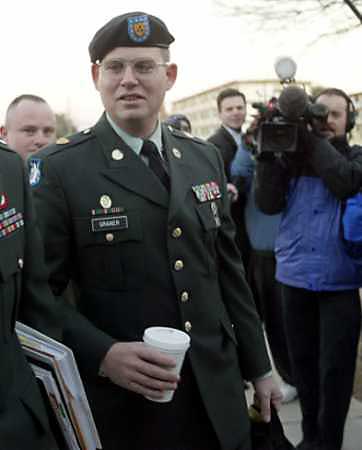
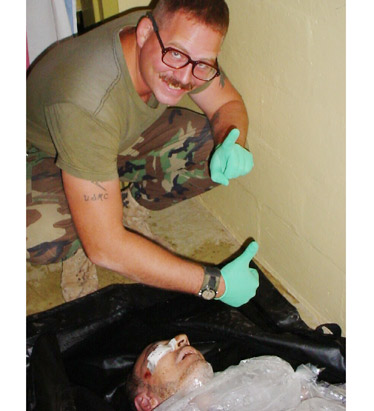
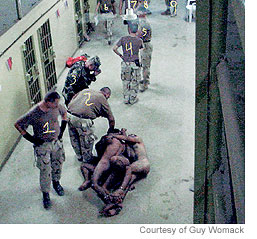
Charles Graner was sentenced to 10 years in prison.
In his closing defence he claimed he was just
following orders. This didn't convince the jury to let him off -
which makes sense, since the "Eichmann defense" has
been soundly rejected. But, the big question
remains open: what sort of responsibility do his superiors
bear, and will any of them face prosecution in this scandal?
Pentagon investigations show there is responsibility at higher
levels....
Here's an article about this from today's
New
York Times:
Kate Zernike
FORT HOOD, Tex., Jan. 16 - The Army reservist accused of being the ringleader
of the abuses at Abu Ghraib prison failed to convince a jury he was following
orders when he mistreated detainees, but higher-ranked officers still may be
prosecuted, military officials and lawyers for the officers say.
The reservist, Specialist Charles A. Graner Jr., who was sentenced here on
Saturday to 10 years in prison, could offer no witnesses or evidence to
prove that higher-ups authorized the treatment seen in the photographs that
set off the abuse scandal: naked detainees leashed and crawling, or forced
to masturbate, simulate oral sex or stack in a pyramid.
But the scandal, which exploded last spring, has led to several Pentagon
investigations that have found what one called "personal responsibility
at higher levels," not only for failure to supervise and enforce
discipline, but also in some cases for condoning and encouraging mistreatment
of detainees in cell blocks and during interrogations.
And at Specialist Graner's trial, prosecutors did not deny sworn testimony
that military intelligence soldiers, civilian interrogators and some officers
asked soldiers to carry out questionable treatment, like striking detainees
and having female soldiers point and laugh as male detainees showered.
A lawyer for one of the officers, who did not want to be named before his
client is charged, said prosecution seemed more likely now. "Maybe
six weeks ago we thought that the worst that was going to happen was a slap
on the wrist, and he was not going to be charged," the lawyer said.
"Things seem to be moving to the forefront."
Several witnesses at the Graner trial testified that Col. Thomas M. Pappas,
the highest-ranking military intelligence officer at Abu Ghraib, and Lt. Col.
Steven Jordan, the head of the Joint Interrogation and Debriefing Center at
the prison, had either known about or specifically encouraged tactics like
using dogs to threaten detainees.
The two men were among five officers recommended for discipline in a Pentagon
report in August, which said they bore responsibility for what happened even
though they were not directly involved in abuse.
That report implicated 29 other military intelligence soldiers in at least 44
cases of abuse from July 2003 to February 2004, including one death, beatings,
using dogs to threaten adolescent detainees, and having prisoners stripped
naked and left for hours in dark, poorly ventilated cells that were stifling
hot or freezing cold.
The report said that while the claims of Specialist Graner and other military
police soldiers that they had been acting at the behest of military
intelligence were "self-serving," they did
"have some basis in fact."
A classified portion of the report said Lt. Gen. Ricardo S. Sanchez, the
former top commander in Iraq, approved the use there of some interrogation
practices intended to be limited to captives held in Afghanistan and
Guant namo Bay, Cuba.
Five investigations have been completed; four others, including one announced
two weeks ago into Federal Bureau of Investigation reports of abuse at
Guant namo Bay, are continuing.
Lt. Col. Barry Venable, a Pentagon spokesman, said Sunday that he did not
know whether other people would be charged, or when the results of two
investigations that are now months overdue would be completed. "There
is no timetable associated with the inquiry process," Colonel Venable
said. "As individuals are identified for potential wrongdoing they'll
be dealt with appropriately."
Three low-ranking military police soldiers face courts-martial for the abuse
at Abu Ghraib.
Paul Bergrin, a lawyer for Sgt. Javal Davis, whose trial is to begin here
Feb. 2, said that following orders was only one part of his defense. He would
also emphasize how interrogators set a bad example, chaining detainees naked to the bars of their cells, striking them and leaving them in isolation units.
"There's a lot of things that Sgt. Javal Davis saw and lived through that
wasn't portrayed" in the Graner case, Mr. Bergrin said.
The findings of the Pentagon report that implicated military intelligence
soldiers were forwarded to military commanders and the Justice Department for
possible criminal charges. But so far, only one military intelligence soldier,
Specialist Armin Cruz, has been charged. He was sentenced to eight months in
prison.
Lawyers for some of the people implicated in the various reports said the
Graner trial would make it harder to prosecute their clients.
"Whatever Graner was spewing was contradicted by the prosecution and
soundly rejected by the jury," said Hank Hockeimer, a lawyer for Steven
Stefanowicz, a civilian contractor who several witnesses at the trial
testified had encouraged them to be rough with detainees. "He
has zero credibility."
Human rights groups still are not completely satisfied and have demanded that
Defense Secretary Donald H. Rumsfeld be held responsible for what happened
at Abu Ghraib.
The Center for Constitutional Rights responded to the Graner verdict by
calling for a special prosecutor to investigate Mr. Rumsfeld's role in
creating policies that governed treatment of prisoners. "Whatever
Charles Graner did, however heinous his acts may have been, we believe
he is taking the fall for the architects of a policy that empowered him
to torture and abuse those being held at Abu Ghraib," said
Michael Ratner, the center's president.
Lawyers for the low-ranking soldiers who have been charged say they remain
skeptical that higher-ups will ever be charged.
"The higher up they go, the more problems they have with people
leading to the Pentagon," said Harvey Volzer, who represented Megan
Ambuhl, who was discharged from the military as part of a plea bargain
in the Abu Ghraib abuses. "Pappas gives them Sanchez, and they don't
want that. Sanchez can give them Rumsfeld, and they don't want that.
"Rumsfeld can lead to Bush and Gonzales, and they definitely don't want
that," Mr. Volzer said, referring to President Bush and to Alberto R.
Gonzales, the White House counsel and attorney general nominee, who argued
in a memorandum
that parts of the Geneva Conventions were "quaint"
and "obsolete."
Mr. Bergrin noted that when he asked a military judge to allow testimony by
Colonel Pappas, Colonel Jordan and others at Sergeant Davis's court-martial,
he was told they could not testify because prosecutors planned to charge them.
"I think the military is using these young enlisteds as scapegoats,"
he said.
As I mentioned earlier, on December
16th a U.S District Court judge demanded that the Justice Department
hand over evidence that would clarify the case of Ahmed Abu Ali, an
American citizen who is being held in Saudi Arabia and possibly being
tortured. The Justice Department stalled for a while, but today it
refused to hand over the evidence, saying it's
secret! There was an interesting report on this on National
Public Radio, which you can hear
online.
Secrecy cloaks a multitude of sins.
In an interesting reversal, the US has now charged Ahmed Abu
Ali with attempting to kill President Bush. There's
an interesting analysis by
Andrew Cohen on CBS News:
The Justice Department says things are a little more simple than that.
The feds say that the Houston-born Abu Ali plotted to assassinate President
Bush and to join and aid al Qaeda. They say that they found incriminating
items at Abu Ali's home in Falls Church, Virginia (items which by themselves
are not illegal to possess, you should know). They say that Abu Ali told
his terror buddies that he wanted to become a terror planner like Muhammad
Atta or
Khalid Sheikh Muhammad;
that he began living with known al Qaeda
associates; and that he received money from those sinister folks to buy a
laptop computer, a cell phone and some books that presumably were to be
used in a terror plot here in the States. If convicted of all six charges,
Abu Ali would face a maximum of 80 years in prison -- a life sentence, in
other words.
Because it purportedly involves a plot against the President, because it
involves many of the issues left unresolved by the early terror law cases,
and because the defendant was the valedictorian of his religious school
class in Virginia, the Abu Ali case shapes up to be not just one of the
more interesting cases since the terror attacks on America, but also
one of the most important. Will the executive branch regain the
initiative in the legal fight against terrorism or will the federal
courts continue their recent streak of siding with individual suspects
over government power? Will Saudi intelligence officials be required to
testify in some fashion about their treatment of Abu Ali? After all,
the young man was apprehended and interrogated by them first. What about U.S.
officials, here or abroad?
Will the Abu Ali case finally turn the judiciary's focus upon
"extraordinary rendition," the practice whereby the U.S.
may turn a blind eye to the abuse of terror suspects at the hands
of foreign governments? If a U.S. citizen is tortured abroad, either
with or without the government's consent, can he be successfully
prosecuted here at home? Will the courts be able, finally, to
balance the constitutional rights of citizens with the government's
national security interests in a manner that reasonably satisfies
both sides? The Abu Ali case could answer these questions, especially
if it generates the sort of heat and light that gains the attention
of the Supreme Court.
Unlike other terror suspects who have found themselves in Abu Ali's
position, the defendant in this case already has offered a very detailed
side of his story. In a pre-indictment lawsuit brought last year to
challenge his detention, Abu Ali and his folks say he was tortured
into confessing the crimes with which he is charged. They say that
U.S. government officials initially left Ali high and dry in Saudi
Arabia after his capture. They say that U.S. officials confirmed his
torture by the Saudis - they say a federal prosecutor told a lawyer for
another terror suspects that Abu Ali is "no good for us here,
he has no fingernails left." Ali's parents say that officials told
them repeatedly that the government had no plans to charge their son.
That is, until the government charged their son.
Why now? We may never know for sure. But it's easy to speculate that the
posture of the Abu Ali case against the government finally prompted the
feds to lay their cards on the table. In that detention case, a federal
judge in December ordered the government to provide information to Abu
Ali's family (at that point he presumably was still being held by the
Saudis) that would shed light on his detention; information the
government had stubbornly refused to provide on national security
grounds. Knowing that its legal position had become untenable, and
thanks to increased public awareness about Abu Ali's story, it's
entirely possible that the government decided it would roll the dice
and try Abu Ali rather than authorize his release. The best defense is a
good offense, you might say.
The indictment doesn't take the heat off the feds - they'll still
have to provide Abu Ali's attorneys with information concerning their
client's detention. And they ultimately will have to explain away the
torture allegations. But now the heat is on Abu Ali as well, 80 years
worth, and so the first old case the Abu Ali case reminds me of is the
case against Lindh. In that case, a young American was captured
overseas (Lindh was in Afghanistan, remember, with the Taliban in a
fight with the Northern Alliance) and then returned to America to
face terror support charges. Then, as now, there were great questions
about post-arrest, pre-indictment interrogation sessions. After being
made the poster child for treason, and in a political and legal climate
much more emotional than the current one, Lindh pleaded guilty
less than one year after the Twin Towers fell. He is now serving a
20-year sentence.
Likewise, the Abu Ali case smells of the Moussaoui case. Like
Moussaoui, Abu Ali has been charged with conspiring to engage in
terrorism here in the states. Like Moussaoui, Abu Ali already has
put the government in the difficult position of having to provide
information about its interrogation methods and results. Indeed,
Moussaoui has sought, and received, testimonial access to one of
the very people prosecutors say Abu Ali wants to be when he grows up -
Khalid Sheikh
Muhammad. The Moussaoui case has been tied up now
for over three years as the judicial and executive branches wrangle
over how much evidence a terror suspect is entitled to. There is no
reason to think that the Abu Ali discover process will be much
smoother. In fact, if anything Abu Ali is entitled to more rights
and protections, here and abroad, because he, unlike Moussaoui,
is a U.S. citizen.
Speaking of U.S. citizens, the Abu Ali case also takes us back to the
case of Yaser Esam Hamdi, the U.S.-born "enemy combatant"
who was held indefinitely and incommunicado until the Supreme Court
rescued him last June. Like Abu Ali, Hamdi was captured overseas and
interrogated. The Hamdi case decided by the Supreme Court stands
for the proposition that US citizens are entitled to certain due
process rights no matter where they are captured and what the
government initially says about their status. If that holds true
in the Abu Ali case, does it preclude the sort of treatment the
defendant says he received at the hands of the Saudis? And, remember,
the government initially let all of us believe that Hamdi was too
dangerous to be either tried or released - until the feds pawned
him off on the Saudis, who promptly let him go.
And that brings us to the Guantanamo Bay detention cases and the
new "extraordinary rendition" cases that are swirling
around federal courts these days. Like those cases, Abu Ali says
he was mistreated by foreign nationals with the knowledge and
consent of the U.S. government. Unlike the men in those other cases,
however, Abu Ali is an American and now on trial in a civilian court.
If federal judges seem a bit more sympathetic these days to
foreign-born detainees, what in the world will they make of Abu Ali?
Especially if only half of what he says is true about the methods
the Saudis used upon him?
I just don't see an American judge allowing prosecutors to get to
trial with a case that has even a scintilla of a suggestion that the
defendant was tortured into confessing. But I would love to hear
what the feds have to say as way of explanation for why they were so
slow in coming to Abu Ali's rescue, even after the Saudis apparently
said they had no interest in prosecuting him themselves. Are the feds
bluffing? Are they hoping that by prosecuting Abu Ali they will
force him to cave, a la John Walker Lindh? Or are they confident
still that they will never have to offer details about how Abu Ali
was treated? If Abu Ali wasn't treated poorly, why did a federal
judge already order the government to reveal more about the matter?
And if he was treated poorly, and if the government was indeed on the
fence about charging him in the first place, why is there a criminal
case at all?
Although I'm sure it doesn't feel that way right now to Abu Ali,
Tuesday's federal terror indictment against him actually improves his
lot in life. At least now the young man knows what charges he faces;
knows (for the most part) what rules will apply in his case; and
knows that his fate ultimately will be decided by a federal judge and
jury. That's a far cry from living at the whim of Saudi intelligence
officers. It's a far cry from having to guess at the evidence against
you; and it's a far cry from wondering whether your fingernails are
going to be ripped off you again after they have grown back.
Today
U.S. District Judge Henry Floyd
ruled that
the Bush administration can't continue to hold
Jose Padilla
as an "enemy combatant" without charging him of any
crime. He gave them 45 days
to charge Padilla with a crime or release him.
Floyd, a Bush appointee, stated that accepting the government's position on
this case "would totally eviscerate the limits placed on
Presidential authority to protect the citizenry's individual
liberties". He added,
Padilla was arrested on May 8th, 2002 and is now in a military
brig in North Carolina.
The ACLU and Human Rights First filed a lawsuit against
Defense Secretary Donald Rumsfeld. Quoting their press
release:
"Secretary Rumsfeld bears direct and ultimate responsibility for this
descent into horror by personally authorizing unlawful interrogation
techniques and by abdicating his legal duty to stop torture",
said Lucas Guttentag, lead counsel in the lawsuit and director of the ACLU's
Immigrants Rights Project. "He gives lip service to being responsible but
has not been held accountable for his actions. This lawsuit puts the blame
where it belongs, on the Secretary of Defense".
The groups are joined as co-counsel in the lawsuit by Rear Admiral John D.
Hutson (Ret. USN), former Judge Advocate General of the Navy; Brigadier
General James Cullen (Ret. USA), former Chief Judge (IMA) of the U.S.
Army Court of Criminal Appeals; and Bill Lann Lee, Chair of the Human
Rights Practice Group at Lieff, Cabraser, Heimann & Bernstein, LLP and
former Assistant Attorney General for Civil Rights at the Department of
Justice. Admiral Hutson and General Cullen are of counsel to Human Rights
First.
Since Abu Ghraib, we have vigorously campaigned for an independent
"commission to investigate U.S. policies that have led to torture and
cruel treatment of detainees. These calls have gone unanswered by the
administration and Congress, and today many of the illegal polices remain
in place", said Michael Posner, Executive Director of Human Rights
First. "We believed the United States could correct its policy
without resort to the courts. In bringing this action today, we
reluctantly conclude that we were wrong".
The men represented in the lawsuit were incarcerated in U.S. detention
facilities in Iraq and Afghanistan, where they were subjected to torture and
other cruel and degrading treatment, including severe and repeated beatings,
cutting with knives, sexual humiliation and assault, mock executions, death
threats, and restraint in contorted and excruciating positions. None of the
men were ever charged with a crime. All have been released.
"One of the greatest strengths of the U.S. military throughout our
history has been strong civilian leadership at the top of the chain of
command", said Admiral Hutson. "Unfortunately, Secretary Rumsfeld
has failed to live up to that tradition. In the end, that imperils our
troops and undermines the war effort. It is critical that we return to
another military tradition: accountability".
In legal papers, the groups charged Secretary Rumsfeld with violations of
the U.S. Constitution and international law prohibiting torture and cruel,
inhuman or degrading punishment. The lawsuit also seeks compensatory damages
for the harms suffered as a result of torture and other abuse.
According to the complaint, Secretary Rumsfeld authorized an abandonment of
our nations inviolable and deep-rooted prohibition against torture or other
cruel, inhuman or degrading treatment or punishment of detainees in U.S.
military custody. The complaint further charges that brutal and illegal
interrogation techniques were personally approved by Secretary Rumsfeld in
December 2002. Those techniques included the use of stress positions,
20-hour interrogations, the removal of clothing, the use of dogs,
isolation, and sensory deprivation.
Although some of these techniques were later rescinded, Rumsfeld personally
approved a new list in April 2003, which included dietary manipulation,
sensory deprivation and "false flag"
(leading detainees to believe that they
have been transferred to a country that permits torture). He also made clear
that harsher techniques could be used with his personal authorization.
The Los Angeles Times had an interesting lead editorial today:
In recent weeks, past and present administration officials have confirmed
that since September 2001 the Central Intelligence Agency has dispatched
between 100 and 150 terror suspects to countries where fine points of law
and human rights don't stop beatings, drugging or long isolation.
Before the 9/11 attacks, the CIA occasionally engaged in this indefensible
practice, known as "extraordinary rendition." But afterward, Bush gave the
agency wider license to export prisoners in terror-related cases who hadn't
been tried or even charged with any crime. Despite his State of the Union
declaration, the president has apparently not revoked that authority.
U.S. law and international conventions bar sending prisoners to another
nation unless there are strong assurances of humane treatment. The CIA
says with a straight face that it gets those assurances before delivering
suspects to jailers in Egypt, Syria, Saudi Arabia, Jordan and Pakistan
countries that have such abysmal human rights records that promises of
decent treatment are a joke.
Bush has argued that tough new rules of engagement are necessary to
fight stateless terrorists. But morality aside, what intelligence of
value have U.S. officials gleaned from suspects who've been handed
off to modern-day dungeons? A case in point: In 2002, federal agents
arrested Maher Arar, a Syrian-born Canadian engineer, at John F.
Kennedy Airport in New York because his name appeared on a terrorist
watch list. Although Arar insisted that he was not a terrorist, the
U.S. delivered him to Syrian interrogators. After months in a
windowless room and regular beatings with thick electric cables,
he said, he confessed to anything they wanted just to stop the
torment. A year later, Arar was released without charges.
This barbarism is why U.S. judges have refused to condone the
indefinite detention of terrorism suspects. Yet the military
still holds about 500 foreign nationals at the U.S. base in
Guantanamo Bay, Cuba. Most have not been charged and have no
lawyer, often after years in custody.
Two American citizens have been held in military brigs. The
evidence against U.S.-born Yaser Esam Hamdi was so flimsy that
last year federal agents packed him off to his family in Saudi
Arabia rather than present their case in court. Last week, a
federal judge ordered the administration to charge the second,
Jose Padilla, or release him within 45 days. Government lawyers
say interrogations produced a lot about Padilla's activities,
including his relationship with Al Qaeda leaders and his plans to
blow up high-rise buildings. Atty. Gen. Alberto R. Gonzales said
this week he may still prosecute him. But because most of Padilla's
disclosures occurred while he was in military custody, without
access to a lawyer, it's doubtful his statements would be
admissible in court.
These are only the practical issues. The more haunting problem with
Bush's war on terrorism remains the moral one: A nation that
considers itself a beacon of freedom seems unable to practice the
respect for law and human rights it ardently preaches to others.
The New York Times claims that a company called
Aero Contractors Limited is involved in transporting people
to secret CIA prisons:
SMITHFIELD, N.C. - The airplanes of
Aero Contractors Ltd.
take off from Johnston County Airport here, then disappear over the scrub
pines and fields of tobacco and sweet potatoes. Nothing about the sleepy
Southern setting hints of foreign intrigue. Nothing gives away the fact that
Aero's pilots are the discreet bus drivers of the battle against terrorism,
routinely sent on secret missions to Baghdad, Cairo, Tashkent and Kabul.
When the Central Intelligence Agency wants to grab a suspected member of Al Qaeda overseas and deliver him to interrogators in another country, an
Aero Contractors plane often does the job. If agency experts need to fly overseas in a hurry after the capture of a prized prisoner, a plane will depart Johnston County and stop at Dulles Airport outside Washington to pick up the C.I.A. team on the way.
Aero Contractors' planes dropped C.I.A. paramilitary officers into Afghanistan in 2001; carried an American team to Karachi, Pakistan, right after the United States Consulate there was bombed in 2002; and flew from Libya to Guantanamo Bay, Cuba, the day before an American-held prisoner said he was questioned by Libyan intelligence agents last year, according to flight data and other records.
While posing as a private charter outfit - "aircraft rental with pilot" is the listing in Dun and Bradstreet -
Aero Contractors is in fact a major domestic hub of the Central Intelligence Agency's secret air service. The company was founded in 1979 by a legendary C.I.A. officer and chief pilot for Air America, the agency's Vietnam-era air company, and it appears to be controlled by the agency, according to former employees.
Behind a surprisingly thin cover of rural hideaways, front companies and shell corporations that share officers who appear to exist only on paper, the C.I.A. has rapidly expanded its air operations since 2001 as it has pursued and questioned terrorism suspects around the world.
An analysis of thousands of flight records, aircraft registrations and corporate documents, as well as interviews with former C.I.A. officers and pilots, show that the agency owns at least 26 planes, 10 of them purchased since 2001. The agency has concealed its ownership behind a web of seven shell corporations that appear to have no employees and no function apart from owning the aircraft.
The planes, regularly supplemented by private charters, are operated by real companies controlled by or tied to the agency, including
Aero Contractors and two Florida companies, Pegasus Technologies and
Tepper Aviation.
The civilian planes can go places American military craft would not be welcome. They sometimes allow the agency to circumvent reporting requirements most countries impose on flights operated by other governments. But the cover can fail, as when two Austrian fighter jets were scrambled on Jan. 21, 2003, to intercept a C.I.A. Hercules transport plane, equipped with military communications, on its way from Germany to Azerbaijan.
"When the C.I.A. is given a task, it's usually because
national policy makers don't want 'U.S. government' written all over
it,"
said Jim Glerum, a retired C.I.A. officer who spent 18 years with the
agency's Air America but says he has no knowledge of current operations.
"If you're flying an executive jet into somewhere where there are
plenty of executive jets, you can look like any other company."
Some of the C.I.A. planes have been used for carrying out renditions, the legal term for the agency's practice of seizing terrorism suspects in one foreign country and delivering them to be detained in another, including countries that
routinely engage in torture. The resulting controversy has breached the secrecy of the agency's flights in the last two years, as plane-spotting hobbyists, activists and journalists in a dozen countries have tracked the mysterious planes' movements.
Dr. Nolte examined the case of
Khaled El-Masri,
a German citizen who American officials have confirmed was pulled from a
bus on the Serbia-Macedonia border on Dec. 31, 2003, and held for three
weeks. Then he was drugged and beaten, by his account, before being flown to
Afghanistan.
The episode illustrates the circumstantial nature of the evidence on
C.I.A. flights, which often coincide with the arrest and transporting of
Al Qaeda suspects. No public record states how
Mr. Masri was taken to Afghanistan. But flight data shows a Boeing
Business Jet operated by
Aero Contractors and owned by
Premier Executive Transport Services,
one of the C.I.A.-linked shell companies, flew from
Skopje, Macedonia, to Baghdad and on to Kabul on Jan. 24, 2004, the day
after Mr. Masri's passport was marked with a Macedonian exit stamp.
Mr. Masri was later released by order of Condoleezza Rice, the national
security adviser at the time, after his arrest was shown to be a case of
mistaken identity.
A C.I.A. spokeswoman declined to comment for this article. Representatives of
Aero Contractors,
Tepper Aviation and Pegasus Technologies, which operate the
agency planes, said they could not discuss their clients' identities.
"We've been doing business with the government for a long time, and
one of the reasons is, we don't talk about it," said Robert W. Blowers,
Aero's assistant manager.
I haven't been posting much lately, because U.S.-run torture has
really hit the front pages of the news, so I can't even keep
up with the daily disclosures. But, here's something interesting
I found lurking in the middle of the Los Angeles Times... though
the Washington Post version is more detailed, so I'll quote that:
Mike Allen
After repeated criticism of the Bush administration, the Republican
chairman of the House Judiciary Committee yesterday gaveled a
hearing to a close and walked out while Democrats continued to
testify -- but with their microphones shut off.
The hearing's announced topic was the USA Patriot Act, which granted
broad new powers to federal law enforcement after the attacks of
Sept. 11, 2001. The Republicans had presented several witnesses at
earlier hearings who supported the administration's call for
reauthorizing the legislation. But yesterday, when four witnesses
handpicked by the Democrats launched into a broad denunciations
of President Bush's war on terrorism and the condition of detainees
at the U.S. prison at Guantanamo Bay, Cuba, Chairman F. James
Sensenbrenner Jr. (R-Wis.) showed his pique.
He urged witnesses to "wrap it up" and repeatedly told
committee members that their time for questioning had expired.
"We ought to stick to the subject," the chairman scolded
at the end. "The Patriot Act has nothing to do with Guantanamo
Bay. The Patriot Act has nothing to do with enemy combatants. The
Patriot Act has nothing to do with indefinite detentions."
"Will the gentleman yield?" Rep. Sheila Jackson Lee (D-Tex.) asked.
"No, I will not yield," replied Sensenbrenner, 61, the
heir to a paper fortune who is known for a brusque insistence on
decorum. He completed his reproof of the witnesses and left the
Rayburn House Office Building hearing room amid a cacophony of
protests from Democrats seeking to be recognized.
Democrats charged that the episode was another example of
Republicans abusing their control of Congress and trying to
stifle dissent over Bush's approach to counterterrorism. During
the two-hour hearing, Rep. Mike Pence (R-Ind.) accused Amnesty
International of endangering U.S. soldiers because a top official
of the group had called the prison at Guantanamo Bay a "gulag."
Sensenbrenner did not allow a group official who was testifying, Chip
Pitts, chairman of Amnesty International USA, to respond until Rep.
Jerrold Nadler (D-N.Y.) raised a "point of decency."
C-SPAN2 continued televising the proceedings for six minutes after
Sensenbrenner had departed, with lettering on the screen explaining the
strange circumstances.
Democrats said the incident was reminiscent of a hearing in 2003 in which
Ways and Means Chairman Bill Thomas (R-Calif.) summoned a Capitol Police
officer during a heated exchange between members of the two parties.
As Sensenbrenner left, Nadler continued talking and was applauded after
saying that "part of the problem is that we have not had the
opportunity to have hearings on all these other administration policies
that have led to abuses."
"The other thing that I wanted to say -- and that I will say at this
point, even though the chairman is not going to listen," Nadler said.
Then his voice faded out. "I notice that my mike was turned
off," Nadler said, speaking up, "but I can be heard anyway."
One of the witnesses then began giving impromptu testimony. James J. Zogby,
president of the Arab American Institute, said he thought the turn of
events was "totally inappropriate -- no mike on, and no record being
kept."
"But I think as we are lecturing foreign governments about the conduct
of their behavior with regard to opposition," Zogby said, "I'm
really troubled about what kind of message this is going to teach to
other countries in the world about how they ought to conduct an open
society that allows for an opposition with rights."
The other witnesses arranged by the Democrats were Carlina Tapia-Ruano
of the American Immigration Lawyers Association and Deborah N.
Pearlstein of the U.S. Law and Security Program at Human Rights First.
Congress is debating what changes to make when reauthorizing the Patriot
Act, which expanded the power of the FBI and other law enforcement
agencies to intercept information and share data obtained through
foreign and domestic surveillance. Congress passed the act with scant
dissent six weeks after the terrorist attacks of Sept. 11, 2001.
Most of the provisions are not considered controversial.
For a second day, Bush said federal, state and local law enforcement
officials will be hamstrung if Congress fails to permanently renew the
16 provisions of the Patriot Act set to expire at the end of this year.
"The Patriot Act has made a difference for those on the front
line of taking the information you have gathered and using it to protect
the American people," Bush told employees at the National
Counterterrorism Center in Tysons Corner.
Sens. Larry E. Craig (R-Idaho) and Richard J. Durbin (D-Ill.)
recently told a congressional committee they have not documented
any cases of abuse of the act, but only because the law makes it
nearly impossible for Congress to provide thorough oversight and
investigate possible misuses of the law.
Some Republicans are moving towards the idea of closing
the U.S. detention center at Guantanamo Bay - not because people
are being held there indefinitely without charges and in some cases
abused, but because it's bad public relations.
According to the
Los Angeles Times (a partial quote of their story):
Los Angeles Times, June 13, 2005
Rep. Duncan Hunter (R-El Cajon), chairman of the House Armed Services
Committee, said the administration was divided on the issue, with some
officials taking the view that if the facility was shut down, "you
shorten the [news] stories, you shorten the heated debate, and you get it off
the table and you move on."
Hunter's comments on "Fox News Sunday" were the latest sign
that the White House was considering a step that would require it to
find other accommodations for about 520 detainees.
[....]
On Friday, Sen. Mel Martinez of Florida became the first prominent
Republican to urge the facility's closing, saying, "It's become
an icon for bad stories, and at some point you wonder the cost-benefit
ratio: Is it serving the purposes you thought it would serve when
initially you began it?"
[....]
In addition to human rights groups, the International Committee of
the Red Cross and the FBI have cited abuses at the prison. Most people
held there were captured in Afghanistan and sent to Cuba in hopes
that they would provide information about Al Qaeda. Some have been
held for three years without being charged with a crime."
Sen. Chuck Hagel (R-Neb.), a member of the Senate Foreign Relations
and Intelligence committees, said on CNN's "Late Edition"
that Guantanamo was one reason the United States was "losing
the image war" around the world.
"It's identifiable with, for right or wrong, a part of America
that people in the world believe is a power, an empire that pushes
people around: We do it our way; we don't live up to our commitments
to multilateral institutions," Hagel said.
[....]
When they close down Guantanamo, what will they do with the people
there? We can only hope that
outsourcing
torture also turns out to be bad public relations.
Right now there's a big fight going on in which Republicans are
defending the Bush administration by saying that Guantanamo
is not really as bad as the Soviet Gulags, and
not as bad as what the Nazis did. I agree, but this
doesn't make me feel good. On the contrary, when we pat ourselves
on the back for not being as bad as the worst, it means we're in
serious trouble.
Future readers of this will probably have forgotten what started
this fight. On the defensive, backers of the Bush administration have
been seeking out rhetorical excesses by people
opposed to torture, and waving around these excesses as
evidence that people opposed to torture are anti-American and silly.
It's a way of diverting attention from the actual issue - replacing
it with the fake issue of whether a certain piece of rhetoric goes
too far.
The game started
when Irene Khan of Amnesty International called Guantanamo Bay
the "Gulag of our time". It got up to full speed when
Democratic Senator Dick Durbin gave a speech on June 14th citing
an FBI report of
Guantanamo Bay prisoners chained to the floor in the fetal position
without food or water, sometimes in extreme temperatures. He then
said:
Luckily Senator Durbin has had the sense to stand his ground
and stay focused on the actual issue: the interrogation
techniques in question were "the kind of thing you
expect from repressive regimes but not from the United
States". Further:
This administration should apologize to the American people for
abandoning the Geneva Conventions and authorizing torture techniques
that put our troops at risk and make Americans less secure.
And I remind the White House the Guantanamo Bay scandal has
reached such a level of national embarrassment that Senators
from both parties are calling for the closure of that facility.
And in Canada, a fight has erupted over
Maher Arar, a
Canadian citizen whom the CIA nabbed and sent off on
a private plane, chained and shackled,
to be tortured in Syria.
Canada's ambassador to Syria,
Franco Pillarella,
is in trouble for failing to take action.
Anyone who wants
can read
Arar's story on the web,
and read the whole chronology of subsequent events on
CBC
News.
The CIA, you may recall, is a US government agency.
But do we hear about these stories here in the United States?
No! Everyone is too busy arguing about whether opponents
of torture are guilty of rhetorical excess.
Harper's magazine has reproduced part of the
"sworn affidavit of Hussain Abdulkadr Youssouf Mustafa,
a Palestinian who plans to sue the U.S. government for cruel
and unusual punishment":
According to this affidavit Mustafa was picked up by Pakistani police
in May 2002 and sent to Bagram, Afghanistan, where he was
tortured by American intelligence agents. He was later sent
to Guantanamo Bay, where he witnessed further prisoner abuse.
He was finally declared innocent and released in August of that year.
Here's part of his affidavit:
Three days later they said we were being taken to Islamabad. I was blindfolded.
The Pakistanis gave us over to the Americans, and they forced me
onto a plane. After it landed, we were taken out and put in a
line with sacks on our heads and our hands shackled. Some Afghans and
Pakistanis said we were in Bagram. The bag was taken off my head
and I was undressed until I was naked. It was very humiliating.
It there was anything at all I could have done to avoid it I would
have done it -- this as the first time as an adult I have been naked in
public.
We were tortured, abused, and put in very embarrassing positions.
They would threaten me, saying that they knew I was guilty and that
they would make me talk. They would deprive me of sleep. You were
never allowed to speak to each other, or even to yourself. They would
hang us on the door by our wrists for an hour or more. If someone was
praying, the American soldiers would make them stop. The soldiers did
not like us praying and made fun of us. They would threaten the
prisoners with ghastly and immoral acts like rape.
In fact, the worst thing that has even happened to me took place in
Bagram. An American soldier took me blindfolded, with my hands tightly
cuffed, and with my ears plugged so I could not hear properly and my
mouth covered so that I could only make a muffled scream. Two soldiers
forced me to bend down, and a third pressed my face down on a table.
A fourth soldier then pulled down my trousers. They forcibly
rammed a stick up my rectum. It was excruciatingly painful.
I have always believed that I am not a person who could scream unless
I was really hurt, but I could not stop screaming when this happened.
This torture went on for several minutes, but it felt like hours,
and the pain afterward was almost as bad as anything I experienced at
the time. I have pain to this day from what they did to me.
I will never feel comfortable having a bowel movement both
because it is sometimes painful and because it always reminds me of
what happened. I simply cannot understand why it happened to me.
It will always cloud my life. It is something I am ashamed to
think about, but it is something I cannot press out of my mind.
Naturally, I do not want it known, yet my fear for my own privacy
is overridden by my desire to make sure that the truth is known,
so that others are not made to suffer in this way.
The Americans never said anything about why they were doing it to me,
so I had to try to work out what was going through their minds.
I think maybe they wanted to make me so embarrassed that it would
dehumanize me and reduce my ability to resist.
One of the threats I would often hear was that if I did not
confess they would send me to Cuba.
They would say that once I was taken to Guantnamo, the
interrogation would be far worse, and I would probably stay there until I died.
I arrived in Cuba around the fifth or sixth of August, 2002. In the beginning, they would constantly yell, "Do you know where you are? You're
with the American Army now!" I still had no idea what my fate
would be, but the way they used to shout, I always expected the worst.
Some of the people I was with would be taken out in the morning for
interrogation, and they would not come back until the evening. The
interrogator would say they had to confess to a particular thing.
But because the people would not admit to it, because they insisted
they were innocent, the pressure put on them would gradually rise.
For example, the Americans would use females who would sexually abuse
the prisoners. In one case a woman was brought into the interrogation
room in a swimsuit or underwear. She paraded in front of the man being
interrogated and tried to make him sexually excited. She went up to
try to kiss him, getting very physical and close to him. The man
tried to move his face away, but that did not work, so in the end he
had to spit in her face to get her to go away, which is all he could
do since he was tightly chained. For doing this, of course, he was beaten.
This kind of abuse was consciously aimed at a devout Muslim -- for
someone else it might not have had such an impact, but in Islam
you are not allowed even to touch a woman to whom you are not married.
The issue of women soldiers in general is a very sensitive one.
Prisoners would have their beards shaved off as punishment for
refusing to be handled by women. This was just heaping one religious
insult on top of another.
Once a Saudi was taken for interrogation and was told he had to
confess to one particular thing. The prisoner was told that if
he did not confess, the interrogator would tread on the Koran.
The prisoner could not confess, so the interrogator went ahead
and stomped on the Koran. The Americans had clearly been trained
in how to abuse Muslims and did things that were calculated to inflame.
It was so outrageous to us that there was a hunger strike in the prison.
One time, after stomping on the Koran, the Americans brought in an
Israeli flag and wrapped it around a prisoner's body, in another
attempt to insult and abuse him.
I was interrogated only twelve or thirteen times. Some other prisoners
were questioned far more often -- almost daily. I assume from the
limited number of times they bothered to question me that they
knew all along that I had nothing I could say.
Some would try to take their own lives in their cells. Nobody
died that I know of, because when we could see someone trying to
kill himself, we would create a loud noise to make sure a guard came.
If a prisoner was badly hurt after trying to kill himself, the Americans
would send him to the infirmary. If not, he would simply be punished,
as if that was any kind of way to deal with his problems. It was a deep
shock to me that the prisoners had been made so desperate that they
would try to take their own lives. In Islam, suicide is a profound sin.
You die a non-Muslim and your cannot have prayers read for you.
They came one day and said I would be taken to Camp November, a
prison used for punishment. I asked why I was being taken there and
they did not say. When I got there, they measured me for jeans,
gave me the shoes I am wearing today, and told me I was leaving.
I thought I was going to Jordan, but actually I was taken to Bagram
again. I stayed there for another four and a half months. There were
no interrogations there. I was told I was innocent and that I was a
guest. It was just a matter of waiting to see where they were going to
send me. I was released in Amman on August 11, 2004.
Nobody from the American government has ever apologized for what
happened to me. A sergeant read out a paper saying that there was a
war on and many people had been killed, and so on, and in that
sort of situation the United States had rounded people up.
I was given a paper by the U.S. military that said I had been
found to be no threat to the United States.
I will never be the same person. Now I spend a lot of my time alone,
sitting in the mosque, as I have become an introvert. I go out only
when it is really necessary. My father came to visit me and warned my
wife and children that I should not be left to brood on my own for long
periods, left with my own thoughts. I have intrusive thoughts while I
am alone about what I have gone through. These are the thoughts that I
sit with, and while I know I should not sit brooding over them, I just
cannot help it. I worry that I am depressed, and I fear that I might be
going through a nervous breakdown.
I sometimes think what I would say to the United States after all
this, and I think it might be something along these lines: In New
York, they have the Statue of Liberty. Surely, it is not only in
America that there should be liberty? Surely, the United States should
stand for liberty for all. The Americans should not have treated me
as they did. They should not continue to treat others as they
do.
The Guardian article mentions a second affidavit in which:
In case you're wondering, I realize that some allegations of
torture may be false. I also know that combatants picked up in the
fighting during wars in Afghanistan and Iraq are - at best! - prisoners
of war, not criminals subject to trial by a jury of their peers.
(Of course, the U.S. government denies that they are prisoners of
war.)
But, even apart from the case of U.S. citizens
being held without charges and abused in various ways, I think
we should be concerned when citizens of other countries are kidnapped
by the United States, interrogated,
and in some cases tortured, all without any due process. There are
too many cases of this becoming known for any reasonable person to
doubt that it's happening. And, it seems obvious that people have
a right not to be treated this way - and that it's the duty of all
American citizens to make our government to stop doing this.
The effort to throw sand in our eyes about U.S.-run torture in
Guantamano Bay picked up steam as Dick Durbin knuckled under
and said he "sincerely regrets if what I said caused anyone to
misunderstand my true feelings." Republicans took
this as an opening to demand more grovelling, as part of their
strategy to direct attention away from the real issue.
Democrats refused to oblige them... but we can expect this
tempest in a teapot to keep bubbling away for some time, distracting
our attention from the real issues:
June 21, 2005
WASHINGTON -- Senate Majority Leader Bill Frist yesterday demanded that Sen. Richard J. Durbin make a
"formal apology"
on the floor of the Senate for comparing U.S. interrogators at Guantanamo
Bay to Nazi and Soviet regimes and that he strike his remarks from the
Congressional Record.
In a letter to Senate Minority Leader Harry Reid of Nevada, Mr. Frist, Tennessee Republican, said previous bids by the Senate's No. 2 Democrat to
clarify his remarks didn't go far enough.
"Subsequent statements by Senator Durbin
indicate only that he was regretful if people misunderstood his remarks,"
Mr. Frist said. "We do not believe his remarks were misunderstood."
The letter is the latest in a wave of criticism against the Illinois
Democrat, which yesterday was joined by the Anti-Defamation League and a
White House spokesman and, over the weekend, by Sen. John McCain, Arizona
Republican and
a prisoner of war in Vietnam who was tortured in captivity.
Reid spokesman Jim Manley called the Frist letter "pathetic."
"Republicans don't have an agenda, so they are trying however they can to pull attention away from the real problems facing the
country," Mr. Manley said.
"It is interesting to note that reporters got the letter before
we did, as far as I can tell."
But enough of that nonsense... here's some real news.
Yesterday Italy ordered the arrest of 13 CIA agents for
kidnapping Abu Omar and whisking him off to Egypt to be tortured
with electric shocks. The arrest warrants will be good throughout
Europe. It's unlikely the CIA agents will be caught and tried.
But, at least in Europe there may be a reduction
of U.S.-run kidnappings for the purpose of torture.
ROME (AP) - An Italian judge has ordered the arrest of 13 CIA agents for allegedly helping deport an imam to Egypt as part of U.S. anti-terrorism efforts, an Italian official familiar with the investigation said Friday.
The agents are suspected in the seizure of an Egyptian-born imam identified as Abu Omar on the streets of Milan in February 2003, according to the official, who requested anonymity because he was not authorized to release the information.
The U.S. Embassy in Rome declined to comment.
Prosecutors believe the agents seized Omar as part of the CIA's ``extraordinary rendition'' program, in which terror suspects are transferred to third countries without court approval, according to reports Friday in newspapers Corriere della Sera and Il Giorno.
Investigators traced the agents through check-in details at Milan hotels and their use of Italian cell phones during the operation, the reports said. All the agents are American and include three women, Il Giorno said.
The reports said another six agents were being investigated for helping prepare the operation.
They said police also received an eyewitness account from an Egyptian woman who heard Omar calling for help and saw him being bundled into a white van as he walked from his house to a mosque.
The report said Omar was taken to Aviano, a joint U.S.-Italian base north of Venice, and was flown from there to another U.S. air base in Ramstein, Germany, before being taken in a second jet to Cairo.
A judge also has issued a separate arrest warrant for Omar, news agencies ANSA and Apcom said. In that warrant, Judge Guido Salvini claimed the seizure of Omar represented a violation of Italian sovereignty, Apcom reported.
Earlier this month, Milan prosecutor Armando Spataro told The Associated Press that the prosecution was treating the disappearance of Omar as an abduction.
Spataro declined to say who was suspected for the alleged abduction, but he said Omar's disappearance damaged an ongoing operation by Italian authorities. He said he visited the air base in February.
Omar was believed to have fought with jihadists in Afghanistan and Bosnia, and prosecutors were seeking evidence against him before his disappearance, according to a report last year in La Repubblica newspaper, which cited intelligence officials.
Italian papers have reported that Omar, 42, called his wife and friends in Milan after his release last year, recounting he had been seized by Italian and American agents and taken to a secret prison in Egypt, where he was tortured with electric shocks.
Italian officials believe he now is living in Egypt, although Italian newspaper accounts suggested he was returned to custody shortly after his release.
You can also read an
interview with Jane Mayer.
And try this:
A federal appeals court ruled that the President of the
United States can declare
citizens to be "enemy combatants" and
lock us up for as long as he wants, without any trial or other legal
procedure - without even any legal charges being filed!
He just needs to write a memo. So, we
just have to hope that the President will be wise and just: otherwise
we're in deep trouble.
In other words, we're in deep trouble.
Read the memo in which President Bush condemned
Jose Padilla to indefinite detention, and
what the court ruled today.
We can only hope the
Supreme Court overturns this ruling,
as they did in the
case of the other American citizen held as an enemy
combatant, Yaser Esam Hamdi.
Richard A. Serrano, Times Staff Writer
WASHINGTON -- An Army captain and two sergeants from the 82nd Airborne
Division who were responsible for supervising prisoners in Iraq have come
forward with allegations that members of the unit routinely beat, tortured
and abused detainees in 2003 and early 2004.
The Pentagon announced Friday that it opened a criminal investigation of
the accusations this week, after learning of the charges recently from the
Senate Armed Services Committee and Human Rights Watch.
Capt. Ian Fishback, a West Point graduate, contacted the Senate panel with the
charges within the last 10 days, saying he was frustrated that his superior
officers had failed to respond, said committee aides.
Fishback and the two sergeants, whose names have not been disclosed, also
made allegations of abuse to Human Rights Watch. The captain is the first
officer to go public with allegations of detainee abuse in Iraq since the
Abu Ghraib prison scandal erupted in April 2004.
In recent letters to several members of the Senate Armed Services Committee,
Fishback said he witnessed detainees being stripped, deprived of sleep,
exposed to the elements and "forced into uncomfortable positions for
prolonged periods of time for the express purpose of coercing them into
revealing information other than name, rank and service number."
New York-based Human Rights Watch said Friday that one of the sergeants
told the group, "We would give them blows to the head, chest, legs and
stomach, pull them down, kick dirt on them. This happened every day."
The sergeant reportedly described the mistreatment at a base near Fallouja
as "just like" Abu Ghraib, saying, "We did that for
amusement."
According to Human Rights Watch, the sergeants said they saw soldiers
break prisoners' legs. The group said the sergeants had related that they
watched and participated in some of the violence.
Neither the sergeants nor the captain - who wrote to Senate committee
members including Chairman John W. Warner (R-Va.), ranking Democrat Carl
Levin of Michigan and John McCain (R-Ariz.), a victim of torture in Vietnam -
could be reached for comment Friday.
If substantiated, the allegations would represent one of the most serious
episodes in the mistreatment of detainees by American military personnel
since the U.S.-led invasion of Iraq in March 2003. This is the first time
that soldiers in the regular Army have been implicated in widespread
abuse. Previous abuse cases have involved misconduct by relatively
untrained National Guard and Reserve troops.
The 82nd Airborne is one of the most storied units in the U.S. military.
The division has a record of distinguished service stretching for nearly a
century, and its members are considered highly trained professionals.
Formed during World War I, the division was reactivated during World War II,
when its handpicked paratroopers landed behind German lines to prepare
for the D-day invasion of Europe.
Based at Ft. Bragg, N.C., it is the largest paratroop force in the world.
Its members served in the 1991 Persian Gulf War and various brigades have
served several tours in Iraq.
In such a unit, evidence of a significant breakdown in discipline would
call into question the Army's contention that previously disclosed
abuses did not reflect systemic problems. The misconduct reported by
Fishback and the two noncommissioned officers was said to have begun in
September 2003 and continued through the following April. The abuses at
Abu Ghraib occurred within that period, mainly the fall of 2003, and
were publicly revealed in April 2004.
A Capitol Hill aide familiar with the new allegations said they were
considered "very credible."
In their disclosures, Fishback and the sergeants said that detainees
feared for their lives and referred to members of the 82nd as the
"Murderous Maniacs" because of the level of brutality
inflicted on prisoners.
At the Pentagon, Army spokesman Paul Boyce said Friday that the military
believed the accusations were serious enough to warrant a full-scale
criminal investigation. "These are allegations of potential
felony crimes," Boyce said. "We want to speak to anyone
else who might be able to corroborate this information. These things
should be looked into thoroughly."
Asked whether the Army's criminal investigation was launched only
because the Senate committee had been told of the allegations, Boyce said,
"We began to investigate as soon as it came to our attention."
The two sergeants provided detailed accounts of prisoners held in the
area around Fallouja routinely being tortured. Fallouja has been the
scene of some of the worst fighting of the war.
"One day a sergeant shows up and tells a PUC [person under
control] to grab a pole," Human Rights Watch said one of the
sergeants recounted. "He told him to bend over and broke the
guy's leg with a mini Louisville Slugger, a metal bat."
The sergeants were part of a forward operating base called Mercury.
In their statements, the three said that collectively they witnessed
soldiers delivering blows and kicks to prisoners' faces, chests,
abdomens and extremities, pouring chemical substances on skin and eyes,
and forcing detainees into stress positions such as holding heavy water
jugs with outstretched arms.
We got to the camp in August [2003] and set up. We started to go out on
missions right away. We didn't start taking PUC's
[Persons Under Control] until September.
Shit started to go bad right away. On my very first guard shift for my
first interrogation that I observed was the first time I saw a PUC
pushed to the brink of a stroke or heart attack. At first I was surprised,
like, this is what we are allowed to do? This is what we are allowed to
get away with? I think the officers knew about it but didn't
want to hear about it. They didn't want to know it even existed.
But they had to.
On a normal day I was on shift in a PUC tent. When we got these guys we
had them sandbagged and zip tied, meaning we had a sandbag on their heads
and zip ties [plastic cuffs] on their hands. We took their belongings and
tossed them in the PUC tent. We were told why they were there. If I was
told they were there sitting on IED's [Improvised Explosive Devices,
homemade bombs] we would fuck them up, put them in stress positions or
put them in a tent and withhold water.
"The Murderous Maniacs"
was what they called us at our camp because they
knew if they got caught by us and got detained by us before they went to
Abu Ghraib then it would be hell to pay. They would be just, you know,
you couldnt even imagine. It was sort of like I told you when they came
in it was like a game. You know, how far could you make this guy goes
before he passes out or just collapses on you. From stress positions to
keeping them up fucking two days straight, whatever. Deprive them of food
water, whatever.
[P]
"Fuck a PUC"
means to beat him up. We would give them blows to the head, chest, legs, and
stomach, pull them down, kick dirt on them. This happened every day.
To "smoke" someone is to put them in stress positions until
they get muscle fatigue and pass out. That happened every day. Some
days we would just get bored so we would have everyone sit in a corner
and then make them get in a pyramid. This was before Abu Ghraib but
just like it. We did that for amusement.
Guard shifts were four hours. We would stress them at least in excess of
twelve hours. When I go off shift and the next guy comes we are already
stressing the PUC and we let the new guy know what he did and to keep
fucking him. We put five-gallon water cans and made them hold them
out to where they got muscle fatigue then made them do pushups and
jumping jacks until they passed out. We would withhold water for whole
guard shifts. And the next guy would too. Then you gotta take them
to the john if you give them water and that was a pain. And we withheld
food, giving them the bare minimum like crackers from MRE's [Meals
Ready to Eat, the militarys prepackaged food]. And sleep deprivation
was a really big thing.
Colin Powell wrote this letter supporting McCain's
legislation:
Dear Senator McCain,
I have read your proposed amendment to the Defense Appropriations Bill
concerning the use of the Army Field Manual as the definitive guidance
for the conduct of our troops with respect to detainees. I have also
studied your impressive statement introducing the amendment.
I fully support this amendment. Further, I join General Shalikashvili
and the long list of other senior officers who have written you
a
letter in support of the Amendment.
Our troops need to hear from the Congress, which has an obligation to
speak to such matters under Article I, Section 8 of the Constitution.
I also believe the world will note that America is making a clear
statement with respect to the expected future behavior of our soldiers.
Such a reaction will help deal with the terrible public diplomacy
crisis created by Abu Ghraib.
Sincerely,
In concluding his argument in favor of this
legislation,
McCain said:
However, Republicans in the House of Representatives
have said they will try to
weaken this bill, and
President Bush has even threatened to
veto it. This would be his first veto as President.
WEST POINT, N.Y. -- Supreme Court Justice Sandra Day O'Connor on Thursday
spoke out for clearer and more high-minded rules governing the detention
and interrogation of prisoners in the war on terrorism.
Addressing cadets at West Point, O'Connor said incidents from Abu Ghraib
prison in Iraq and at Guantanamo Bay in Cuba have shown confusion among
soldiers and the need for guidance.
While the Supreme Court has ruled that prisoners should have a meaningful
opportunity to challenge indefinite detention, O'Connor said the court
should not and cannot give broad answers to policy questions.
The president and Congress have done little to date to clarify the
situation, she said.
However, she cited fundamental national values that the rules should reflect,
citing "belief in protecting the basic humanity of all people,
including our adversaries. We will not stoop to the atrocities of some of
our adversaries."
O'Connor, 75, became the first woman on the court when she was appointed by
President Reagan in 1981. She announced her retirement this year but is
serving until her successor is confirmed. White House counsel Harriet Miers
has been nominated.
O'Connor addressed 4,000 cadets Thursday night after receiving the
Thayer Award, named for Col. Sylvanus Thayer, known as the father of the
military academy.
The award is presented by West Point's Association of Graduates to an
outstanding citizen whose service and accomplishments in the national
interest exemplify the academy's motto of "Duty, Honor, Country."
The Bush administration has proposed exempting employees of the Central Intelligence Agency from a legislative measure endorsed earlier this month by 90 members of the Senate that would bar cruel and degrading treatment of any prisoners in U.S. custody.
The proposal, which two sources said Vice President Cheney handed last Thursday to Sen. John McCain (R-Ariz.) in the company of CIA Director
Porter J. Goss, states that the measure barring inhumane treatment shall not apply to counterterrorism operations conducted abroad or to operations conducted by "an element of the United States government" other than the Defense Department.
Although most detainees in U.S. custody in the war on terrorism are held by the U.S. military, the CIA is said by former intelligence officials and others to be holding several dozen detainees of particular intelligence interest at locations overseas -- including senior al Qaeda figures
Khalid Sheikh Mohammed
and Abu Zubaida.
Cheney's proposal is drafted in such a way that the exemption from the rule barring ill treatment could require a presidential finding that "such operations are vital to the protection of the United States or its citizens from terrorist attack." But the precise applicability of this section is not clear, and none of those involved in last week's discussions would discuss it openly yesterday.
McCain, the principal sponsor of the legislation, rejected the proposed exemption at the meeting with Cheney, according to a government source who spoke without authorization and on the condition of anonymity. McCain spokeswoman Eileen McMenamin declined to comment. But the exemption has been assailed by human rights experts critical of the administration's handling of detainees in Iraq and Afghanistan.
"This is the first time they've said explicitly that the intelligence community should be allowed to treat prisoners inhumanely," said Tom Malinowski, the Washington advocacy director for Human Rights Watch. "In the past, they've only said that the law does not forbid inhumane treatment." Now, he said, the administration is saying more concretely that it cannot be forbidden.
Al-Jamadi is the dead fellow shown here:
Also today, 15 Republicans in the House of Representatives
signed a
letter supporting McCain's anti-torture legislation, saying
"We believe the antitorture provisions are vital to
protecting American service members in the field both now and
in the future."
These Republicans were Representatives
Michael N. Castle of Delaware; Christopher Shays, Nancy L. Johnson
and Rob Simmons of Connecticut; James T. Walsh, Sherwood Boehlert and
John R. Kuhl Jr. of New York; Joe Schwartz and Vernon J. Ehlers of
Michigan; Charlie Dent of Pennsylvania; Wayne T. Gilchrest of
Maryland; Tom Petri of Wisconsin; Ron Paul of Texas; Jim Leach of
Iowa; and Jeb Bradley of New Hampshire.
John McCain
proposed legislation
that would prohibit torture.
This legislation passed 90-9 in the Senate, but the
House has not yet tackled the issue. Vice-President Cheney recently
urged that there be an
exemption for the CIA.
Today, the Washington Post reminded us of evidence
that the CIA is running a network of secret
prisons, called "black sites".
The most notorious is the so-called
Salt Pit
in Afghanistan.
The White House won't confirm the existence of these
prisons, but assures us that if they exist, just because
they're secret doesn't mean torture is tolerated there. Hmm.
Okay. So why the exemption?
(Note how the above remark cleverly avoids promising that torture
is not happening at these prisons that may or may not exist. This ain't
doubletalk - it's tripletalk!)
Evidence of a secret CIA prison network is
not news,
but the Post article reveals more than I'd seen before. I'll
quote just a bit:
Dana Priest
The CIA has been hiding and interrogating some of its most important al
Qaeda captives at a Soviet-era compound in Eastern Europe, according to
U.S. and foreign officials familiar with the arrangement.
The secret facility is part of a covert prison system set up by the
CIA nearly four years ago that at various times has included sites
in eight countries, including Thailand, Afghanistan and several
democracies in Eastern Europe, as well as a small center at the
Guantanamo Bay prison in Cuba, according to current and former
intelligence officials and diplomats from three continents.
The hidden global internment network is a central element in the CIA's
unconventional war on terrorism. It depends on the cooperation of foreign
intelligence services, and on keeping even basic information about the
system secret from the public, foreign officials and nearly all members of
Congress charged with overseeing the CIA's covert actions.
The existence and locations of the facilities -- referred to as
"black sites" in classified White House, CIA, Justice
Department and congressional documents -- are known to only a handful
of officials in the United States and, usually, only to the president
and a few top intelligence officers in each host country.
[....]
Host countries have signed the U.N. Convention Against Torture and Other Cruel, Inhuman or Degrading Treatment or Punishment, as has the United States. Yet CIA interrogators in the overseas sites are permitted to use the CIA's approved
"Enhanced Interrogation Techniques,"
some of which are prohibited by the U.N. convention and by U.S. military
law. They include tactics such as "waterboarding," in which a
prisoner is made to believe he or she is drowning.
Some detainees apprehended by the CIA and transferred to foreign intelligence
agencies have alleged after their release that they were tortured,
although it is unclear whether CIA personnel played a role in the alleged
abuse. Given the secrecy surrounding CIA detentions, such accusations have
heightened concerns among foreign governments and human rights groups about
CIA detention and interrogation practices.
The contours of the CIA's detention program have emerged in bits and pieces
over the past two years. Parliaments in Canada, Italy, France, Sweden and the
Netherlands have opened inquiries into alleged CIA operations that secretly
captured their citizens or legal residents and transferred them to the
agency's prisons.
More than 100 suspected terrorists have been sent by the CIA into the
covert system, according to current and former U.S. intelligence officials
and foreign sources. This figure, a rough estimate based on information
from sources who said their knowledge of the numbers was incomplete,
does not include prisoners picked up in Iraq.
The detainees break down roughly into two classes, the sources said.
About 30 are considered major terrorism suspects and have been held
under the highest level of secrecy at black sites financed by the
CIA and managed by agency personnel, including those in Eastern Europe
and elsewhere, according to current and former intelligence officers
and two other U.S. government officials. Two locations in this category --
in Thailand and on the grounds of the military prison at Guantanamo Bay --
were closed in 2003 and 2004, respectively.
A second tier -- which these sources believe includes more than 70
detainees -- is a group considered less important, with less direct
involvement in terrorism and having limited intelligence value. These
prisoners, some of whom were originally taken to black sites, are delivered
to intelligence services in Egypt, Jordan, Morocco, Afghanistan and other
countries, a process sometimes known as "rendition."
While the first-tier black sites are run by CIA officers, the jails
in these countries are operated by the host nations, with CIA financial
assistance and, sometimes, direction.
Morocco, Egypt and Jordan have said that they do not torture detainees,
although years of State Department human rights reports accuse all
three of chronic prisoner abuse.
The top 30 al Qaeda prisoners exist in complete isolation from the outside
world. Kept in dark, sometimes underground cells, they have no recognized
legal rights, and no one outside the CIA is allowed to talk with or even
see them, or to otherwise verify their well-being, said current and
former and U.S. and foreign government and intelligence officials.
[....]
Among the first steps was to figure out where the CIA could secretly hold the
captives. One early idea was to keep them on ships in international waters,
but that was discarded for security and logistics reasons.
CIA officers also searched for a setting like Alcatraz Island. They
considered the virtually unvisited islands in Lake Kariba in Zambia,
which were edged with craggy cliffs and covered in woods. But poor
sanitary conditions could easily lead to fatal diseases, they decided, and
besides, they wondered, could the Zambians be trusted with such a secret?
Still without a long-term solution, the CIA began sending suspects it
captured in the first month or so after Sept. 11 to its longtime partners, the
intelligence services of Egypt and Jordan.
A month later, the CIA found itself with hundreds of prisoners who were
captured on battlefields in Afghanistan. A short-term solution was improvised.
The agency shoved its highest-value prisoners into metal shipping containers
set up on a corner of the Bagram Air Base, which was surrounded with a triple
perimeter of concertina-wire fencing. Most prisoners were left in
the hands of the Northern Alliance, U.S.-supported opposition forces who
were fighting the Taliban.
"I remember asking: What are we going to do with these people?" said a senior CIA officer. "I kept saying, where's the help? We've got to bring in some help. We can't be jailers -- our job is to find Osama."
Then came grisly reports, in the winter of 2001, that prisoners kept by allied Afghan generals in cargo containers had died of asphyxiation. The CIA asked Congress for, and was quickly granted, tens of millions of dollars to establish a larger, long-term system in Afghanistan, parts of which would be used for CIA prisoners.
The largest CIA prison in Afghanistan was code-named the
Salt Pit.
It was also the CIA's substation and was first housed in an old brick factory outside Kabul. In November 2002, an inexperienced CIA case officer allegedly ordered guards to strip naked an uncooperative young detainee, chain him to the concrete floor and leave him there overnight without blankets. He froze to death, according to four U.S. government officials. The CIA officer has not been charged in the death.
The Salt Pit was protected by surveillance cameras and tough Afghan guards, but the road leading to it was not safe to travel and the jail was eventually moved inside Bagram Air Base. It has since been relocated off the base.
By mid-2002, the CIA had worked out secret black-site deals with two countries, including Thailand and one Eastern European nation, current and former officials said. An estimated $100 million was tucked inside the classified annex of the first supplemental Afghanistan appropriation.
Then the CIA captured its first big detainee, in March 28, 2002. Pakistani forces took
Abu Zubaida,
al Qaeda's operations chief, into custody and the CIA whisked him to the new black site in Thailand, which included underground interrogation cells, said several former and current intelligence officials. Six months later, Sept. 11
planner Ramzi
Binalshibh was also captured in Pakistan and flown to Thailand.
But after published reports revealed the existence of the site in June 2003, Thai officials insisted the CIA shut it down, and the two terrorists were moved elsewhere, according to former government officials involved in the matter. Work between the two countries on counterterrorism has been lukewarm ever since.
In late 2002 or early 2003, the CIA brokered deals with other countries to establish black-site prisons. One of these sites -- which sources said they believed to be the CIA's biggest facility now -- became particularly important when the agency realized it would have a growing number of prisoners and a shrinking number of prisons.
Thailand was closed, and sometime in 2004 the CIA decided it had to give up its small site at Guantanamo Bay. The CIA had planned to convert that into a state-of-the-art facility, operated independently of the military. The CIA pulled out when U.S. courts began to exercise greater control over the military detainees, and agency officials feared judges would soon extend the same type of supervision over their detainees.
(Brussels-AP, November 3, 2005) - The European Commission said Thursday
it will investigate reports that the CIA set up secret jails in eastern
Europe. The governments of the European Union's 25 members nations
will be informally questioned about the allegations, EU spokesman
Friso Roscam Abbing said.
"We have to find out what is exactly happening. We have all
heard about this, then we have to see if it is confirmed."
He said such prisons could violate EU human rights laws and other
European human rights conventions, and as the watchdog to ensure
EU rules are properly adhered to the Commission would look into the issue.
He cautioned that the EU head office as such could not take action
against member states if they violated human rights.
"As far as the treatment of prisoners is concerned ... it is clear
that all 25 member states having signed up to European Convention on
Human Rights, and to the International Convention Against Torture, are
due to respect and fully implement the obligations deriving from those
treaties," Roscam Abbing told reporters.
U.S. officials refused to confirm or deny a
report by the Washington
Post that the CIA has been hiding and interrogating top al-Qaida suspects
at a Soviet-era compound in several eastern European countries, some of
which are EU member states.
According to the report, a covert prison system was set up by the
CIA nearly four years ago which at various times included sites in
eight countries, including Afghanistan and several eastern Europe
nations. It quoted current and former intelligence officials and
diplomats as sources for its story.
So, McCain introduced this legislation
as an amendment in another bill!
And again, it passed in the
Senate.
In fact, McCain said his measure would be "on every
vehicle that goes through this body" until it becomes law.
"It's not going away. It's not going away."
This is my kind of guy. Having been a
prisoner
of war in Vietnam
for more than five years -
and having been tortured for one year - McCain is more likely
than most to have the persistence to get this legislation through.
Here's another reason that torture is bad: it produces unreliable
evidence that can't be used in court.
WASHINGTON, Nov. 8 - A classified report issued last year by the Central Intelligence Agency's inspector general warned that interrogation procedures approved by the C.I.A. after the Sept. 11 attacks might violate some provisions of the international Convention Against Torture, current and former intelligence officials say. The previously undisclosed findings from the report, which was completed in the spring of 2004, reflected deep unease within the C.I.A. about the interrogation procedures, the officials said. A list of 10 techniques authorized early in 2002 for use against terror suspects included one known as waterboarding, and went well beyond those authorized by the military for use on prisoners of war. The convention, which was drafted by the United Nations, bans torture, which is defined as the infliction of "severe" physical or mental pain or suffering, and prohibits lesser abuses that fall short of torture if they are "cruel, inhuman or degrading." The United States is a signatory, but with some reservations set when it was ratified by the Senate in 1994. The report, by John L. Helgerson, the C.I.A.'s inspector general, did not conclude that the techniques constituted torture, which is also prohibited under American law, the officials said. But Mr. Helgerson did find, the officials said, that the techniques appeared to constitute cruel, inhuman and degrading treatment under the convention. The agency said in a written statement in March that "all approved interrogation techniques, both past and present, are lawful and do not constitute torture." It reaffirmed that statement on Tuesday, but would not comment on any classified report issued by Mr. Helgerson. The statement in March did not specifically address techniques that could be labeled cruel, inhuman or degrading, and which are not explicitly prohibited in American law. The officials who described the report said it discussed particular techniques used by the C.I.A. against particular prisoners, including about three dozen terror suspects being held by the agency in secret locations around the world. They said it referred in particular to the treatment of
Khalid
Sheikh Mohammed, who is said to have organized the Sept. 11 attacks and who has been detained in a secret location by the C.I.A. since he was captured in March 2003. Mr. Mohammed is among those believed to have been subjected to waterboarding, in which a prisoner is strapped to a board and made to believe that he is drowning. In his report, Mr. Helgerson also raised concern about whether the use of the techniques could expose agency officers to legal liability, the officials
said. They said the report expressed skepticism about the Bush administration
view that any ban on cruel, inhuman and degrading treatment under the treaty
does not apply to C.I.A. interrogations because they take place overseas on
people who are not citizens of the United States. The current and former intelligence officials who described Mr. Helgerson's report include supporters and critics of his findings. None would agree to be identified by name, and none would describe his conclusions in specific detail. They said the report had included 10 recommendations for changes in the agency's handling of terror suspects, but they would not say what those recommendations were.
Porter J. Goss,
the C.I.A. director, testified this year that eight of the report's recommendations had been accepted, but did not describe them. The inspector general is an independent official whose auditing role at the agency was established by Congress, but whose reports to the agency's director are not binding. Some former intelligence officials said the inspector general's
findings had been vigorously disputed by the agency's general counsel.
To date, the Justice Department has brought charges against only one C.I.A.
employee in connection with prisoner abuse, and prosecutors have signaled
that they are unlikely to bring charges against C.I.A. officers in several
other cases involving the mishandling of prisoners in Iraq and Afghanistan.
But the current and former intelligence officials said Mr. Helgerson's report had added to apprehensions within the agency about gray areas in the rules surrounding interrogation procedures. "The ambiguity in the law must cause nightmares for intelligence officers who are engaged in aggressive interrogations of Al Qaeda suspects and other terrorism suspects," said John Radsan, a former assistant general counsel at the agency who left in 2004. Mr. Radsan, now an associate professor at William Mitchell College of Law in St. Paul, would not comment on Mr. Helgerson's report. Congressional officials said the report had emerged as an unstated backdrop in the debate now under way on Capitol Hill over whether the C.I.A. should be subjected to the same strict rules on interrogation that the military is required to follow. In opposing an amendment sponsored by Senator John McCain,
Republican of Arizona,
Mr. Goss and Vice President
Dick Cheney have argued that the C.I.A. should be granted an exemption allowing it extra latitude, subject to presidential authorization, in interrogating high-level terrorists abroad who might have knowledge about future attacks. The issue of the agency's treatment of detainees arose shortly after the attacks of Sept. 11, after C.I.A. officers became involved in interrogating prisoners caught in Afghanistan, and the agency sought legal guidance on how far its employees and contractors could go in interrogating terror suspects, current and former intelligence officials said. The list of 10 techniques, including feigned drowning, was secretly drawn up in early 2002 by a team that included senior C.I.A. officials who solicited recommendations from foreign governments and from agency psychologists, the officials said. They said officials from the Justice Department and the National Security Council, which is part of the White House, were involved in the process. Among the few known documents that address interrogation procedures and that have been made public is an August 2002 legal opinion by the Justice Department, which said that interrogation methods just short of those that might cause pain comparable to "organ failure, impairment of bodily function or even death" could be allowable without being considered torture. The administration disavowed that classified legal opinion in the summer of 2004 after it was publicly disclosed. A new opinion made public in December 2004 and, signed by James B. Comey, then the deputy attorney general, explicitly rejected torture and adopted more restrictive standards to define it. But a cryptic footnote to the new document about the "treatment of detainees" referred to what the officials said were other still-classified opinions. Officials have said that the footnote meant that coercive techniques approved by the Justice Department under the looser interpretation of the torture statutes were still lawful even under the new, more restrictive standards. It remains unclear whether all 10 of the so-called enhanced procedures approved in early 2002 remain authorized for use by the C.I.A. In an unclassified report this summer, the Senate Intelligence Committee referred briefly to Mr. Helgerson's report and said that the agency had fully put in effect only 5 of his 10 recommendations. But in testimony before Congress in February Mr. Goss said that eight had. Some former intelligence officials have said the C.I.A. imposed tighter safeguards on its interrogation procedures after the abuses at Abu Ghraib prison came to light in May 2004. That was about the same time Mr. Helgerson completed his report. The agency issued its earlier statement on the legality of approved interrogation techniques after Mr. Goss, in testimony before Congress on March 17, said that all interrogation techniques used "at this time" were legal but declined, when asked, to make the same broad assertion about practices used over the past few years. On March 18, Jennifer Millerwise Dyck, the agency's director of public affairs, said that "C.I.A. policies on interrogation have always followed legal guidance from the Department of Justice."
Fourteen people were arrested
for trespassing in North Carolina as
part of a protest against
Aero Contractors Limited, a company
named by the New York Times
as a "major domestic hub
of the CIA's secret air service".
60 people were involved in this protest, which was
organized by a group called
Stop Torture
Now. You can watch a video of this protest.
Jan Sliva
PARIS - The head of an investigation into reports of secret CIA
prisons in Eastern Europe said Tuesday he was checking 31 suspect
planes that landed in Europe in recent years and was trying to
acquire past satellite images of sites in Romania and Poland.
If the European probe uncovers evidence of covert facilities, the
potential impact ranges from major embarrassment for the United States
to political turmoil in countries that might have participated, even
unwittingly. Countries found housing secret detention centers could
be suspended or expelled from the 46-member
Council of Europe,
a human rights watchdog organization.
Swiss Sen. Dick Marty said the Council of Europe, on whose behalf
he was investigating, had a "moral obligation" to look into
claims the CIA set up secret prisons on the continent to interrogate
al-Qaida suspects.
He said there were "many hints, such as
suspicious moving
patterns of aircraft, that have to be investigated."
But given the limited powers of the Strasbourg-based council, Marty's
chances of uncovering explosive state secrets seemed unclear.
The U.S. government has neither confirmed nor denied the existence of
such facilities.
Why the turnaround?
It's widely
believed that the Bush administration is trying to keep
Padilla's case from reaching the Supreme Court. In
February, a U.S. District judge
ruled that the government couldn't keep Padilla in prison without
charging him. This decision was later overturned, but Padilla
had made an appeal to the Supreme Court, which was due to be heard
soon.
The transatlantic row over the secret transfer of terror suspects by the
Bush administration took a new twist yesterday when it emerged that more
than 300 flights operated by the CIA had landed at European airports.
According to flight logs seen by the Guardian, Britain was second only to
Germany as a transit hub for the CIA, which stands accused of operating a
covert network of interrogation centres in eastern Europe. Several European
governments have launched urgent investigations into whether clandestine
CIA flights were used in the aftermath of September 11 to transfer
Islamist
prisoners to third countries where they could be interrogated
beyond the reach of international law.
The allegations have provoked a furore in Europe. On Tuesday the foreign
secretary, Jack Straw, acting on behalf of the EU, asked the US to
clarify whether planes containing terror suspects - known as "rendition"
flights - had stopped off in Europe. He also raised the
allegations
made by Human Rights Watch earlier this month about covert interrogation
centres.
The US has so far refused to confirm or deny the reports. But on Tuesday the
secretary of state, Condoleezza Rice, told Germany's new foreign minister,
Franz-Walter Steinmeier, the administration would respond. Ms Rice is
likely to come under further pressure when she visits Europe next week. The
Guardian's survey of flight logs taken from 26 CIA planes reveals a far
higher level of activity than previously known. The CIA visited Germany
96 times. Britain was second with more than 80 flights by CIA-owned planes,
although when charter flights are added the figure rises to more than 200.
France was visited just twice and neutral Austria not at all, according to
the logs, which also reveal regular trips to eastern Europe, including 15
visits to the Czech capital Prague.
Only one visit is recorded to the
Szymany airbase in north-east Poland, which
has been identified as the alleged site of a secret CIA jail. Poland and
Romania have denied hosting CIA prisons.
While the logs show unprecedented CIA activity, they do not show which planes
were involved in prisoner transfers. In October and December 2003 a CIA
Boeing flew from RAF Northolt to Tripoli while the CIA and MI6 were
negotiating with Libya over its weapons of mass destruction programme. In
January 2004 the same Boeing was allegedly involved in shipping suspects
to a US prison in Afghanistan.
The Council of Europe
has appointed a special investigator and is examining
possible human rights violations by member countries. The European Union has
launched an inquiry and the Austrian government has asked the
US to explain a US C-130 Hercules that flew into its airspace. The flight
logs were obtained from Federal Aviation Administration data and sources
in the aviation industry.
In May 2004, the White House dispatched the U.S. ambassador in Germany to pay an unusual visit to that country's interior minister. Ambassador Daniel R. Coats carried instructions from the State Department transmitted via the CIA's Berlin station because they were too sensitive and highly classified for regular diplomatic channels, according to several people with knowledge of the conversation.
Coats informed the German minister that the CIA had wrongfully imprisoned one of its citizens,
Khaled Masri, for five months, and would soon release him, the sources said. There was also a request: that the German government not disclose what it had been told even if Masri went public. The U.S. officials feared exposure of a covert action program designed to capture terrorism suspects abroad and transfer them among countries, and possible legal challenges to the CIA from Masri and others with similar allegations.
The Masri case, with new details gleaned from interviews with current and former intelligence and diplomatic officials, offers a rare study of how pressure on the CIA to apprehend al Qaeda members after the Sept. 11, 2001, attacks has led in some instances to detention based on thin or speculative evidence. The case also shows how complicated it can be to correct errors in a system built and operated in secret.
The CIA, working with other intelligence agencies, has captured an estimated 3,000 people, including several key leaders of al Qaeda, in its campaign to dismantle terrorist networks. It is impossible to know, however, how many mistakes the CIA and its foreign partners have made.
Unlike the military's prison for terrorist suspects at Guantanamo Bay, Cuba -- where 180 prisoners have been freed after a review of their cases -- there is no tribunal or judge to check the evidence against those picked up by the CIA. The same bureaucracy that decides to capture and transfer a suspect for interrogation-- a process called "rendition" -- is also responsible for policing itself for errors.
The CIA inspector general is investigating a growing number of what it calls "erroneous renditions," according to several former and current intelligence officials.
One official said about three dozen names fall in that category; others believe it is fewer. The list includes several people whose identities were offered by al Qaeda figures during CIA interrogations, officials said. One turned out to be an innocent college professor who had given the al Qaeda member a bad grade, one official said.
"They picked up the wrong people, who had no information. In many, many cases there was only some vague association" with terrorism, one CIA officer said.
While the CIA admitted to Germany's then-Interior Minister Otto Schily that it had made a mistake, it has labored to keep the specifics of Masri's case from becoming public. As a German prosecutor works to verify or debunk Masri's claims of kidnapping and torture, the part of the German government that was informed of his ordeal has remained publicly silent. Masri's attorneys say they intend to file a lawsuit in U.S. courts this week.
Masri was held for five months largely because the head of the CIA's Counterterrorist Center's al Qaeda unit "believed he was someone else," one former CIA official said. "She didn't really know. She just had a hunch."
The CIA declined to comment for this article, as did Coats and a spokesman at the German Embassy in Washington. Schily did not respond to several requests for comment last week.
CIA officials stress that apprehensions and renditions are among the most sure-fire ways to take potential terrorists out of circulation quickly. In 2000, then-CIA Director George J. Tenet said that "renditions have shattered terrorist cells and networks, thwarted terrorist plans, and in some cases even prevented attacks from occurring."
After the September 2001 attacks, pressure to locate and nab potential terrorists, even in the most obscure parts of the world, bore down hard on one CIA office in particular, the
Counterterrorist Center, or CTC, located until recently in the basement of one of the older buildings on the agency's sprawling headquarters compound. With operations officers and analysts sitting side by side, the idea was to act on tips and leads with dramatic speed.
The possibility of missing another attack loomed large. "Their logic was: If one of them gets loose and someone dies, we'll be held responsible," said one CIA officer, who, like others interviewed for this article, would speak only anonymously because of the secretive nature of the subject.
To carry out its mission, the CTC relies on its Rendition Group, made up of case officers, paramilitaries, analysts and psychologists. Their job is to figure out how to snatch someone off a city street, or a remote hillside, or a secluded corner of an airport where local authorities wait.
Members of the Rendition Group follow a simple but standard procedure:
Dressed head to toe in black, including masks, they blindfold and cut the
clothes off their new captives, then administer an enema and sleeping drugs.
They outfit detainees in a diaper and jumpsuit for what can be a day-long
trip. Their destinations: either a detention facility operated by cooperative
countries in the Middle East and Central Asia, including Afghanistan, or
one of the CIA's own covert prisons - referred to in classified documents
as "black sites," which at various times have been operated in
eight countries, including several in Eastern Europe.
In the months after the Sept. 11 attacks, the CTC was the place to be for
CIA officers wanting in on the fight. The staff ballooned from 300 to
1,200 nearly overnight.
"It was the Camelot of counterterrorism," a former
counterterrorism official said. "We didn't have to mess with
others - and it was fun."
Thousands of tips and allegations about potential threats poured in after the attacks. Stung by the failure to detect the plot, CIA officers passed along every tidbit. The process of vetting and evaluating information suffered greatly, former and current intelligence officials said. "Whatever quality control mechanisms were in play on September 10th were eliminated on September 11th," a former senior intelligence official said.
J. Cofer
Black, a professorial former spy who spent years chasing Osama bin Laden, was the CTC's director. With a flair for melodrama, Black had earned special access to the White House after he briefed President Bush on the CIA's war plan for Afghanistan.
Colleagues recall that he would return from the White House inspired and talking in missionary terms. Black, now in the private security business, declined to comment.
Some colleagues said his fervor was in line with the responsibility Bush bestowed on the CIA when he signed a top secret presidential finding six days after the 9/11 attacks. It authorized an unprecedented range of covert action, including lethal measures and renditions, disinformation campaigns and cyber attacks against the al Qaeda enemy, according to current and former intelligence officials. Black's attitude was exactly what some CIA officers believed was needed to get the job done.
Others criticized Black's CTC for embracing a "Hollywood model" of operations, as one former longtime CIA veteran called it, eschewing the hard work of recruiting agents and penetrating terrorist networks. Instead, the new approach was similar to the flashier paramilitary operations that had worked so well in Afghanistan, and played well at the White House, where the president was keeping a scorecard of captured or killed terrorists.
The person most often in the middle of arguments over whether to dispatch a rendition team was a former Soviet analyst with spiked hair that matched her in-your-face personality who heads the CTC's al Qaeda unit, according to a half-dozen CIA veterans who know her. Her name is being withheld because she is under cover.
She earned a reputation for being aggressive and confident, just the right
quality, some colleagues thought, for a commander in the CIA's global war
on terrorism. Others criticized her for being overzealous and too quick to order paramilitary action.
One way the CIA has dealt with detainees it no longer wants to hold is to transfer them to the custody of the U.S. military at Guantanamo Bay, where defense authorities decide whether to keep or release them after a review.
About a dozen men have been transferred by the CIA to Guantanamo Bay, according to a Washington Post review of military tribunal testimony and other records. Some CIA officials have argued that the facility has become, as one former senior official put it, "a dumping ground" for CIA mistakes.
But several former intelligence officials dispute that and defend the transfer of CIA detainees to military custody. They acknowledged that some of those sent to Guantanamo Bay are prisoners who, after interrogation and review, turned out to have less valuable information than originally suspected. Still, they said, such prisoners are dangerous and would attack if given the chance.
Among those released from Guantanamo is
Mamdouh Habib, an Egyptian-born Australian citizen, apprehended by a CIA team in Pakistan in October 2001, then sent to Egypt for interrogation, according to court papers. He has alleged that he was burned by cigarettes, given electric shocks and beaten by Egyptian captors. After six months, he was flown to Guantanamo Bay and let go earlier this year without being charged.
Another CIA former captive, according to declassified testimony from military tribunals and other records, is
Mohamedou
Oulad Slahi,
a Mauritanian and former Canada resident, who says he turned himself in to the Mauritanian police 18 days after the 9/11 attacks because he heard the Americans were looking for him. The CIA took him to Jordan, where he spent eight months undergoing interrogation, according to his testimony, before being taken to Guantanamo Bay.
Another is Muhammad Saad Iqbal Madni, an Egyptian imprisoned by Indonesia authorities in January 2002 after he was heard talking -- he says jokingly -- about a new shoe bomb technology. He was flown to Egypt for interrogation and returned to CIA hands four months later, according to one former intelligence official. After being held for 13 months in Afghanistan, he was taken to Guantanamo Bay, according to his testimony.
Khaled Masri came to the attention of Macedonian authorities on New Year's Eve 2003. Masri, an unemployed father of five living in Ulm, Germany, said he had gone by bus to Macedonia to blow off steam after a spat with his wife. He was taken off a bus at the Tabanovce border crossing by police because his name was similar to that of an associate of a 9/11 hijacker. The police drove him to Skopje, the capital, and put him in a motel room with darkened windows, he said in a recent telephone interview from Germany.
The police treated Masri firmly but cordially, asking about his passport, which they insisted was forged, about al Qaeda and about his hometown mosque, he said. When he pressed them to let him go, they displayed their pistols.
Unbeknown to Masri, the Macedonians had contacted the CIA station in Skopje. The station chief was on holiday. But the deputy chief, a junior officer, was excited about the catch and about being able to contribute to the counterterrorism fight, current and former intelligence officials familiar with the case said.
"The Skopje station really wanted a scalp because everyone wanted a part of the game," a CIA officer said. Because the European Division chief at headquarters was also on vacation, the deputy dealt directly with the CTC and the head of its al Qaeda unit.
In the first weeks of 2004, an argument arose over whether the CIA should take Masri from local authorities and remove him from the country for interrogation, a classic rendition operation.
The director of the al Qaeda unit supported that approach. She insisted he was probably a terrorist, and should be imprisoned and interrogated immediately.
Others were doubtful. They wanted to wait to see whether the passport was proved fraudulent. Beyond that, there was no evidence Masri was not who he claimed to be -- a German citizen of Arab descent traveling after a disagreement with his wife.
The unit's director won the argument. She ordered Masri captured and flown to a CIA prison in Afghanistan.
On the 23rd day of his motel captivity, the police videotaped Masri, then bundled him, handcuffed and blindfolded, into a van and drove to a closed-off building at the airport, Masri said. There, in silence, someone cut off his clothes. As they changed his blindfold, "I saw seven or eight men with black clothing and wearing masks," he later said in an interview. He said he was drugged to sleep for a long plane ride.
Afghanistan
Masri said his cell in Afghanistan was cold, dirty and in a cellar, with no light and one dirty cover for warmth. The first night he said he was kicked and beaten and warned by an interrogator: "You are here in a country where no one knows about you, in a country where there is no law. If you die, we will bury you, and no one will know."
Masri was guarded during the day by Afghans, he said. At night, men who sounded as if they spoke American-accented English showed up for the interrogation. Sometimes a man he believed was a doctor in a mask came to take photos, draw blood and collect a urine sample.
Back at the CTC, Masri's passport was given to the Office of Technical Services to analyze. By March, OTS had concluded the passport was genuine. The CIA had imprisoned the wrong man.
At the CIA, the question was: Now what? Some officials wanted to go directly to the German government; others did not. Someone suggested a reverse rendition: Return Masri to Macedonia and release him. "There wouldn't be a trace. No airplane tickets. Nothing. No one would believe him," one former official said. "There would be a bump in the press, but then it would be over."
Once the mistake reached Tenet, he laid out the options to his counterparts, including the idea of not telling the Germans. Condoleezza Rice, then Bush's national security adviser, and Deputy Secretary of State Richard L. Armitage argued they had to be told, a position Tenet took, according to one former intelligence official.
"You couldn't have the president lying to the German chancellor" should the issue come up, a government official involved in the matter said.
Senior State Department officials decided to approach Interior Minister Schily, who had been a steadfast Bush supporter even when differences over the Iraq war strained ties between the two countries. Ambassador Coats had excellent rapport with Schily.
The CIA argued for minimal disclosure of information. The State Department insisted on a truthful, complete statement. The two agencies quibbled over whether it should include an apology, according to officials.
Meanwhile, Masri was growing desperate. There were rumors that a prisoner had died under torture. Masri could not answer most questions put to him. He said he steadied himself by talking with other prisoners and reading the Koran.
A week before his release in late May 2004, Masri said he was visited in prison by a German man with a goatee who called himself Sam. Masri said he asked him if he were from the German government and whether the government knew he was there. Sam said he could not answer either question.
"Does my wife at least know I'm here?" Masri asked.
"No, she does not," Sam replied, according to Masri.
Sam told Masri he was going to be released soon but that he would not receive any documents or papers confirming his ordeal. The Americans would never admit they had taken him prisoner, Sam added, according to Masri.
On the day of his release, the prison's director, who Masri believed was an American, told Masri that he had been held because he "had a suspicious name," Masri said in an interview.
Several intelligence and diplomatic officials said Macedonia did not want the CIA to bring Masri back inside the country, so the agency arranged for him to be flown to Albania. Masri said he was taken to a narrow country road at dusk. When they let him off, "They asked me not to look back when I started walking," Masri said. "I was afraid they would shoot me in the back."
He said he was quickly met by three armed men. They drove all night, arriving in the morning at Mother Teresa Airport in Tirana. Masri said he was escorted onto the plane, past all the security checkpoints, by an Albanian.
Masri has been reunited with his children and wife, who had moved the family to Lebanon because she did not know where her husband was. Unemployed and lonely, Masri says neither his German nor Arab friends dare associate with him because of the publicity.
Meanwhile, a German prosecutor continues to work Masri's case. A Macedonia bus driver has confirmed that Masri was taken away by border guards on the date he gave investigators. A forensic analysis of Masri's hair showed he was malnourished during the period he says he was in the prison. Flight logs show a plane registered to a CIA front company flew out of Macedonia on the day Masri says he went to Afghanistan.
Masri can find few words to explain his ordeal. "I have very bad feelings" about the United States, he said. "I think it's just like in the Arab countries: arresting people, treating them inhumanly and less than that, and with no rights and no laws."
Staff researcher Julie Tate contributed to this article.
But Condoleeza Rice has recently carried out a strange stunt:
a whirlwind tour designed to reassure European leaders that the
US is not doing anything bad in Europe - or at least, not too
bad. She said a lot of things that might not technically be lies,
at least if you read them very carefully and interpret them
a specific way. But it's all very fishy....
I think this news analysis says it about as well as I can:
[....]
Most American journalists deal poorly with governmental and corporate
hypocrisy and duplicity for a couple of reasons. The antidote to official
doublespeak is context and the acknowledgment of contradiction, but making
that part of your reporting requires a certain amount of mental effort
and a willingness to hold more than the next deadline in mind.
Pointing out that what a powerful person says today contradicts what
they said yesterday or what others of equal authority have said risks
making a story seem contentious. Far safer to make a fetish of that
faux-fairness that housebreaks reporting by rendering it a subset of
stenography.
Take, for example, this week's coverage of Secretary of State Condoleezza
Rice's pirouettes from one European capital to another, vainly
attempting to simultaneously deny and justify the Bush administration's
embrace of torture as state policy.
The Washington Post's editorial page, which has been a rare voice of
clarity and moral sanity on this issue, got the matter
exactly right Tuesday when it described Rice as employing "the same
legalistic
jujitsu and morally obtuse double talk that led the Bush Administration
into a swamp of human rights abuses in the first place. Ms. Rice insisted
that the U.S. government 'does not authorize or condone torture' of
detainees. What she didn't say is that President Bush's political
appointees have redefined the term 'torture' so that it does not cover
practices, such as simulated drowning ['water boarding' is the grisly
term of art], mock execution and 'cold cells' that have long been
considered abusive by authorities such as her State Department."
But by Thursday even the Post's reports heralded Rice's efforts to
"clarify" the U.S. position while stories in The Times and elsewhere
recorded her failure to "clarify" what the administration was up to.
What was generally missing from all these reports was the context that
would have pointed readers toward the truth.
Fact: As the Post previously has reported,
the United States has been
operating a network of clandestine CIA prisons in Eastern Europe and
elsewhere, where suspected terrorists and adherents of Islamo-fascism are
tortured.
Fact: U.S. intelligence agents have repeatedly kidnapped people and
handed them over to third countries to be tortured in a process called
"extraordinary rendition."
Fact: As the New York Times has reported,
U.S. officials believe that
information obtained from one of Al Qaeda's most infamous operatives -
Khalid
Sheik Mohammed, who planned the 9/11 atrocities - cannot be
used in American legal proceedings because it was obtained by torture.
Similarly, false information regarding purported links between Al
Qaeda and Saddam Hussein, which the administration used to make the
case for invading Iraq, was obtained under torture from another terrorist,
Ibn
Al-Shaykh al-Libi, who was captured by the CIA in Afghanistan and
turned over to the Egyptians for interrogation.
Fact: As
the Post's editorial pointed out,
" 'It is also U.S. policy that authorized interrogation will be consistent
with U.S. obligations under the Convention Against Torture, which prohibit
cruel, inhuman or degrading treatment.' What she didn't explain is that,
under this Administration's eccentric definition of 'U.S. obligations,'
cruel, inhuman and degrading treatment is not prohibited as long as it
does not occur on U.S. territory."
Eccentric? Sinister would seem the more apt adjective.
That was pointed out more than a week ago in an essay in the Wall Street
Journal. The author was not an ACLU spokesman or functionary of Amnesty
International but Abraham D. Sofaer, who was the legal advisor to the
State Department under Presidents Reagan and George H.W. Bush and who
presented the torture convention to the U.S. Senate for ratification in 1990.
Now the George P. Shultz Fellow at the Hoover Institution, Sofaer called the
administration's interpretation of the convention plainly "wrong. It has
created confusion in the field, and it exposes the president and the
nation to criticism.... While the administration says that the post-9/11
world demands greater flexibility to use 'cruel, inhuman or degrading'
pressure or punishment, the convention includes a provision that precludes
this argument: 'No exceptional circumstances whatsoever, whether a
state of war or a threat of war, internal political instability or any
other emergency, may be invoked to justify torture.' ... The notion
that the conduct of the enemies we face is so lawless that we should
make exceptions to the normal rules is a formula for subjectivity and
lawlessness."
Had all these facts and voices of rational authority - like Sofaer's -
been made part of the day-to-day reporting on Rice's tour, all her deliberate
ambiguity would have come into focus for what it was: a convoluted defense
of the indefensible.
The U.S. policy of "extraordinary rendition" has a human face, and it is mine.
I am still recovering from an experience that was completely beyond the
pale, outside the bounds of any legal framework and unacceptable in any
civilized society. Because I believe in the American system of justice, I
sued
George Tenet, the former CIA director, last week. What happened to me
should never be allowed to happen again.
I was born in Kuwait and raised in Lebanon. In 1985, when Lebanon was being
torn apart by civil war, I fled to Germany in search of a better life.
There I became a citizen and started my own family. I have five children.
On Dec. 31, 2003, I took a bus from Germany to Macedonia.
When we arrived, my nightmare began. Macedonian agents confiscated my
passport and detained me for 23 days. I was not allowed to contact
anyone, including my wife.
At the end of that time, I was forced to record a video saying I had been
treated well. Then I was handcuffed, blindfolded and taken to a
building where I was severely beaten. My clothes were sliced from my
body with a knife or scissors, and my underwear was forcibly removed. I
was thrown to the floor, my hands pulled behind me, a boot placed on my
back. I was humiliated.
Eventually my blindfold was removed, and I saw men dressed in
black, wearing black ski masks. I did not know their nationality. I was
put in a diaper, a belt with chains to my wrists and ankles, earmuffs,
eye pads, a blindfold and a hood. I was thrown into a plane, and my
legs and arms were spread-eagled and secured to the floor. I felt two
injections and became nearly unconscious. I felt the plane take off,
land and take off. I learned later that I had been taken to Afghanistan.
There, I was beaten again and left in a small, dirty, cold concrete cell.
I was extremely thirsty, but there was only a bottle of putrid water in the
cell. I was refused fresh water.
That first night I was taken to an interrogation room where I saw men
dressed in the same black clothing and ski masks as before. They
stripped and photographed me, and took blood and urine samples. I was
returned to the cell, where I would remain in solitary confinement for
more than four months.
The following night my interrogations began. They asked me if I knew why I
had been detained. I said I did not. They told me that I was now in a
country with no laws, and did I understand what that meant?
They asked me many times whether I knew the men who were responsible for
the Sept. 11 attacks, if I had traveled to Afghanistan to train in
camps and if I associated with certain people in my town of Ulm, Germany.
I told the truth: that I had no connection to any terrorists, had
never been in Afghanistan and had never been involved in any extremism. I
asked repeatedly to meet with a representative of the German government,
or a lawyer, or to be brought before a court. Always, my requests were ignored.
In desperation, I began a hunger strike. After 27 days without food,
I was taken to meet with two Americans - the prison director and another
man, referred to as "the Boss." I pleaded with them to release me or
bring me before a court, but the prison director replied that he could not release me without permission from Washington. He also said that he believed
I should not be detained in the prison.
After 37 days without food, I was dragged to the interrogation room,
where a feeding tube was forced through my nose into my stomach. I
became extremely ill, suffering the worst pain of my life.
After three months, I was taken to meet an American who said he had
traveled from Washington, D.C., and who promised I would soon be released.
I was also visited by a German-speaking man who explained that I would be
allowed to return home but warned that I was never to mention what had
happened because the Americans were determined to keep the affair a secret.
On May 28, 2004, almost five months after I was first kidnapped, I was
blindfolded, handcuffed and chained to an airplane seat. I was told we would
land in a country other than Germany, because the Americans did not
want to leave traces of their involvement, but that I would eventually
get to Germany.
After we landed I was driven into the mountains, still blindfolded.
My captors removed my handcuffs and blindfold and told me to walk down a
dark, deserted path and not to look back. I was afraid I would be
shot in the back.
I turned a bend and encountered three men who asked why I was
illegally in Albania. They took me to the airport, where I bought a
ticket home (my wallet had been returned to me). Only after the plane
took off did I believe I was actually going home. I had long hair, a
beard and had lost 60 pounds. My wife and children had gone to
Lebanon, believing I had abandoned them. Thankfully, now we are
together again in Germany.
I still do not know why this happened to me. I have been told that the
American secretary of State, Condoleezza Rice, confirmed in a
meeting with the German chancellor that my case was a "mistake" -
and that American officials later denied that she said this. I was not
present at this meeting. No one from the American government has ever
contacted me or offered me any explanation or apology for the pain they
caused me.
Secretary Rice has stated publicly, during a discussion of my case,
that "any policy will sometimes result in errors." But that is exactly
why extraordinary rendition is so dangerous. As my interrogators made
clear when they told me I was being held in a country with no laws, the
very purpose of extraordinary rendition is to deny a person the
protection of the law.
I begged my captors many times to bring me before a court, where I
could explain to a judge that a mistake had been made. Every time, they
refused. In this way, a "mistake" that could have been quickly
corrected led to several months of cruel treatment and meaningless
suffering, for me and my entire family.
My captors would not bring me to court, so last week I brought them to
court. Helped by the American Civil Liberties Union, I
sued the U.S. government because I believe what happened to me was illegal and
should not be done to others. And I believe the American people,
when they hear my story, will agree.
Since it was almost New Year's Eve,
nobody paid much attention until two days later....
A:
First of all, the NSA program is an important program in protecting America
We're at war, and as Commander-in-Chief, I've got to use the resources at my
disposal, within the law, to protect the American people. And that's what
we're doing.
The NSA program is one that listens to a few numbers, called from the
outside of the United States and of known al Qaeda or affiliate people.
In other words, the enemy is calling somebody and we want to know who
they're calling and why. And that seems to make sense to me, as the
Commander-in-Chief, if my job is to protect the American people.
This program has been reviewed, constantly reviewed, by people throughout
my administration. And it still is reviewed. It has got - not only has
it been reviewed by Justice Department officials, it's been reviewed by
members of the United States Congress. It's a vital, necessary program.
Q: In 2004, when you were doing an event about the Patriot Act, in your
remarks you had said that any wiretapping required a court order,
and that nothing had changed. Given that we now know you had prior
approval for this NSA program, were you in any way misleading?
A: I was talking about roving wire taps, I believe, involved in the
Patriot Act. This is different from the NSA program. The NSA program is
a necessary program. I was elected to protect the American people from
harm. And on September the 11th, 2001, our nation was attacked. And
after that day, I vowed to use all the resources at my disposal, within
the law, to protect the American people, which is what I have been doing,
and will continue to do. And the fact that somebody leaked this program
causes great harm to the United States.
There's an enemy out there. They read newspapers, they listen to what
you write, they listen to what you put on the air, and they react. And
it seems logical to me that if we know there's a phone number associated
with al Qaeda and/or an al Qaeda affiliate, and they're making phone calls,
it makes sense to find out why. They attacked us before, they will attack
us again if they can. And we're going to do everything we can to stop
them.
Yes, Ed.
Q: Mr. President, with this program, though, what can you say to those
members of the public that are worried about violations of their privacy?
A: Ed, I can say that if somebody from al Qaeda is calling you, we'd
like to know why. [....]
Now lots of people are scared. Apparently
Bush thinks that as Commander in Chief, he can violate the law as long
as doing so "protects the American people".
Bush's signing statement for
McCain's anti-torture law
seems to say - amidst the legal gobbledygook -
that he's free to violate this law if he feels it "protects the American
people from further terrorist attacks".
And,what's even more scary is that Bush has often used these
"signing statements" as a way of challenging the constitutionality
of laws, instead of vetoing such laws.
According to Phillip J. Cooper (see below),
Bush issued 23 signing statements in 2001; 34 statements in 2002,
raising 168 constitutional objections; 27 statements in 2003,
raising 142 constitutional challenges, and 23 statements in 2004,
raising 175 constitutional criticisms. During his first term Bush
raised a total of 505 constitutional challenges by this method.
By now that number may have reached 600.
What can a US president actually accomplish by means of a
"signing statements"? This question is discussed here:
Shortly after 8 p.m. on Friday, Dec. 30, 2005, the White House sent out an
e-mail message
with an innocuous "Statement by the President" in the subject
line. As might be expected of a seemingly routine announcement released
in the dead time before New Year's weekend, almost no one paid attention.
But last week, Washington opened its eyes. President George W. Bush's quiet
little statement not only set off fireworks at the Supreme Court nomination
hearings of Judge Samuel Alito Jr., but also has ignited a new debate about
the Bush administration's drive to expand the powers of the president.
To start at the beginning, Congress late last year passed what became known
as the torture amendment, sponsored by Senator John McCain, Republican of
Arizona, to ban cruel, inhuman or degrading treatment of prisoners in U.S.
custody. Bush at first opposed the amendment, but gave in when it became
clear that it had overwhelming support from both parties on Capitol Hill.
The president then invited McCain, his old political nemesis, to the
Oval Office to announce that he agreed with him and "to make clear to the
world that this government does not torture."
But on Dec. 30, after signing the legislation into law with no ceremony
at his Texas ranch, Bush issued an accompanying "signing statement"
- the 8 p.m. e-mail - that Democrats and some Republicans say asserted that
he could ignore the law if he wished.
Specifically, the statement said that the administration would interpret the
amendment "in a manner consistent with the constitutional authority of the president to supervise the unitary executive branch and as commander in
chief and consistent with the constitutional limitations on
judicial power."
McCain issued a strong statement
rejecting Bush's assertion, even as the
White House has repeatedly declined to say what the president meant.
But Senator Edward Kennedy, Democrat of Massachusetts, had no
doubts and told Alito at the hearings that Bush had in essence stated that
"whatever the law of the land might be, whatever Congress might have
written, the executive branch has the right to authorize torture without
fear of judicial review."
Alito was not just an interested observer at a hearing. In 1986, as a
lawyer in the Reagan administration's Justice Department, he had helped
Edwin Meese 3rd, then attorney general, develop a new theory that signing
statements could be used to advance the president's interpretation of
legislation.
Before then, the statements had been largely triumphal proclamations.
Alito wrote that the new signing statements would "increase the
power of the executive to shape the law" even as they created
resentment in Congress.
At his hearings, Alito distanced himself from the memo, calling it the
work of a government employee, and sidestepped questions about his
current view on the statements. At this point, their legality is
largely untested.
But one thing is clear: Bush has issued more than 100 of them, which
scholars believe may be more than any other president. (Signing statements
have been around since at least the administration of Andrew Jackson.)
More significant, scholars say, Bush has greatly expanded the scope and
character of the signing statement, even from the time of the Reagan
administration.
"The whole history of American government is one of trying to figure
out what executive power actually is, so here is the president saying,
'Well, it's my job to tell you what that power is,'" said
Andrew Rudalevige, an associate professor of political science at
Dickinson College and the author of The New Imperial Presidency:
Renewing Presidential Power After Watergate.
Scholars say that many of Bush's most significant signing statements
have been attached to national security and intelligence legislation and
that he frequently uses them to assert that the administration regards
requirements to turn over information as purely advisory.
For example, in signing the legislation that created the independent
commission that investigated the Sept. 11 attacks, Bush said that
while the law established "new requirements for the executive branch to
disclose sensitive information," he would interpret the law
quot;in a manner consistent with the president's constitutional authority
to withhold information" for national security.
As the members of the Sept. 11 commission soon learned, they had a
difficult time obtaining information from the White House.
"Now, we can't prove that the reason the administration held
back the information was because of the signing statement, but it
announced its intentions quite clearly," said Phillip Cooper,
a professor of public administration in the Mark O. Hatfield School of
Government at Portland State University and the author of
By
Order of the President: The Use and Abuse of Executive Direct Action.
Bush also used a signing statement, in November 2003 to assert that an
inspector general created for oversight of the Coalition Provisional
Authority, the U.S.-led administration that governed Iraq, should
"refrain" from audits or investigations into matters of
intelligence or counterintelligence.
In December 2004, Bush used a signing statement to say that in the
act that created the new post of national intelligence director, he
considered "advisory" those provisions setting forth how -
and from whom - he received intelligence information.
Or as Rudalevige put it, "The president is basically saying that
those structural changes are nice, but I don't have to listen to anybody
in particular."
As Human Rights Watch noted in last year's World Report, that
explanation was always inadequate. For one thing, the abuse at
Abu Ghraib paralleled similar if not worse abuse in Afghanistan,
Guantánamo, elsewhere in Iraq, and in the chain of secret detention
facilities where the U.S. government holds its high value detainees.
For another, these abuses were, at the very least, the predictable
consequence of an environment created by various policy decisions
taken at the highest levels of the U.S. government to loosen constraints
on interrogators. Those decisions included ruling that combatants
seized in the global war on terrorism were unprotected by any part of the
Geneva Conventions (not simply the sections on prisoners of war);
adopting a definition of torture that rendered the prohibition virtually
meaningless; not prosecuting offenders until the Abu Ghraib photos
became public, even then refusing to permit independent scrutiny of the
role of senior policy makers; and making the claim, still not repudiated,
that President Bush had commander-in-chief authority to order torture.
Still, it is one thing to create an environment in which abuse of detainees
flourishes, quite another to order that abuse directly. In 2005 it became
disturbingly clear that the abuse of detainees had become a deliberate,
central part of the Bush administrations strategy for interrogating
terrorist suspects.
President Bush continued to offer deceptive reassurance that the United
States does not torture suspects, but that reassurance rang hollow.
To begin with, the administrations understanding of the term torture
remained unclear. The United Nations widely ratified Convention against
Torture defines the term as any act by which severe pain or suffering,
whether physical or mental, is intentionally inflicted on a person.
Yet as of August 2002, the administration had defined torture as nothing
short of pain equivalent to that associated with serious physical injury
so severe that death, organ failure, or permanent damage resulting in a loss of significant body function will likely result. In December 2004,
the administration repudiated this absurdly narrow definition, but it
offered no alternative definition.
The classic forms of torture that the administration continued to
defend suggested that its definition remained inadequate. In March
2005, Porter Goss, the CIA director, justified water-boarding, a
sanitized term for an age-old, terrifying torture technique in which
the victim is made to believe that he is about to drown. The CIA
reportedly instituted water-boarding beginning in March 2002 as one
of six enhanced interrogation techniques for selected terrorist suspects.
In testimony before the U.S. Senate in August 2005, the former deputy White
House counsel, Timothy Flanigan, would not even rule out using mock executions.
Moreover, President Bush's pronouncements on torture continued to studiously
avoid mention of the parallel prohibition of cruel, inhuman, or degrading
treatment. That is because, in a policy first pronounced publicly by
Attorney General Alberto Gonzales in January 2005 Senate testimony, the
Bush administration began claiming the power, as noted above, to use cruel,
inhuman, or degrading treatment so long as the victim was a non-American
held outside the United States. Other governments obviously subject
detainees to such treatment or worse, but they do so clandestinely.
The Bush administration is the only government in the world known to claim
this power openly, as a matter of official policy, and to pretend that
it is lawful.
The administration was so committed to this policy that, in October,
Vice President Dick Cheney presented the sad spectacle of the nation's
second highest ranking official imploring the Congress to exempt the
CIA - the part of the U.S. government that holds the high value detainees -
from a legislative effort to reaffirm the absolute ban on cruel, inhuman, or
degrading treatment.
While proclaiming the power to subject some detainees to inhuman
treatment, President Bush somehow managed with a straight face still
to insist that his administration would treat all detainees humanely.
He never publicly grappled with this obvious contradiction, and in August,
it became clear why. The former deputy White House counsel, Timothy
Flanigan, revealed in Senate testimony that, in the administration's
view, the term humane treatment is not susceptible to a succinct
definition. In fact, he explained, the White House has provided no
guidance on its meaning.
The Bush administration's effort to prevent Congress from unambiguously
outlawing abusive treatment was hardly an academic matter. Lt. Gen.
Michael V. Hayden, the deputy director of national intelligence and
one of those who oversees the CIA, explained to human rights groups in
August that U.S. interrogators have a duty to use all available authority to
fight terrorism. "We're pretty aggressive within the law, he explained.
We're going to live on the edge."
The European Union's
Committee on Legal Affairs and Human Rights has released
a memo on Alleged
secret detentions in Council of Europe
member states, written by Dick Marty. It's good reading
if you want to know about CIA-run kidnappings,
air transport of kidnapped people, and possible secret
torture sites in Europe, and how the EU
has been investigating the complicity of European countries.
Over 1000 new pictures of abuse
at Abu Ghraib have been obtained by the magazine
Salon.
They show a fiendishly sadistic mentality at work:
Pentagon spokesman Bryan Whitman responded by saying "The
abuses at Abu Ghraib have been fully investigated,".
Alas, this is not true.
Nine American soldiers - all low-ranking reservists - were convicted
and sentenced to terms ranging from discharge from the Army to 10 years
imprisonment. But, the people higher up have
not been officially investigated, much less charged.
Among many other things, it also describes the CIA's methods:
84. The “security check” used by the CIA to prepare a detainee for transport on a rendition plane was described to us by one source in the American intelligence community as a “twenty-minute takeout”62. His explanation was that within a very short space of time, a detainee is transformed into a state of almost total immobility and sensory deprivation. “The CIA can do three of these guys in an hour. In twenty minutes they’re good to go.”63 An investigating officer for the Swedish Ombudsman was struck by the “fast and efficient procedure” used by the American agents64, while the Swedish interpreter who witnessed the CIA operation at Bromma Airport said simply: “it surprised me how the heck they could have dressed him so fast”65. 85. The general characteristics of this “security check” can be established from a host of testimonies as follows66: i. it generally takes place in a small room (a locker room, a police reception area) at the airport, or at a transit facility nearby. ii. the man is sometimes already blindfolded when the operation begins, or will be blindfolded quickly and remain so throughout most of the operation. iii. four to six CIA agents perform the operation in a highly-disciplined, consistent fashion – they are dressed in black (either civilian clothes or special 'uniforms'), wearing black gloves, with their full faces covered. Testimonies speak, variously, of “big people in black balaclavas”67, people “dressed in black like ninjas”68, or people wearing “ordinary clothes, but hooded”69. iv. the CIA agents “don’t utter a word when they communicate with one another”70, using only hand signals or simply knowing their roles implicitly. v. some men speak of being punched or shoved by the agents at the beginning of the operation in a rough or brutal fashion71; others talked about being gripped firmly from several sides vi. the man’s hands and feet are shackled. vii. the man has all his clothes (including his underwear) cut from his body using knives or scissors in a careful, methodical fashion; an eye-witness described how “someone was taking these clothes and feeling every part, you know, as if there was something inside the clothes, and then putting them in a bag”72. viii. the man is subjected to a full-body cavity search, which also entails a close examination of his hair, ears, mouth and lips. ix. the man is photographed with a flash camera, including when he is nearly73 or totally naked74; in some instances, the man's blindfold may be removed for the purpose of a photograph in which his face is also identifiable75. x. some accounts speak of a foreign object being forcibly inserted into the man's anus; some accounts speak more specifically of a tranquiliser or suppository being administered per rectum76 - in each description this practice has been perceived as a grossly violating act that affronts the man’s dignity. xi. the man is then dressed in a nappy or incontinence pad and a loose-fitting "jump-suit" or set of overalls; “they put diapers on him and then there is some handling with these handcuffs and foot chains, because first they put them on and then they are supposed to put him in overalls, so then they have to alternately unlock and relock them”77. xii. the man has his ears muffled, sometimes being made to wear a pair of "headphones"78 xiii. finally a cloth bag is placed over the man's head, with no holes through which to breathe or detect light; they “put a blindfold on him and after that a hood that apparently reaches far down on his body” 79. xiv. the man is typically forced aboard a waiting aeroplane, where he may be “placed on a stretcher, shackled”80, or strapped to a mattress or seat, or “laid down on the floor of the plane and they bind him up in a very uncomfortable position that makes him hurt from moving”81. xv. in some cases the man is drugged and experiences little or nothing of the actual rendition flight82; in other cases, factors such as the pain of the shackles or the refusal to drink water or use the toilet make the flight unbearable: “this was the hardest moment in my life”83. xvi. in most cases, the man has no notion of where he is going, nor the fate that awaits him upon arrival.
The Bush administration pooh-poohed this report, but did not deny
its truth. Instead, State Department spokesman
Sean
McCormick said it's a "rehash of the previous efforts by
this group", and claimed that the CIA's extraordinary
renditions were an
"internationally recognized legal practice".
In other words: we already knew this stuff, and it's actually okay.
Some European countries
angrily
denied being involved. Some observers believe that the torture camps
have been moved off European soil by now, and the European
leaders believe they can bluster their way through this episode.
On National Public Radio, you can
hear how President Bush carefully followed the torture of Al Qaeda leader
Abu Zubaydah.
Also hear how American doctors failed to prevent torture at
Abu Ghraib.
He also wanted to create his
own interpretation of the Geneva Convention ban on "outrages upon
human dignity". In his own eloquent words:
But GOP leaders in the Senate, notably Tom Warner, John
McCain and Lindsey Graham, seem to be stopping him, at least on this
last issue. We'll see.
Meanwhile, a Canadian federal inquiry slammed the treatment of the Canadian
citizen Maher Arar,
who was nabbed by CIA agents at a US airport and shipped off to Syria.
Today a federal appeals court
ruled that prisoners in Guantanamo Bay can be held indefinitely without
being charged with any crime — they have no right to a trial.
Why not? Because, wrote Judge A. Raymond Randolph,
"Cuba, not the United States, has sovereignty over
Guantanamo Bay."
Zounds! Someone tell Fidel Castro to
put those detainees on trial! It's true that Guantanamo Bay has been leased
from Cuba since 1903, but I'd call this tortured logic.
The worst part is that the judge called the prisoner's legal arguments
"creative but not cogent".
I'm sure you've heard of the memo
signed by Alberto Gonzales, now Attorney General of the
United States, which claimed that the "new paradigm"
of the war against terrorism "renders obsolete Geneva's
strict limitations on questioning of enemy prisoners".
And I'm sure you know some of what followed: torture at
Abu Ghraib
and elsewhere, a
worldwide network of
secret prisons, kidnappings at airports, and more.
You've probably also heard how the Bush administration began
a massive program of secret wiretapping of US citizens, in
direct contradiction to the Foreign Intelligence Surveillance Act.
And, more recently, you've probably heard how Dick
Cheney claimed the office of the vice presidency was
"not an entity within the executive branch" of
the US government — and clearly not part of the legislative or
judicial branches, either, hence exempt from regulations governing any
branch of government!
I could list many more examples of how the Bush administration has
flouted the Constitution, federal laws, and international treaties.
Ever wonder about just how this tide
of lawlessness started, and who is behind it?
To a surprisingly large extent there's one man behind it:
Dick Cheney.
For the full story — or the little we know so far "
read this:
Here's a taste of his methods:
Across the board, the vice president's office goes to unusual lengths to avoid transparency. Cheney declines to disclose the names or even the size of his staff, generally releases no public calendar and ordered the Secret Service to destroy his visitor logs. His general counsel has asserted that "the vice presidency is a unique office that is neither a part of the executive branch nor a part of the legislative branch," and is therefore exempt from rules governing either. Cheney is refusing to observe an executive order on the handling of national security secrets, and he proposed to abolish a federal office that insisted on auditing his compliance.
A backlash beginning in 2004, after reports of abuse leaked out of Iraq's Abu Ghraib prison and Guantanamo Bay, brought what appeared to be sharp reversals in courts and Congress — for Cheney's claims of executive supremacy and for his unyielding defense of what he called "robust interrogation."
But a more careful look at the results suggests that Cheney won far more than he lost. Many of the harsh measures he championed, and some of the broadest principles undergirding them, have survived intact but out of public view.
The vice president's unseen victories attest to traits that are often ascribed to him but are hard to demonstrate from the public record: thoroughgoing secrecy, persistence of focus, tactical flexibility in service of fixed aims and close knowledge of the power map of government. On critical decisions for more than six years, Cheney has often controlled the pivot points — tipping the outcome when he could, engineering stalemate when he could not and reopening debates that rivals thought were resolved.
The Christian in me says it's wrong, but the corrections officer
in me says 'I love to make a grown man piss himself.' -
Charles A. Graner, Jr. on the torture of prisoners at Abu Ghraib
© 2007 John Baez
January 17, 2005
High-Ranking Officers May Face Prosecution in Iraqi Prisoner Abuse,
Military Officials Say
February 10, 2005
February 22, 2005
The curious case of Ahmed Omar Abu Ali is really a hybrid of the four biggest
terror-law cases to arise since Sept. 11, 2001. It's a little bit John Walker
Lindh, the so-called "American Taliban."
It's a little bit Zacarias Moussaoui, the al Qaeda foot soldier
the feds still can't get to trial. It's a little bit
Yaser Esam Hamdi, the
"enemy combatant" who last June won a
big ruling from the Supreme Court. And it's a little bit Guantanamo Bay, where
detainees are fighting to have federal courts recognize whatever
rights they may have.
February 28, 2005
To do otherwise would not only offend the rule of law and
violate this country's constitutional tradition, but it would
also be a betrayal of this Nation's commitment to the separation
of powers that safeguards our democratic values and individual
liberties.
March 1, 2005
The lawsuit was filed in federal court in Illinois on behalf of eight men who
were subject to torture and abuse at the hands of U.S. forces under Secretary
Rumsfeld's command. The parties are seeking a court order declaring that
Secretary Rumsfeld/s actions violated the U.S. Constitution, federal statutes
and international law.
In looking through the ACLU website on this case I found
an interesting file of torture-related government documents
that the ACLU obtained by a request
under the Freedom of Information
Act. For example, there's an FBI file entitled
Impersonating FBI at
GTMO (that is, Guantanamo Bay), which says that:
If this detainee is ever released or his story made public in any way,
DOD [Department of Defense] interrogators will not be held accountable
because these torture techniques were done [by] the "FBI"
interrogators. The FBI will be left holding the bag before the public.
March 11, 2005
Torture by Proxy
President Bush declared in his State of the Union address, "Torture is never
acceptable, nor do we hand over people to countries that do torture."
Considering what's come to light since then, the most charitable conclusion
is that Bush is completely out of the loop.
May 31, 2005
There's a lot more in this article....
C.I.A. Expanding Terror Battle Under Guise of Charter Flights
Scott Shane, Stephen Grey and Margot Williams
New York Times
May 31, 2005
Inquiries From Abroad
The authorities in Italy and Sweden have opened investigations into the C.I.A.'s alleged role in the seizure of suspects in those countries who were then flown to Egypt for interrogation. According to Dr. Georg Nolte, a law professor at the University of Munich, under international law, nations are obligated to investigate any substantiated human rights violations committed on their territory or using their airspace.
June 11, 2005
Proxy Chairman Leaves Hearing
Sensenbrenner Ends Patriot Act Meeting as Democrats Plug On
Washington Post Staff Writer
Saturday, June 11, 2005, Page A04
June 13, 2005
Support
for Guantanamo Eroding in Bush's Circle
Paul Richter, Times Staff Writer
June 17, 2005
If I read this to you and did not tell you that it was an
FBI agent describing what Americans had done to prisoners in
their control, you would most certainly believe
this must have been done by Nazis, Soviets in their gulags, or
some mad regime -- Pol Pot or others -- that had no concern
for human beings.
This seems reasonable to me - not
a silly exaggeration like calling Guantanamo
Bay the "Gulag of our time". But
Republicans saw it as an opportunity to whip up a distracting
storm of criticism. White House press secretary Scott McClellan
said:
I think the senator's remarks are reprehensible. It's a real
disservice to our men and women in uniform who adhere to high
standards and uphold our values and our laws.
Republican Senator John Warner did an even better job,
wringing his hands and
lamenting that Durbin had made a "grievous misjudgement",
etcetera etcetera.
No one, including the White House, can deny that the statement
I read on the Senate floor was made by an FBI agent describing
the torture of a prisoner at Guantanamo Bay. That torture was
reprehensible and totally inconsistent with the values we hold
dear in America.
While all this goes on, Amnesty International has put out
a report
warning that airports in Shannon Ireland,
Frankfurt Germany, and Mallorca Spain are helping unmarked
CIA jets carry out "extraordinary
renditions" -
a euphemism for kidnapping someone and taking them to
some nasty place to be interrogated and sometimes tortured.
June 18, 2005
You can read more about this here:
On May 25, 2002, the Pakistani police took me to a
detention center. After seven days they began the interrogation.
The interrogator spoke very good Arabic, but the Pakistanis
told me he was American. He asked me only about my life for about
half an hour. He never asked me about any criminal offense and
never suggested that I might have done anything wrong.
[...] the Jordanian citizen, Wesam Abdulrahman Ahmed Al Deemawi,
detained from March 15 2002 to March 31 2004, says that during a
40-day period of detention at Bagram he was threatened with dogs,
stripped and photographed "in shameful and obscene positions"
and placed in a cage with a hook and a hanging rope. He says he was
hung from this hook, blindfolded, for two days although he was
occasionally given hour-long "breaks".
June 21, 2005
Frist Tells Durbin to Apologize on Senate Floor
James G. Lakely and Stephen Dinan
The Washington Times
June 25, 2005
Actually, on June 21st
Durbin gave in and offered a tearful apology
on the floor of the Senate - which of course was not enough
to satisfy his Republican critics.
By the way, nothing suggests that Abu Omar was a good guy.
He's a wanted man in Italy. The Italians are upset that the
U.S. took matters into their own hands.
Italy Judge Orders Arrest of 13 CIA Agents
Friday June 24, 2005
Aidan Lewis
Associated Press Writer
July 11, 2005
Jane Mayer wrote an article that should be required reading
for anyone wanting to understand American torture tactics:
It describes how medical and scientific personnel at Guantanamo
are working to assist the interrogators there. These Behavioral
Science Consultation Teams, or BSCTs, are "essential in
developing integrated interrogation strategies", according
to Major General Geoffrey D. Miller, who commanded the Guantanamo
Bay detention center until March 2004, when he was sent to run Abu Ghraib.
These teams use psychological torture methods taken from the
military's Survival, Evasion, Resistance and Escape (SERE)
training programs - which, ironically, are designed to help American
soldiers resist torture. For the grisly details, read
the article.
September 9, 2005
The rule of law just took a big hit.
September 24, 2005
Two sergeants and a captain have reported torture of
Iraqi detainees in Fallouja. Their superiors ignored and
hushed up their complaints until they went to Human Rights
Watch and the Senate:
Here's what one of the
sergeants
said:
More Iraqis Tortured, Officer Says
The 82nd Airborne is accused of abuses in 2003 and early 2004.
A criminal inquiry begins.
In retrospect what we did was wrong, but at the time we did what we
had to do. Everything we did was accepted, everyone turned their heads.
For more, read the report by
Human
Rights Watch.
October 5, 2005
In response to the latest allegations of
prisoner abuse
in Iraq, Senator
John McCain,
who himself suffered one year
of torture and two of solitary confinement in the Vietnam War,
has introduced legislation to:
He added this as an amendment to a defense spending bill.
Oct. 5, 2005
General Colin L. Powell, USA (Retired)
October 6, 2005
Today the bill containing McCain's anti-torture
legislation passed in the US Senate by a margin
of 90 to 9. The only Senators who voted against it were:
Allard (R-CO)
Bond (R-MO)
Coburn (R-OK)
Cochran
(R-MS)
Cornyn (R-TX)
Inhofe (R-OK)
Roberts (R-KS)
Sessions
(R-AL)
Stevens (R-AK)
Mr. President, let me just close by noting that I hold no brief for the
prisoners. I do hold a brief for the reputation of the United States of
America. We are Americans, and we hold ourselves to humane standards of
treatment of people no matter how evil or terrible they may be. To do
otherwise undermines our security, but it also undermines our greatness
as a nation. We are not simply any other country. We stand for something
more in the world - a moral mission, one of freedom and democracy and human
rights at home and abroad. We are better than these terrorists, and we
will we win. The enemy we fight has no respect for human life or human
rights. They don't deserve our sympathy. But this isn't about who they
are. This is about who we are. These are the values that distinguish us
from our enemies.
Eloquent!
October 20, 2005
Supreme Court Justice Sandra Day O'Connor bravely spoke out on the treatment
of detainees when accepting an award from West Point, the top American
military academy:
O'Connor Calls for Clearer Detainee Rules
Michael Virtanen
The Associated Press
Thursday, October 20, 2005
October 25, 2005
Vice-President Cheney has proposed watering down
McCain's anti-torture legislation
by making an exemption for the CIA!!! Since
the CIA is in charge of most American-run torture, this would
make the legislation meaningless.
Cheney Plan Exempts CIA From Bill Barring Abuse of
Detainees
R. Jeffrey Smith and Josh White
Washington Post Staff Writers
Tuesday, October 25, 2005, page A01
October 27, 2005
There's a new report on the final hours
of Manadel al-Jamadi's life:
He died while being interrogated by the CIA, hours after his capture.
A military autopsy has ruled his death a homicide, but
nobody has yet been held accountable for his death. There are
discrepancies between the CIA's and the Army's accounts of what
happened.
November 2, 2005
Let's recall the story so far, because it's heating up fast.
CIA Holds Terror Suspects in Secret Prisons
Debate Is Growing Within Agency About Legality and Morality of Overseas System Set Up After 9/11
Washington Post Staff Writer
Wednesday, November 2, 2005, p. A01.November 4, 2005
Today the European Union moved to investigate
claims that
the CIA has secret prisons in Eastern Europe:
CIA Secret Prisons Investigated
November 5, 2005
The defense spending bill containing
John McCain's
anti-torture legislation has stalled in negotiations with
the House of Representatives. The House version of the bill
does not contain any law against torture, although
fifteen
Republicans have written a letter advocating this.
November 9, 2005
Classified Report Warned on C.I.A.'s Tactics in Interrogation
Douglas Jehl
New York Times
November 9, 2005
November 18, 2005
November 23, 2005
The European Union is checking on the Washington Post's claims
that the CIA operates a secret network of prisons in Eastern Europe:
According to the BBC,
the British intelligence agency MI5
has received information given by terror suspects held
in US-run secret prisons. These "ghost detainees"
are believed to include
Khalid
Sheikh Mohammed and
at
least ten others.
CIA Prisons Investigator Seeking Files
Associated Press
November 23, 2005
November 24, 2005
Jose Padilla has
finally
been indicted
after three years of being imprisoned without any charges.
Though the government had previously claimed that Padilla
was trying to help Al Qaeda
to make a "dirty bomb" - a crude nuclear
weapon - the charges filed against him make no specific mention of
either a dirty bomb nor Al Qaeda! Instead, it says he was part of
a "terror support cell" raising money and recruiting
people to fight for radical Islamic causes.
December 1, 2005
The Guardian reported that the CIA is making heavy use of
European airports, quite likely for "extraordinary
renditions":
Twist to terror suspects row as logs show 80 CIA planes visited UK
Stephen Grey and Luke Harding in Berlin
Thursday December 1, 2005
The Guardian
December 4, 2005
Here's a detailed description of how the U.S. government has
been trying to cover up the case of
Khaled El-Masri, an innocent
German citizen who was kidnapped by CIA agents and taken to
the
Salt Pit
in Afghanistan, where he was held and tortured for 5
months before being released.
Wrongful Imprisonment: Anatomy of a CIA Mistake
Dana Priest
German Citizen Released After Months in 'Rendition'
Washington Post Staff Writer
Sunday, December 4, 2005; A01
The Counterterrorist Center
The CIA and Guantanamo Bay
The Masri Case
December 10, 2005
I haven't been keeping this page up to date, because I was most
worried back when CIA-run torture camps seemed like a possibility
that most people were willing to ignore. Now that it's
in the news all the time, I figure there's less that
I can or should do...
Rice and the Press Make it Unclear
Tim Rutten: Regarding Media
Los Angeles Times
December 10, 2005
December 18, 2005
Here's a first-hand account of how CIA agents kidnapped
Khaled El-Masri
and took him to Afghanistan to be tortured
at the notorious
Salt Pit in Afghanistan -
in what turned out to be a case of mistaken identity.
America Kidnapped Me
Khaled El-Masri
Los Angeles Times
December 18, 2005
December 30, 2005
Shortly after 8 pm today, at his ranch in Texas,
President Bush signed McCain's
anti-torture legislation.
Yay! But then he sent out a "signing statement" in
his email, saying:
The executive branch shall construe Title X in Division A of the
Act, relating to detainees, in a manner consistent with the
constitutional authority of the President to supervise the
unitary executive branch and as Commander in Chief and consistent
with the constitutional limitations on the judicial power, which
will assist in achieving the shared objective of the Congress and
the President, evidenced in Title X, of protecting the American
people from further terrorist attacks.
Further, in light of the principles enunciated by the Supreme Court
of the United States in 2001 in Alexander v. Sandoval, and noting
that the text and structure of Title X do not create a private
right of action to enforce Title X, the executive branch shall
construe Title X not to create a private right of action.
Finally, given the decision of the Congress reflected in subsections
1005(e) and 1005(h) that the amendments made to section 2241 of
title 28, United States Code, shall apply to past, present, and future
actions, including applications for writs of habeas corpus, described in
that section, and noting that section 1005 does not confer any constitutional right upon an alien detained abroad as an enemy combatant, the executive
branch shall construe section 1005 to preclude the Federal courts from
exercising subject matter jurisdiction over any existing or future action,
including applications for writs of habeas corpus, described in section 1005.
He also sent out another
supplementary
statement.
January 1, 2006
Today Bush admitted to
running a secret program of wiretapping American citizen's phones
without court-issued warrants. This violates the
Foreign Intelligence Surveillance Act of 1978. But
Bush dodged this issue at a
press conference today:
Q: Mr. President, were you aware of any resistance to the launching
of the NSA program at high levels of your administration, and if so,
how did that influence your decision to approve it?
Note that even if Bush's program were reviewed by people throughout
"his administration", it's still illegal, because a court -
part of the judicial branch, not the executive branch
- didn't issue a warrant. But this doesn't seem to faze Bush.
January 4, 2006
In response to Bush's attempt to weasel out of their
anti-torture legislation with a
delicately worded
signing statement,
Senators John McCain and John Warner
wrote:
We believe the president understands Congress's intent in passing,
by very large majorities, legislation governing the treatment of
detainees. The Congress declined when asked by administration
officials to include a presidential waiver of the restrictions included
in our legislation. Our committee intends through strict oversight to
monitor the administration's implementation of the new law.
January 15, 2006
More on Bush's signing statement
in which he claimed the right to interpret
McCain's anti-torture
legislation to his own
liking. People are nervous because Bush has made a
regular
practice of using such statements to put his spin on laws he signed.
Worse, his latest nominee for the
Supreme Court, Samuel Alito, has favored
such statements as a method of boosting
the power of the executive branch. In today's news:
White
House Letter: How Bush Tries Shaping New Laws to His Liking
Elisabeth Bumiller
International Herald Tribune
January 15, 2006
January 18, 2006
Human Rights Watch has issued a
532-page report on human rights worldwide. One of the sad features
of this report is detailed evidence that the United States has a
deliberate policy of torture. As Kenneth Roth writes in the
introduction:
Any discussion of detainee abuse in 2005 must begin with the United States,
not because it is the worst violator but because it is the most influential.
New evidence demonstrated that the problem was much greater than it first
appeared after the shocking revelations of abuse at Abu Ghraib prison in
Iraq. Indeed, the sexual degradation glimpsed in the Abu Ghraib photos was
so outlandish that it made it easier for the Bush administration to
deny having had anything to do with it - to pretend that the abuse erupted
spontaneously at the lowest levels of the military chain of command and
could be corrected with the prosecution of a handful of privates and sergeants.
January 22, 2006
February 16, 2006
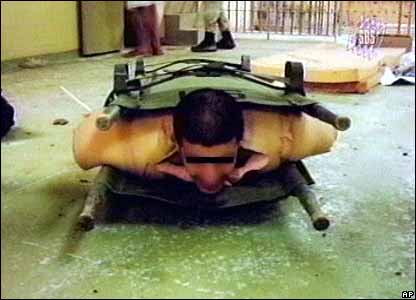
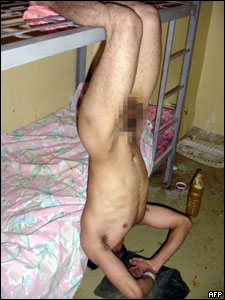
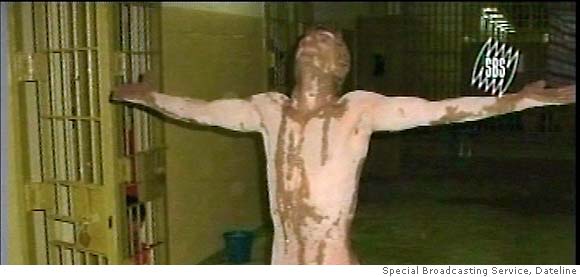
June 7, 2006
The
Council of Europe
has finally released their main report on
how European countries helped the CIA run a "global spider's
web" devoted to kidnapping people and flying them to secret
sites to be interrogated and tortured:
It lists Sweden, Bosnia-Hercegovina, Britain, Italy, Macedonia, Germany
and Turkey as countries "responsible, at varying degrees...
for violations of the rights of specific persons."
Seven other countries "could be held responsible for collusion -
active or passive": Cyprus, Greece, Ireland, Poland, Romania and
Spain.
I'm afraid the footnote links don't work on my website;
to see them you'll have to go to the
actual report.
June 14, 2006
Amnesty International issued a report entitled
Partners
in Crime on how European countries helped the CIA kidnap
and torture people on European soil.
June 22, 2006
You may recall the issue of
Bush's
signing statements. He attaches these
to laws in order to interpret the laws how he wants - for
example, he wants to let the CIA torture people even though
Congress passed a law banning torture.
The issue is not going away: Elizabeth Drew just wrote a detailed
article on how this fits into
Bush's overall power
grab.
June 29, 2006
The US Supreme Court
blocked Bush's attempt
to try Salim
Ahmed Hamdan in a military tribunal
for conspiring against US citizens. They said this goes against
U.S. law and the Geneva convention. Hamdan has been held without
trial for 4 years in Guantanamo Bay - along with about 450 other people.
September 6, 2006
Bush
admitted
the CIA has secret prisons: he said
14 prisoners have just been shipped from there to
Guantanamo. He praised the "tough" methods of
interrogation used on these prisoners, which include simulated
drownings.
September 20, 2006
I think I will stop writing this little journal now, not because
the problem has been solved, but because
I can't keep up with all the news anymore. As I write this,
Bush is pressing Congress to pass a law letting
the US try people in military tribunals where confessions
forced through torture would count as evidence - and the accused
cannot see all the evidence against them.
That's like - it's very vague. What does that mean, "outrages
upon human dignity"?
September 26, 2006
Today the Senate voted 65-34 in favor of the Military Commissions
Act. Unfortunately,
this gives the President to
"interpret the meaning and application of the Geneva Conventions."
And, it guts the right to habeas corpus:
it allows unlawful enemy combatants
to be tried by military tribunals without being able to see
the evidence against them. This includes US citizens, since
"unlawful enemy combatants" include anyone
who, before, on, or after the date of the enactment of the Military
Commissions Act of 2006, has been determined to be an unlawful enemy
combatant by a Combatant Status Review Tribunal or another competent
tribunal established under the authority of the President or the
Secretary of Defense.
For more details, see:
These guy aren't nutty bloggers.
Lederman worked for the Department of Justice from 1994 to 2002 and
now teaches law at Georgetown University.
Ackerman is a Yale law professor and author of this book:
Interestingly, even Arlen Specter fell into line. Quoting the
Washington Post:
Judiciary Committee Chairman Arlen Specter (R-Pa.) voted for the bill after
telling reporters earlier that he would oppose it because it is "patently
unconstitutional on its face." He cited its denial of the habeas corpus right to military detainees. In an interview last night, Specter said he decided to
back the bill because it has several good items, "and the court will clean
it up" by striking the habeas corpus provisions.
September 27, 2006
Today the House of Representatives voted
253-168 in favor of the Military Commissions Act, HR6166.
So, as soon as he signs the bill, the President of the United
States can now legally detain anyone in the world, indefinitely,
after a military tribunal has convicted them of being an "
unlawful enemy combatant". And, they needn't be allowed
to see the evidence against them.
February 20, 2007
I'm skipping over a lot of the story, but...
June 26, 2007
I've long since stopped trying to keep this webpage updated:
there is simply too much going on.
It's gripping reading for anyone who cares about democracy,
and how democracy can start to unravel thanks to the work of a
ruthless and skillful man.
Stealth is among Cheney's most effective tools. Man-size Mosler safes, used elsewhere in government for classified secrets, store the workaday business of the office of the vice president. Even talking points for reporters are sometimes stamped "Treated As: Top Secret/SCI." Experts in and out of government said Cheney's office appears to have invented that designation, which alludes to "sensitive compartmented information," the most closely guarded category of government secrets. By adding the words "treated as," they said, Cheney seeks to protect unclassified work as though its disclosure would cause "exceptionally grave damage to national security."
And, the truly scary thing is how he never gives up, even when he
seems to be defeated:

A document from the Office of the Vice President is stamped
"Treated as Secret/SCI"
Cheney and his allies, according to more than two dozen current and former officials, pioneered a novel distinction between forbidden "torture" and permitted use of "cruel, inhuman or degrading" methods of questioning. They did not originate every idea to rewrite or reinterpret the law, but fresh accounts from participants show that they translated muscular theories, from Yoo and others, into the operational language of government.
It has always been against the policy of despotic
governments to suffer the victims of their persecutions to
reappear. - Alexander Dumas, The Count of Monte Cristo
baez@math.removethis.ucr.andthis.eduhome