
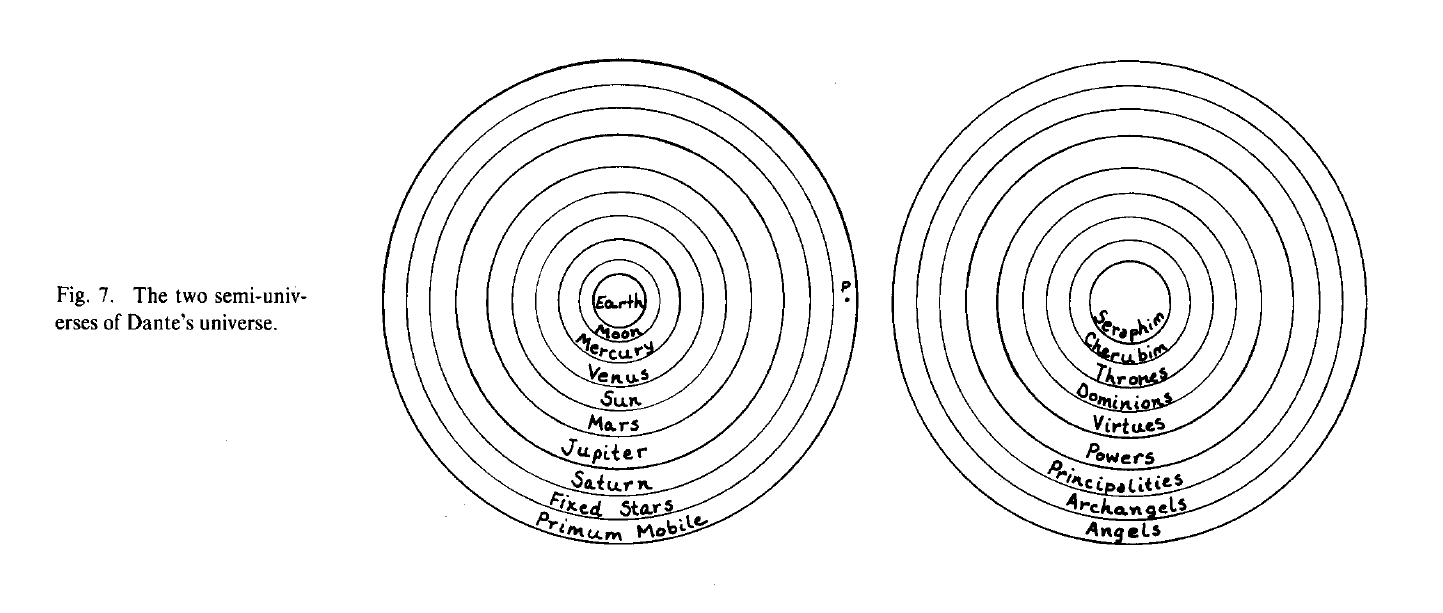
Apparently Dante conceived of the universe as a 3-sphere! That's a 3-dimensional space formed by taking two solid 3-dimensional balls and completely gluing their surfaces together.
In his Divine Comedy, Dante describes the usual geocentric universe of his day. It has concentric spheres for the Moon and Sun, the various planets, and then the so-called 'fixed stars'. Outside the sphere of fixed stars, there's a sphere for the 'first mover', the Primum Mobile. Ptolemy believed in this, and so did Copernicus — and even Galileo did, at first.
But that's not all! Outside that sphere, Dante describes 9 concentric spheres of the Empyrean, where various levels of angel live. And as we go up into the Empyrean, these spheres get smaller. They all surround a point — which is God. This is shown above in an illustration by Gustav Doré.
At the opposite extreme, at the center of the Earth, is another point — and that's where Satan lives, surrounded by the 9 levels of Hell.
Altogether we have a 3-dimensional closed universe, which mathematicians call a 3-sphere!
Much later Einstein also postulated that the universe was a 3-sphere, which was kept from collapsing by the cosmological constant. This was before Hubble and others saw that the universe is expanding.
Here are a couple of good references on this subject:
In the Paradiso Dante describes his ascent sphere by sphere through the Aristotelian universe to the Primum Mobile. Beyond this is the Empyrean, the abode of God and the angels. The conventional picture of the Empyrean seems to have been rather vague, geometrically speaking. In diagrams of the universe, for example, it was represented by the border area, outside the Primum Mobile, often richly populated with angelic beings. Dante, however, endows the Empyrean with a detailed and precise geometric structure. This structure is described in Canto 28, as if seen from the Primum Mobile, as a bright Point representing God, surrounded by nine concentric spheres representing the various angelic orders. The details which follow leave the almost inescapable impression that he conceives of these nine angelic spheres as forming one hemisphere of the entire universe and the usual Aristotelian universe up to the Primum Mobile as the other hemisphere, while he is standing more or less on the equator between them [....] Taken all together, then, his universe is a 3-sphere.Dante himself believed he was expressing something entirely new at this juncture.
Dante’s elation with this idea — a feeling we may readily share — has traditionally left readers somewhat puzzled. That is just another way of saying that if this passage is not taken as a description of the organization of 2-spheres into a 3-sphere, then it is hard to see what the point of it is.
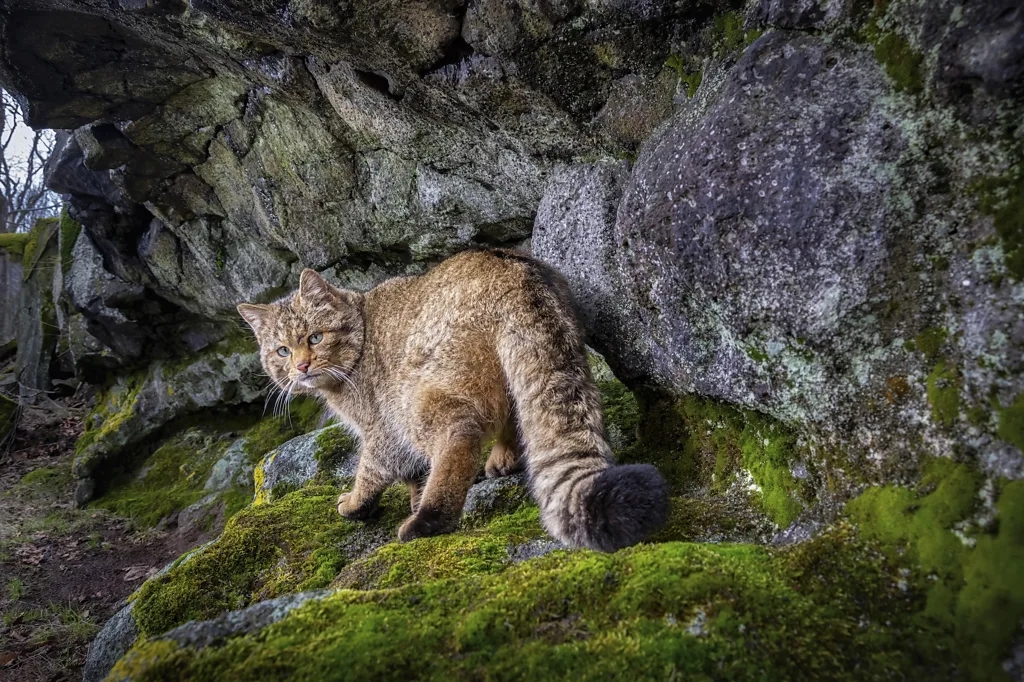
Some good news in a time of darkness: the European wildcat, Felis sylvestris, is making a comeback! This thoughtful-looking example was photographed in a mountainous region of the Czech republic.
The European wildcat's extreme elusiveness may have helped it avoid hunters in places where a larger native cat, the lynx, has been killed off. There may be about 140,000 European wildcats spread across more than two dozen countries. But they are very hard to find!
Wildlife photographer Andrea Giovanni, who made a video of one, writes:
I'd never even thought of taking photos of wildcats, for a simple reason: I thought it was impossible, or at least, extremely difficult. It's considered 'the ghost of the forests' because it's very, very elusive, and it's hard to predict where it can be spotted. Other animals tend to follow the same trails through the forest. The wildcat goes wherever she wants to.
One reason the European wildcat is coming back is increased legal protections. But another is that villages in Italy and other regions are becoming depopulated! Some are very worried about declining human populations. But it does make room for other species. That gives me some hope for the future.
I got this picture, taken by Vladimír Čech Jr in the Doupov mountains, from a very nice article on the European wildcat: