
I love quasicrystals — like crystals, but with patterns that never repeat, like Penrose tiles. But they've very rare in nature. They're created only by the most exotic and violent events: a high-speed collision of asteroids, lightning hitting a downed power cable in a sand dune — or an atomic bomb!
Amazingly, the first 3 kinds of naturally occurring quasicrystal were discovered in a single meteorite that landed in Khatyrka, in the far east of Russia. They've never been found anywhere else! And this meteorite is highly anomalous: it's the only meteorite known that contains metallic aluminum — and it seems to have been formed in a ultra-high-velocity collision between asteroids.
The only other quasicrystal I know that may be naturally created came from a bolt of lightning hitting a sand dune near a downed power cable in Nebraska. Then there was one found amid the fused desert sand and copper transmission cable left behind by the first atomic bomb test at Trinity, New Mexico. That's not quite 'naturally created'.
And that's all. As far as I can tell, all the rest have been made in labs!
Here are the 3 kinds of quasicrystal found in the Khatyrka meteorite, in order of their discovery:
Icosahedrite has full three-dimensional icosahedral symmetry and is quasiperiodic in all 3 directions. The easiest way to describe it mathematically is the 'slice and project’ method. You start with a lattice in 6 dimensions, choose a 3d slice, thicken that up a bit, take the lattice points that lie in this slice, and project them down to 3d space. The lattice in 6 dimensions is called the D6 lattice: it consists of those 6-tuples of integers that sum to an even integer. If we slice along the correct 3d subspace the result has icosahedral symmetry. A lot of math in this mineral!
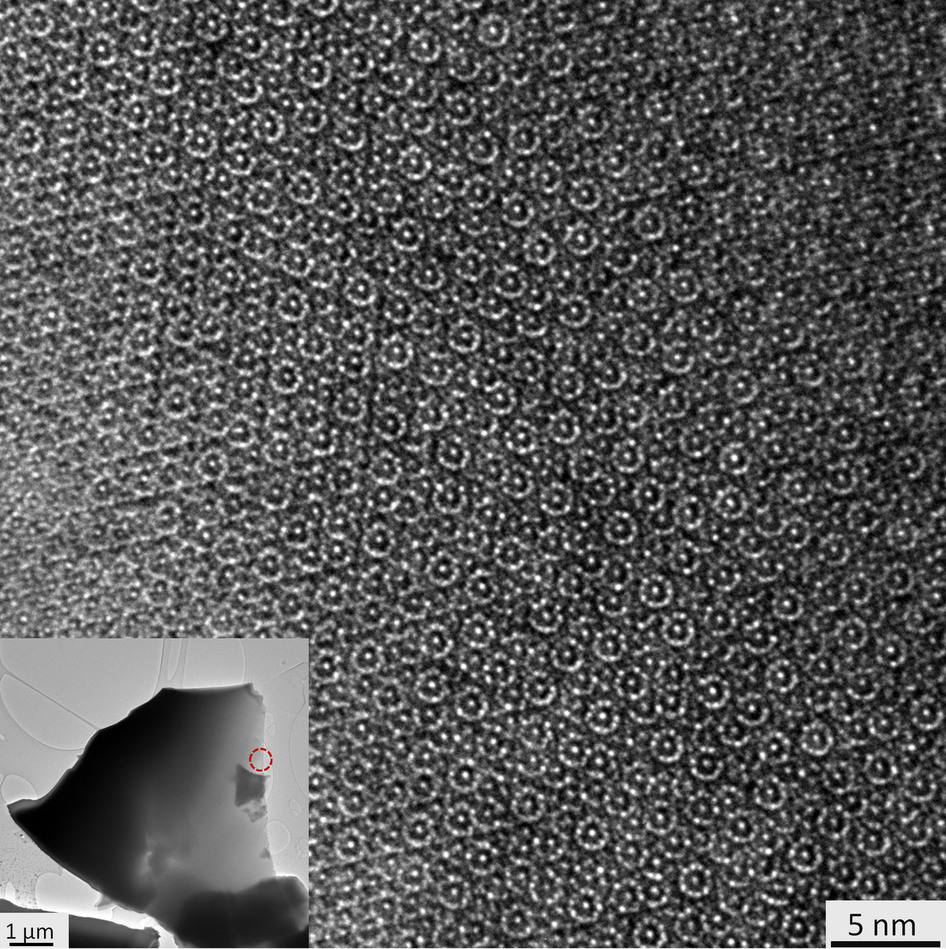
The Nebraska quasicrystal shows how blurry the concept of 'natural' can be. It was found inside a 'fulgurite': a rock made when lightning hits sand. They found it in the Sand Hills near Hyannis, Nebraska, near a downed power line during a storm. It's unclear whether this fulgurite was created by a lightning strike or by the falling power line creating its own arc, so the 'natural vs manmade' status is genuinely ambiguous.
What's more important is it was a new kind of quasicrystal produced by a high-current, high-temperature, rapid-quench event on Earth's surface! It has a composition of roughly Mn72.3Si15.6Cr9.7Al1.8Ni0.6. Its atomic planes have 12-fold symmetry in a nonrepeating pattern, and these planes are stacked periodically along the perpendicular direction.
Here's a picture of this quasicrystal:
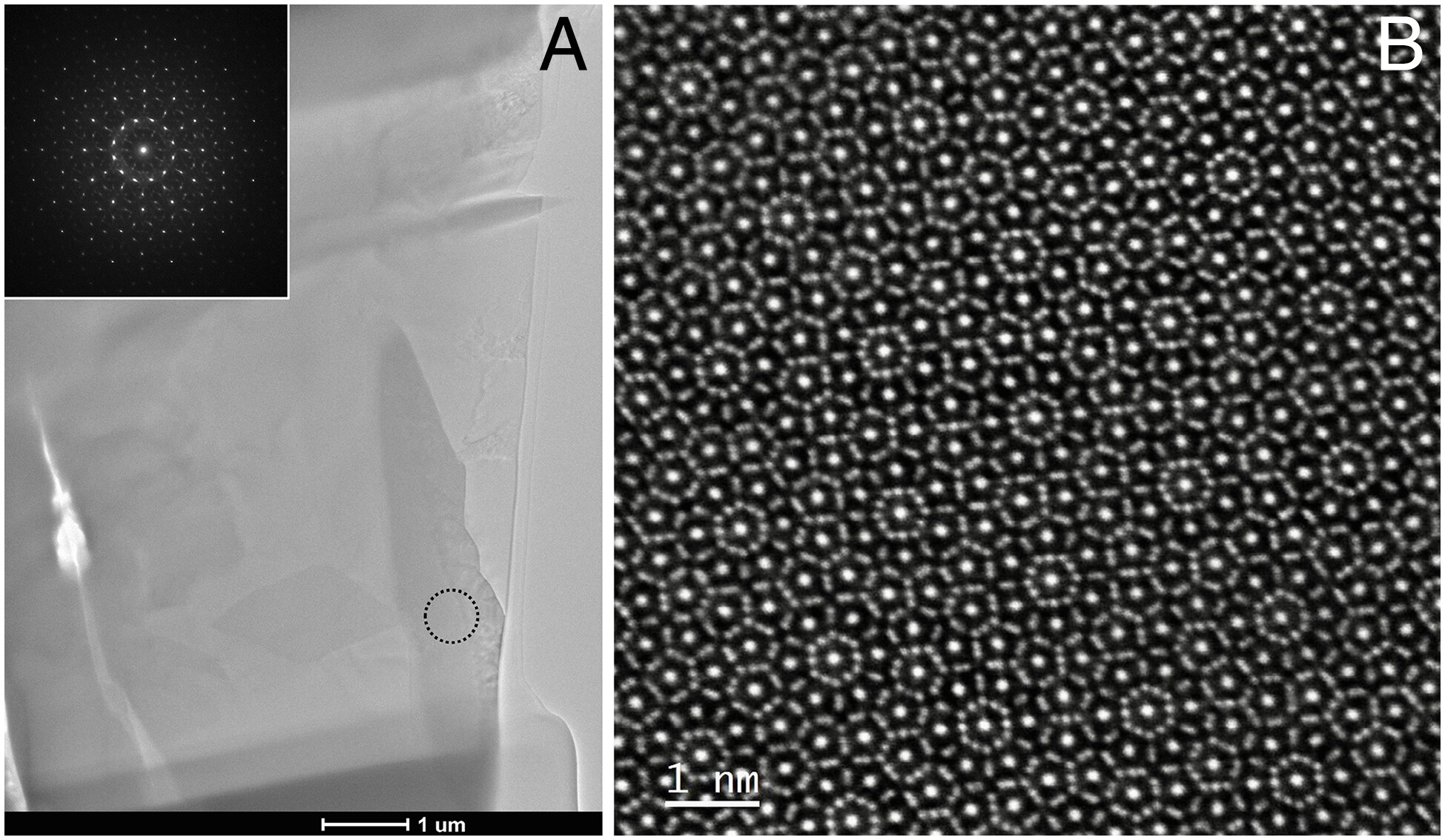
On decagonite, the second to be found:
On i-phase II, which is the provisional designation of the third quasicrystal found in that meteorite:
On the dodecagonal quasicrystal found in the dune in Nebraska:
This has icosahedral symmetry, but it's quite different than the other quasicrystals I've mentioned, since it's mostly made of silicon! Its formula is Si61Cu30Ca2Fe2.
May 15, 2026
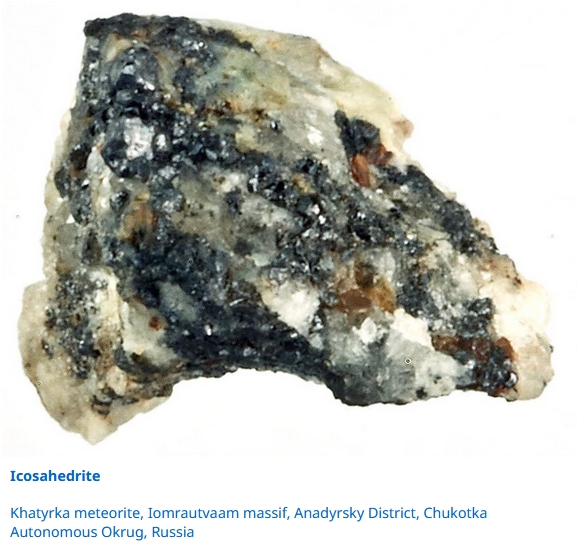
In 2025, researchers studied a quasicrystal forged in a hypervelocity asteroid collision 600 million years ago — and found that it contains 'phasons'!
It's not a perfect icosahedral quasicrystal: it's slightly distorted. 6 gentle 'phason waves' run through it, oriented along the 6 fivefold symmetry axes of an icosahedron. These waves were locked in when the alloy quickly cooled after impact, and they've been sitting there frozen in the structure ever since.
This quasicrystal is called 'icosahedrite'. The easiest way to describe it is the 'slice and project' method. You start with a lattice in 6 dimensions, choose a 3d slice, thicken that up a bit, take the lattice points that lie in the thickened slice, and project them down to 3d space. The atoms in the icosahedrite are exactly the projections of the 6d lattice points that happen to fall inside the thickened slice.
But now imagine wobbling the slice gently — not tilting it, but wiggling it sideways in the other three dimensions, the ones perpendicular to physical space. Some 6d lattice points slip out of the slice and others slip in. In physical space this looks like atoms suddenly hopping from one position to a nearby alternative one.
These atomic hops are called 'phason flips', and a wave of them is a 'phason'. Sound waves involve atoms swaying smoothly in place; phasons involve atoms jumping between alternative positions, and they exist only in quasicrystals.
These phasons are a fossil record of the collision that made the
quasicrystal: the instant of cooling, preserved as a piece of warped
6-dimensional geometry, sitting inside a rock for 600 million years!
May 26, 2026
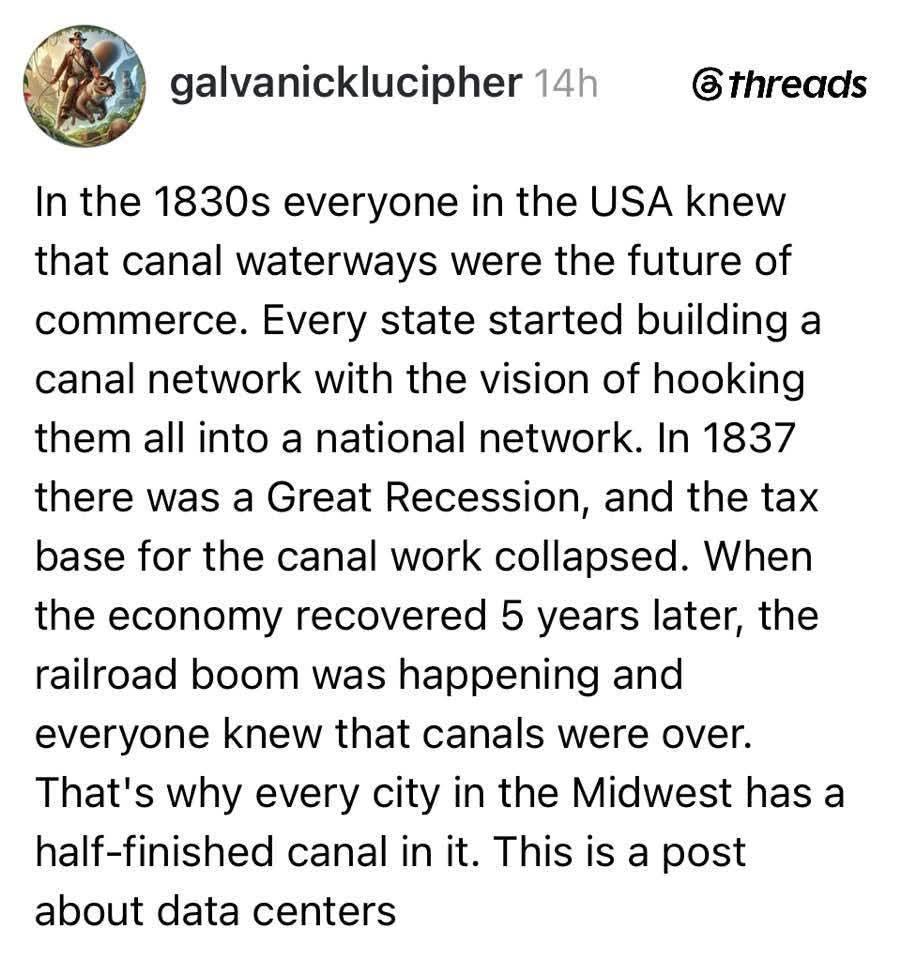
"Every city in the Midwest has a half-finished canal in it."
I love canals, so this makes me want to do a tour of the midwest US and its half-finished canals — and a boat tour of the finished canals. But I'm in Scotland so... let me do it online.
First up: Indianapolis!
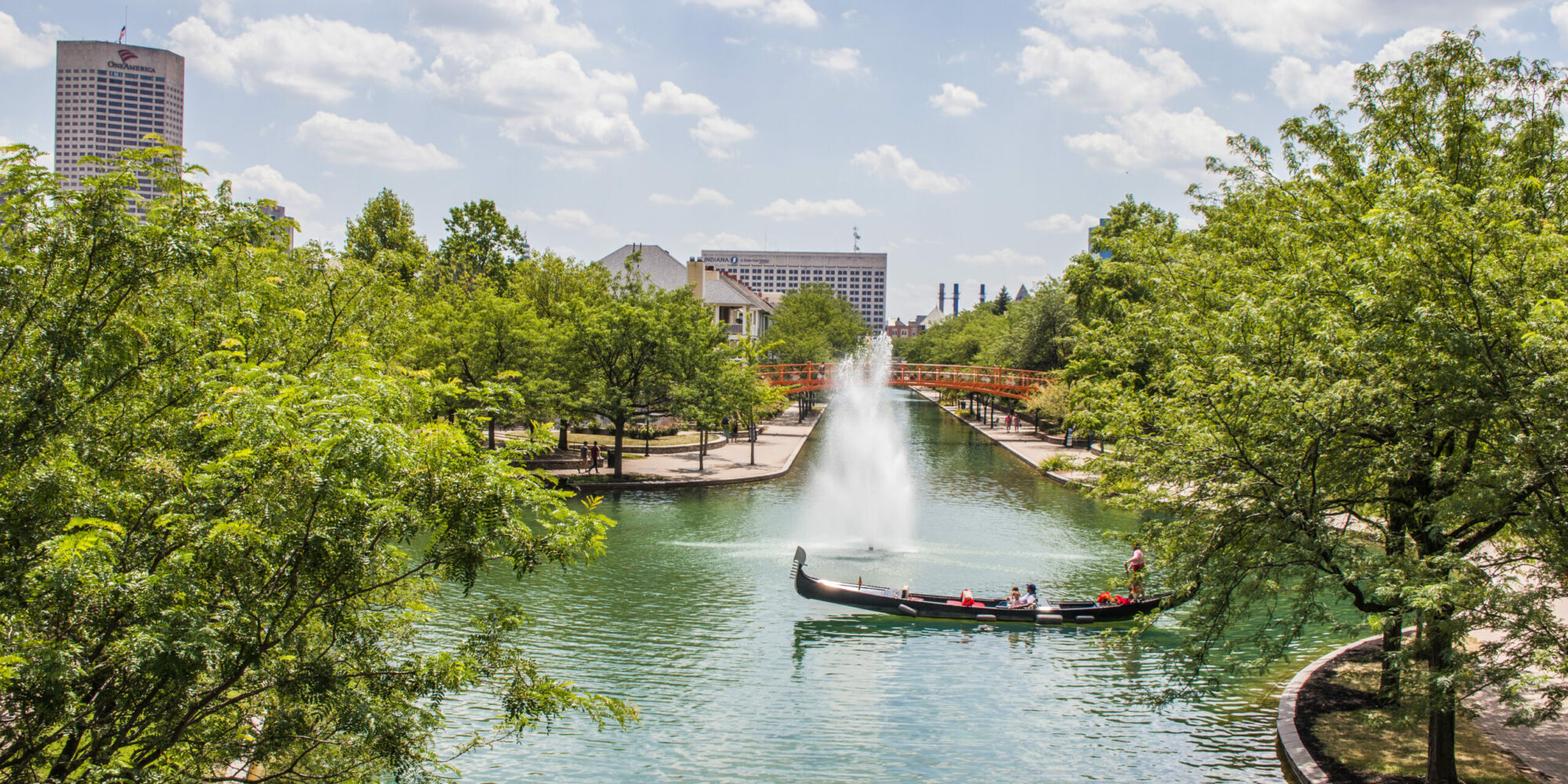
In 1836, Indiana's Mammoth Internal Improvement Act authorized eight major canal projects on a $10 million loan.
After the Panic of 1837, the state went broke; by 1841 it could no longer make interest payments, and of the eight projects, none were completed by the state and only two were ever finished — by London creditors who took them over.
The Central Canal was supposed to run roughly 300 miles down the middle of the state. Only about 8 miles around Indianapolis were ever built. That stub still exists: it's the Canal Walk downtown, now a beautiful pedestrian promenade. See the picture!
South of the city you can still find unfinished culverts, locks, and an abandoned aqueduct where work stopped in 1839. Anyone got good pics of those? I like the melancholy charm of such things.
Next: the Clinton-Kalamazoo canal, which was supposed to go all way across Michigan!
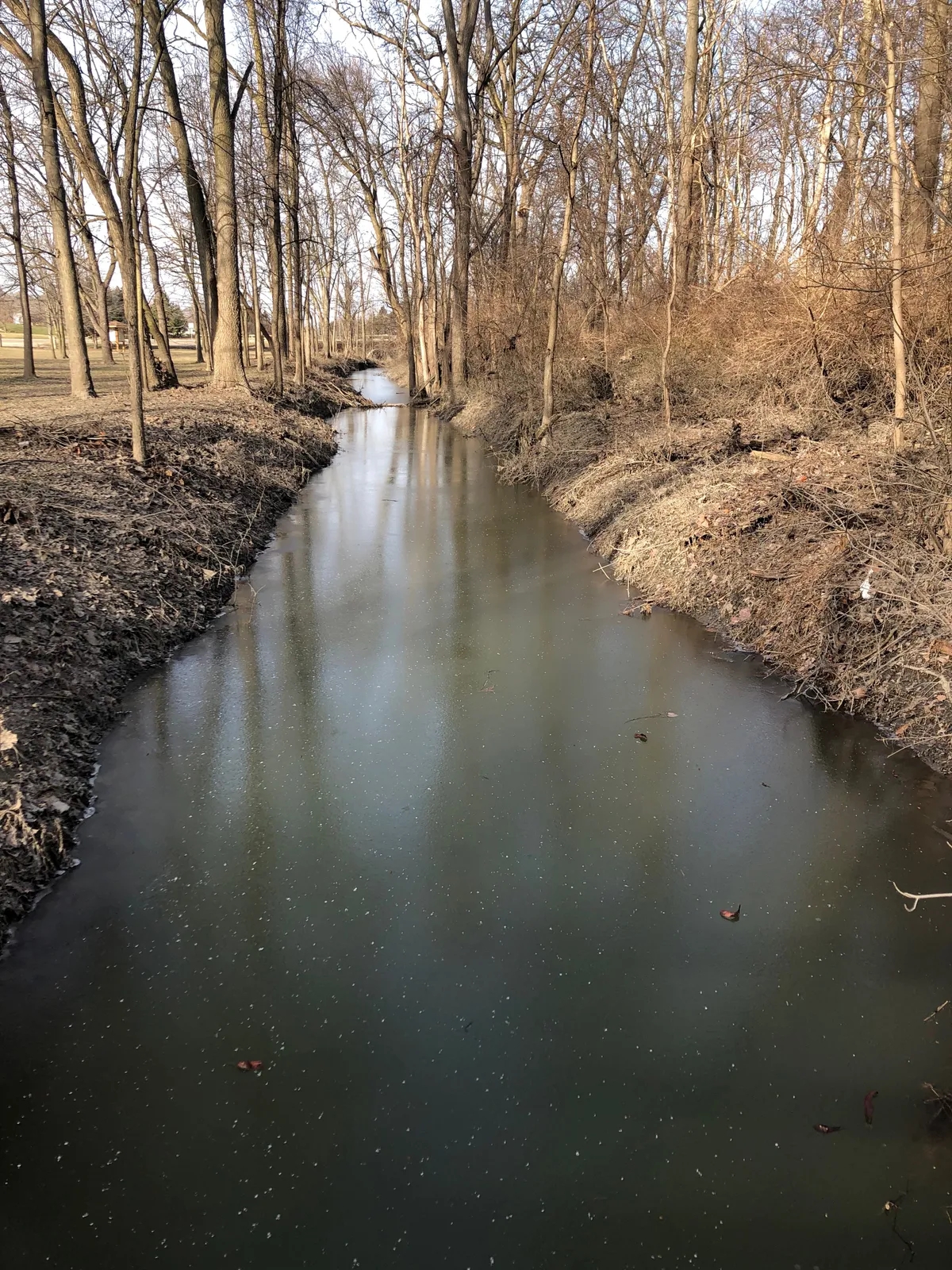
Michigan became a state in 1837 and immediately borrowed $5 million to build canals and other stuff. The Clinton-Kalamazoo Canal was supposed to cross the Lower Peninsula — 216 miles from Lake St. Clair to Lake Michigan — saving ships from the long sail around the mitt.
Construction started in 1838 with great fanfare. But they finished only about 16 miles — Mt. Clemens to Rochester — before the money ran out.
"Bank payments were not being paid, and workers weren’t getting their wages, which led to boozing it up, numerous fights, and stealing supplies. Disgruntled, many of the workers began destroying and ripping up parts of the canal they had constructed."
Work on the canal ground to a halt in 1843. The legislature formally abandoned it in 1895. Reconstructed fragments can be seen today in Clinton Township and Bloomer State Park.
You might never guess this stream running through the woods was part of a colossal, overambitious engineering project — though the suspiciously straight banks are a clue.
Next: some big canals in Ohio that were actually finished!
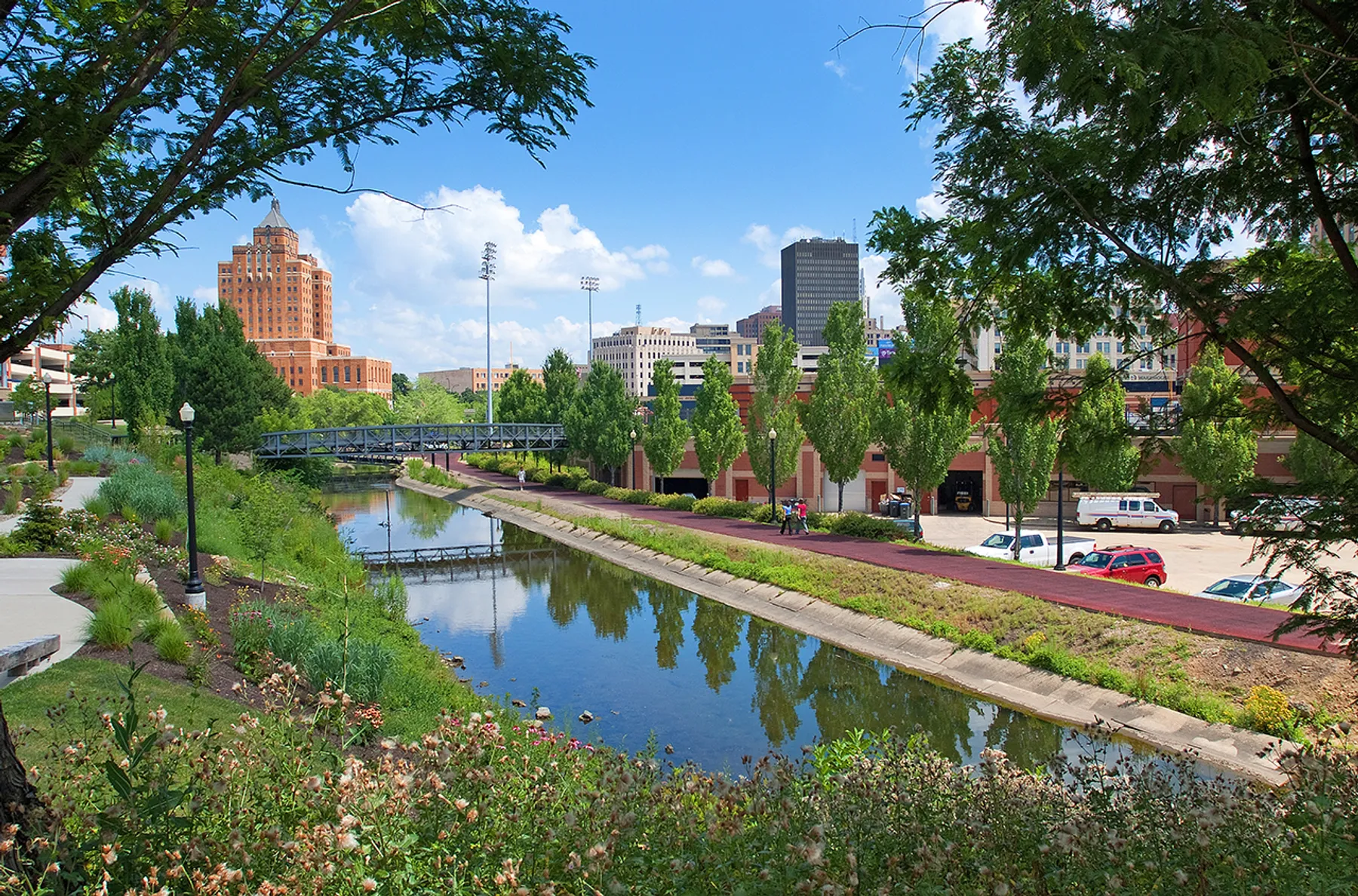
Ohio actually completed both of its big canals: the Ohio & Erie (Cleveland to Portsmouth, 1832) and the Miami & Erie (Cincinnati to Toledo, 1845).
In the 1840s, Ohio grew to become the third most prosperous state, thanks in part to these canals. But by the dawn of the Civil War, they were losing business to railroads that could deliver goods cheaper and faster. They fell into disrepair, and after some feeble attempts to revive these canals, people gave up on them.
Cities like Akron, Dayton, Cincinnati, Toledo, and Cleveland have prominent canal remnants. But they're not half-finished: they were finished and then abandoned!
This remnant of the Ohio & Erie canal in downtown Akron has been made into something quite nice, called the Towpath Trail, shown above.
Next stop: the Miami & Erie Canal!

The Miami & Erie Canal was a 274-mile canal that ran from Cincinnati to Toledo, creating a water route between the Ohio River and Lake Erie. Construction began in 1825, and the canal was completed two decades later at a cost of $8 million — a quarter of a billion in today's money!
At its peak, it included 19 aqueducts, three guard locks, 103 canal locks, multiple feeder canals, and a few man-made water reservoirs. Boats up to 80 feet long were towed along the canal by mules, horses and oxen.
Because of competition from railroads, commercial use of the canal declined in the late 1800s, and it was permanently abandoned for commercial use in 1913 after a historic flood in Ohio. Cincinnati's Central Parkway and Dayton's Patterson Boulevard literally pave over filled-in portions of this canal! Only a small fraction survives today.
Above you see a lock from the Miami & Erie canal in the aptly named town of Lockington.
Our next and final stop: the Illinois & Michigan Canal!
The Illinois & Michigan Canal is what happens when a nice idea waits 175 years for follow-through.
In 1673, the French-Canadian explorer Louis Joliet stood at the Chicago portage and noted that a modest ditch — really, just a ditch! — could link the Great Lakes to the Gulf of Mexico.
Illinois finally agreed and broke ground on July 4, 1836. But soon it ran into the financial disaster called the Panic of 1837 — so the state nearly went broke while digging a 96-mile trench it had assured everyone would take "a few years."
It took twelve. By the time the first boat chugged through in April 1848, the railroads were already laying track to make the whole enterprise seem quaint. Nonetheless, the canal was wildly profitable for thirty years — long enough to pay off its bonds — before being superseded.
Today much of the canal is a 'linear park' with canoeing and a 62-mile hiking and biking trail. Above you see the old lock tender's house near Morris, Illinois.
Will data centers, built for AI, be converted to something equally pleasant when their day has passed? I believe some form of AI is here to stay — but the current version is wildly inefficient compared to the human brain, so if we don't find some other use for them, they may simply fall into ruin.