So, if we simply slap these two theories together, we get a mess! How can we study electrically conductive fluids — like plasma — without bringing special relativity into the game?
We can use a limiting case of Maxwell's equations where we ignore terms that become tiny when all the particles are moving much slower than light.
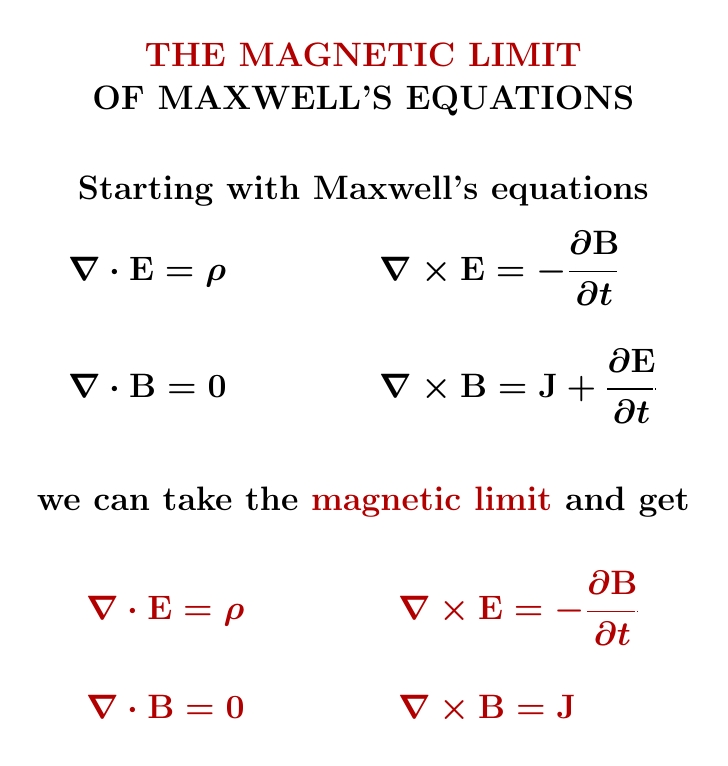
There seem to be at least two ways to do this: there's an 'electric limit' of Maxwell's equations and a 'magnetic limit'. Apparently both are invariant under Galilean transformations. The original derivation of these limits by Le Bellac and Lévy-Leblond in 1973 used the version of Maxwell's equations including the electric permittivity \(\varepsilon_0\) and magnetic permeability \(\mu_0\) of the vacuum, whose product is \(1/c^2\). This is convenient but not necessary, as explained here:
People ofen use the magnetic limit when studying nonrelativistic electrically conductive fluids. When they do this, they often consider a version of the magnetic limit where the charge density \(\rho\) is zero, since this is typically close to true in a plasma. However Heras does not do this, nor does the original paper:
In the electric limit of Maxwell’s equations, we throw out effects due to time-varying magnetic fields:
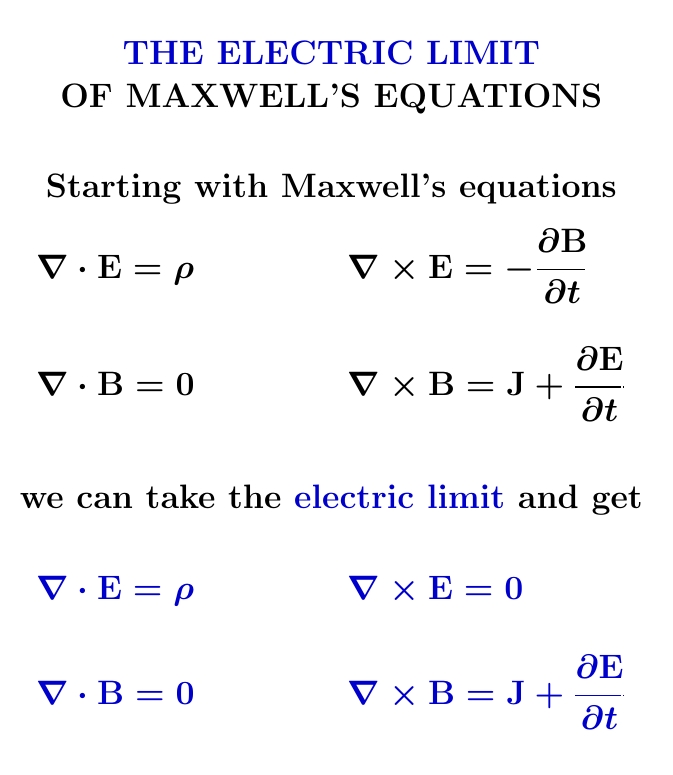
It’s fun to compare the magnetic and electric limits.
The magnetic limit has been called 'pre-Maxwellian', because it's like electromagnetism before Maxwell added the extra term that makes a changing electric field create a curl in the magnetic field. Without this term there is no light!
In the electric limit you also can't have light, because it's missing the term that makes a changing magnetic field create a curl in the electric field.
In the magnetic limit you can't have capacitors, because those store energy in the electric field, and in the magnetic limit the energy density is just \(\mathbf{B} \cdot \mathbf{B}/2\).
Similarly, in the electric limit you can't have inductors, because inductors store energy in the magnetic field, and in this limit the energy density is just \(\mathbf{E} \cdot \mathbf{E}/2\).
It's all nicely symmetrical! But still somewhat mysterious to me. All the derivations of these limits that I've seen involve too many parameters for my taste, and too much talk. But that's how I often feel when I'm just starting to study a piece of physics.
Besides the two papers mentioned in my last post, I've been looking at this:
Someday I should dig deeper into this subject and explain how the two limits work in a way I find satisfying. I should also draw the connections to this blog article of mine: