
I'm realizing more and more how modern-day AI taps into some very old urges.
So many would like "unsurpassed mastery without any effort", and would summon a demon to get it.
The quote is from Magic in the MIddle Ages by Richard Kieckhefer.
July 11, 2026
The exceptional groups \(\text{E}_6, \text{E}_7\) and \(\text{E}_8\)
are famous — but in fact we can define \(\text{E}_n\) groups for
smaller \(n\) too. \(\text{E}_3\) is the gauge group of the Standard
Model! Some larger ones are gauge groups of famous grand unified
theories. I used to think this was cute — but now I think it
could be a clue. I'm starting to see how this series of groups is
connected to the foundations of quantum physics.
Here's part of the story that remains puzzling to me. It's about things called del Pezzo surfaces.
A del Pezzo surface is a special kind of 2-dimensional smooth complex projective variety, so it's a compact oriented 4-manifold in the usual real sense. Any such 4-manifold gives a lattice called its '2nd cohomology'. A del Pezzo surface gives a lattice with a special vector in it called its 'canonical class'. And if we look at all the lattice vectors orthogonal to this, we get a special sort of lattice called an \(\text{E}_n\) lattice! From this there's a way to get the \(\text{E}_n\) group — that's part of the general theory of root lattices and semisimple Lie groups.
But what the heck is a del Pezzo surface?
In algebraic geometry you can 'blow up' a surface by removing a point \(p\) and sticking in a bunch of new points, one for each direction in which you could approach \(p\). But be careful: we're working with complex numbers, and we count two vectors as giving the same 'direction' if is one is some complex number times the other.
You get a del Pezzo surface if you take the complex projective plane \(\mathbb{CP}^2\) and blow it up at a bunch of points in 'general position'. That roughly means that they're random, nothing special about them. And if you blow up at \(n\) points, you get a del Pezzo surface that gives the \(\text{E}_n\) lattice!
The original source for this is in Chapter IV of this book:
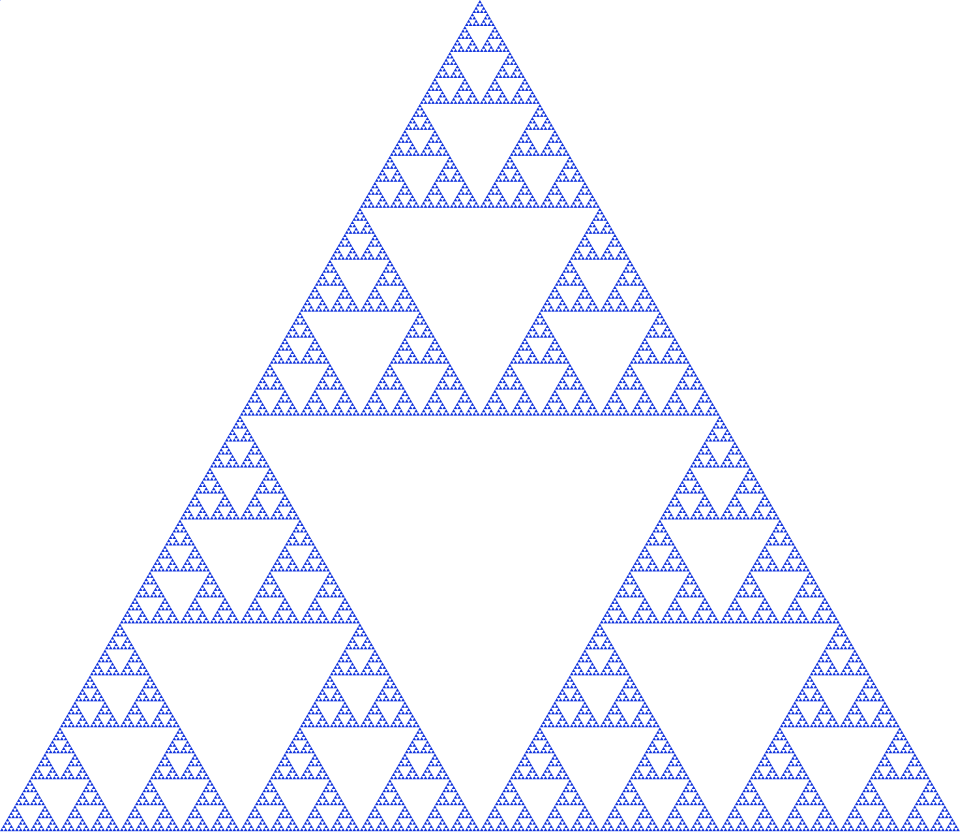
Wow! If the side length of this "Sierpiński triangle" is 1, the average distance between its points is 466/885.
Double wow! The average number of moves in a shortest path between two random states in the \(n\)-disc Tower of Hanoi puzzle is asymptotically \((466/885)\cdot 2^n\) as \(n \to \infty\).
But be careful:
By 'distance', I mean the length of the shortest path moving inside the Sierpiński triangle, not the usual distance between points in the plane.
Also: we compute the 'average' distance using the natural measure on the Sierpiński triangle, not Lebesgue measure.
But suppose we measure distance between points in the plane in the usual way. What's the average distance between two points in the Sierpiński triangle with side length 1? I'm getting $$ 0.4226884 ± 0.00004 $$ This is close to 41/(56√3). But I don't think that's the exact value.
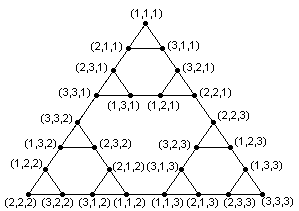
Why do paths through the \(n\)th approximation to the Sierpiński triangle correspond to allowed sequences of moves in the n-disc Tower of Hanoi?
Well, suppose you have 3 discs. Draw the allowed states of the Tower of Hanoi puzzle as below. For example, (3,2,1) means "smallest disc on post 3, second smallest on post 2, third smallest on post 3". Draw edges for allowed moves between states. You get the 3rd approximation to the Sierpiński triangle!
I got this picture from an article with more details:
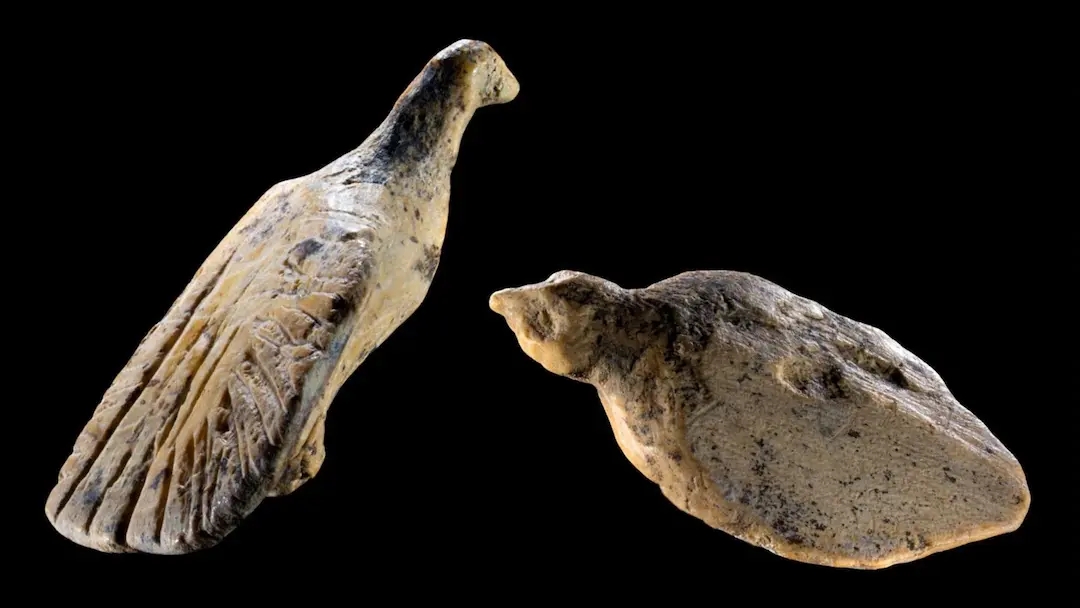
Brand new old stuff! Tiny ivory figurines of birds made around 40,000 BC, recently found 1.5 meters apart in a cave called Hohle Fels in Germany.
This art is typical of the Early Aurignacian culture, known for their ivory carvings, fine flint blades, and some of the earliest cave paintings.
The glaciers had receded in Germany by this time: it was a steppe-tundra with regions of permafrost that supported mammoth, reindeer, horse, and bison. It was a time of rapid climate oscillations — the Dansgaard-Oeschger cycles — swinging between mild and colder weather on timescales of centuries to a couple thousand years.
It's really fun to imagine what it would be like to be an Aurignacian! Of course life would have been tough by current standards.
For more, read this: