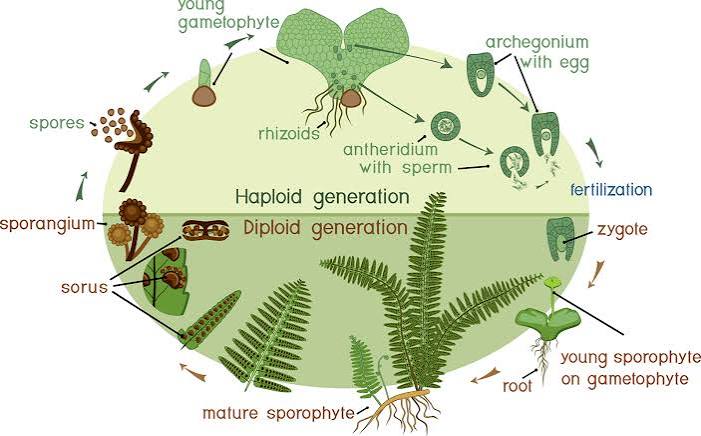
Ferns live a double life, alternating between two completely separate plants each generation. The one you'd recognize as a fern — the leafy thing with fronds — is called the 'sporophyte'. Its cells are 'diploid', meaning they carry two copies of every chromosome, one from each parent, just like your own cells do.
On the undersides of its fronds, the sporophyte produces spores, and it makes them through a special kind of cell division that halves the chromosome count. So while the sporophyte itself is diploid, its spores are 'haploid': they carry just a single copy of each chromosome.
Here's where ferns get weird: those haploid spores don't grow into new leafy ferns! Instead, each spore grows into a tiny, separate plant — often a green heart-shaped flap just a few millimeters across — called a 'gametophyte'.
Being haploid, this has only one copy of each chromosome, and it's this modest little plant, not the showy frond, that produces the eggs and sperm. When a sperm swimming through a film of water reaches an egg and fertilizes it, the two haploid cells combine their single chromosome sets into one cell with a double set: a diploid cell again! That grows into a new leafy sporophyte, and the cycle begins again.
So a fern is really two alternating plants: a big diploid sporophyte that makes spores, and a small haploid gametophyte that makes eggs and sperm.
Ferns can spread quickly because they produce vast numbers of spores, which can be blown by the wind for enormous distances. Then, when a lone spore grows into a little gametophyte, this can fertilize itself!
And here's another strange thing. While you have 46 chromosomes, certain ferns carry huge numbers: the record is 1,400! Their genomes can be gigantic too: a little fern called Tmesipteris oblanceolata packs about 160 billion base pairs of DNA into each cell, the largest genome ever found in any living thing on Earth.
People call these ferns 'chromosome hoarders'. But why all the hoarding? One classic idea from 1966 blames the ferns' sex lives.
Many ferns can fertilize themselves. A single spore grows into a gametophyte that makes both egg and sperm. The egg from one plant can be fertilized by the sperm of another plant... or a sperm from the same plant! But when that happens, the offspring end up with two identical copies of every gene, losing the genetic variety that keeps a population healthy. The fix? Keep extra whole sets of chromosomes! This restores some redundancy and diversity.
It's a nice theory — but newer genetic data have complicated it, and scientists are still arguing about whether it really explains chromosome hoarding among ferns.
For more, read this:
We know there was an asteroid impact around when the dinosaurs went extinct 65 million years ago, because we see a rare metal called iridium in the strata from this time — and droplets formed by molten quartz.
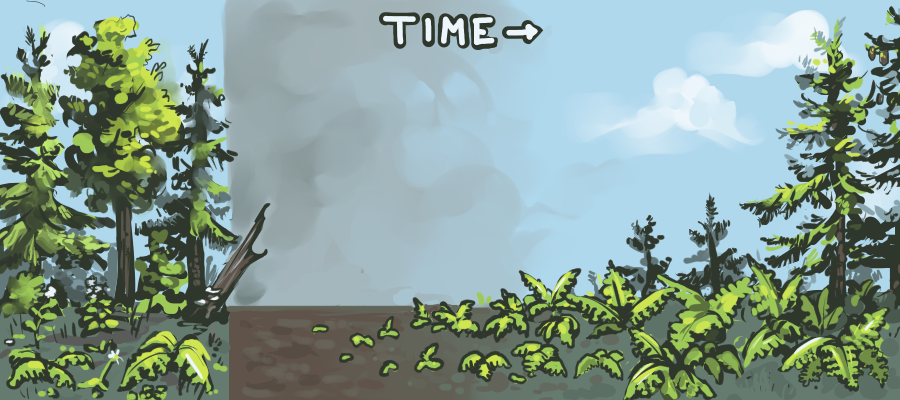
But we also see lots of fern spores! This is called a 'fern spike', and it's not the only one.
Ferns spread rapidly using spores, and they're tougher than they look. When everything dies, these ancient, humble plants are the first to recolonize the land. They did it after the Permian-Triassic, Triassic-Jurassic and Cretaceous-Paleogene extinction events. They may do it again.
I like ferns. Knowing this makes me like them even more.
As always, click on the picture to see its creator: in this case, Chantal Bussiere.