
This year the Republican Party's midterm convention used the traditional red, white and blue decorations — but added Trump's favorite color: gold.
I recommend that they use a new US flag. The traditional colors were
red for blood, white for purity and blue for justice. The new version
features red for blood, gold for wealth and purple for monarchy.
September 19, 2026
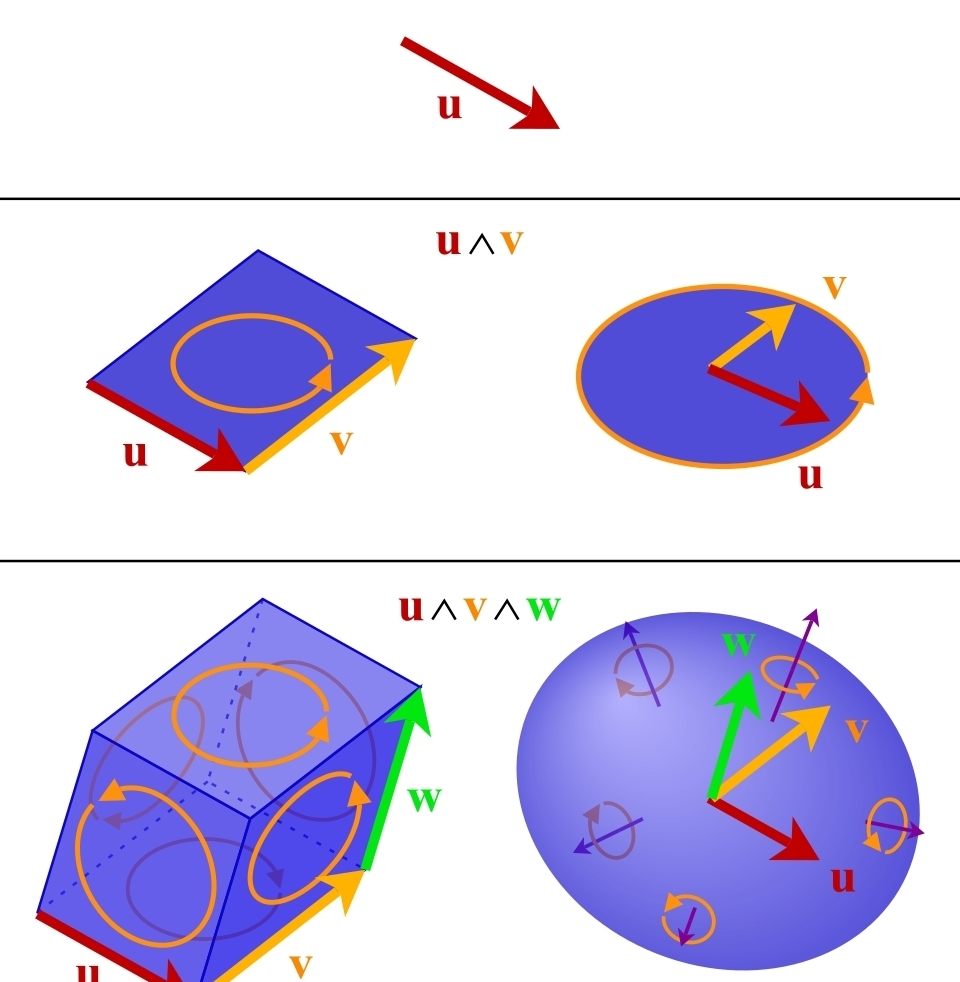
A vector looks like an arrow; anyone studying math or physics in college learns about vectors.
Bivectors are important too - though less widely taught. You can create a bivector by taking the 'wedge product' \(u \wedge v\) of two vectors \(u\) and \(v\), and you can visualize this as the parallelogram shown at left here.
But in fact, an ellipse or any other flat surface with the same area lying in the same plane is just as good a picture of this bivector. Further, you can add bivectors, so there are bivectors like \(u \wedge v + w \wedge z\) that you can't picture as just a single surface.
Thus, you need to be good at the algebraic manipulation of bivectors to keep from making mistakes: unlike with vectors, the picture is just a rough indication of what's going on. Yet bivectors are extremely important.
For example, while the electric field is a vector field, the magnetic field is really a bivector field. In 3d space we can convert bivectors into vectors using a trick called the 'cross product': we replace \(u \wedge v\) with a vector called \(u \times v\). So that's what they teach us in college, to avoid talking about bivectors. But this trick requires an awkward 'right-hand rule', and in higher dimensional space it doesn't work at all.
You can go on and define trivectors, etc., and some of the same issues show up.
So let's talk about the classification of trivectors in 9-dimensional space.
[Typical way a math professor gracefully transitions from stuff that makes some sense to what they really wanted to talk about.]
Every nonzero vector is basically just an arrow: sure, they can have different lengths and point in different directions, but they all look like arrows.
For bivectors the classification is different. Some look like flat surfaces: these are the ones you can write as \(u \wedge v\) for two vectors u and v. Some can't be written this way, but can be written as a sum of two terms like \(u \wedge v + w \wedge z\) for some vectors \(u,v,w,z\). In 3d or 4d space that's as bad as it gets. But in higher dimensions there are bivectors that can only be written as a sum of three terms, or four, etc. When space has dimension at most \(2n\), you need at most \(n\) terms.
For trivectors the classification gets a lot more interesting. You can write every trivector as \(u \wedge v \wedge w\) when the dimension of space is low enough, namely 5-dimensional or lower. When you hit 6 dimensions you also get trivectors that you can only write as a sum of two terms, like \(u \wedge v \wedge w + a \wedge b \wedge c\). The same holds in dimensions 7 and 8.
But in 9 dimensional space, all hell breaks loose! There are infinitely many kinds of trivectors.
To be honest: these new ones can all be written as a sum of at most three terms, like \(u \wedge v \wedge w + a \wedge b \wedge c + d \wedge e \wedge f\). So you could say there's just one new kind. But that's not how mathematicians think about it. To explain this, I really need to say more precisely what I mean by a 'kind' of trivector.
[Typical way math professor starts to talk about what they really really wanted to talk about.]
Let's look at linear combinations of wedge products of \(k\) different vectors in \(n\)-dimensional space. We call these '\(k\)-vectors'.
The group \(\mathrm{GL}(n)\) of linear transformations of \(n\)-dimensional space acts on the set of \(k\)-vectors. We can look at orbits of this group action. Each orbit is what I'm calling a 'kind' of \(k\)-vector in \(n\)-dimensional space.
There are finitely many kinds of \(k\)-vector in \(n\)-dimensional space in these cases, and only these:
\(k = 0\) and \(n\) is anything.
\(k = 1\) and \(n\) is anything.
\(k = 2\) and \(n\) is anything.
\(k = 3\) and \(n \lt 9\).
\(k = 4\) and \(n \lt 8\).
\(n-k = 4\) and \(n \lt 8\).
\(n-k = 3\) and \(n \lt 9\).
\(n-k = 2\) and \(n\) is anything.
\(n-k = 1\) and \(n\) is anything.
\(n-k = 0\) and \(n\) is anything.
(You'll notice this list is palindromic! That's not a coincidence. I will just mutter two words for those in the know: Hodge duality.)
Why are these the only cases where there are finitely many kinds of \(k\)-vectors in \(n\) dimensions? We can give a heuristic argument.
In \(n\) dimensions, the space of trivectors has dimension \(\binom{n}{3}\), since you can find a basis of trivectors like \(x_i \wedge x_j \wedge x_j\) where \(i,j,k\) go from \(1\) to \(n\) and \(x_i\) is a basis of vectors, but we have \(x_i \wedge x_j =−x_j \wedge x_i\) so we can assume \(i \lt j \lt k\).
On the other hand, the group \(\mathrm{GL}(n)\) of all invertible \(n \times n\) matrices has dimension \(n^2\).
The space of 'kinds' of trivectors is the space of trivectors modulo the action of \(\mathrm{GL}(n)\). Thus, we expect its dimension to be at most \(\binom{n}{3} - n^2\).
And this is true! In particular, the space of kinds of trivectors is zero-dimensional — in fact, a finite set — precisely when $$ \binom{n}{3} \ge n^2 $$
This accounts for the list above.
For example, let's look at trivectors in \(n\) dimensional space.
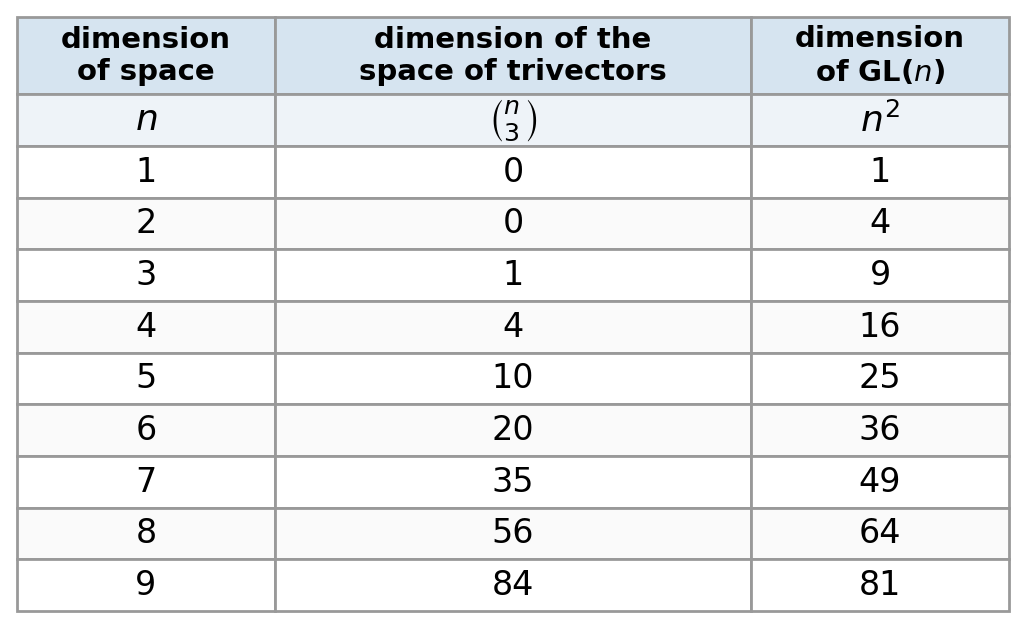
For \(n\) less than \(9\), there's a finite set of different kinds of trivectors in \(n\)-dimensional space. But when \(n = 9\), the space of different kinds has dimension $$ 84 - 81 = 3 $$ This is not a proof, just a heuristic argument. But it's correct.
In 1978, Vinberg and Elashvili classified all kinds of trivectors in \(\mathbb{C}^n\). But they looked at the space of trivectors modulo \(\mathrm{SL}(n)\) rather than \(\mathrm{GL}(n)\). Here \mathrm{SL}(n)\) is the group of \(n \times n\) matrices with determinant \(1\). So, they didn't count two trivectors as the same when they differ by an overall scale factor. This actually makes things more pretty, though it means the space has dimension 4 rather than 3.
They showed that you can get a 4d space of kinds of trivectors in \(\mathbb{C}^9\) by looking at all linear combinations of these 4 trivectors:
$$ \begin{align} h_1 &= x_1 \wedge x_2 \wedge x_3 + x_4 \wedge x_5 \wedge x_6 + x_7 \wedge x_8 \wedge x_9, \\ h_2 &= x_1 \wedge x_4 \wedge x_7 + x_2 \wedge x_5 \wedge x_8 + x_3 \wedge x_6 \wedge x_9, \\ h_3 &= x_1 \wedge x_5 \wedge x_9 + x_2 \wedge x_6 \wedge x_7 + x_3 \wedge x_4 \wedge x_8, \\ h_4 &= x_1 \wedge x_6 \wedge x_8 + x_2 \wedge x_4 \wedge x_9 + x_3 \wedge x_5 \wedge x_7. \end{align} $$
This looks very scary - almost random! But in fact there's a beautiful pattern! Draw a \(3 \times 3\) grid, label the points 1 through 9. If we draw three horizontal through these points, we get this:
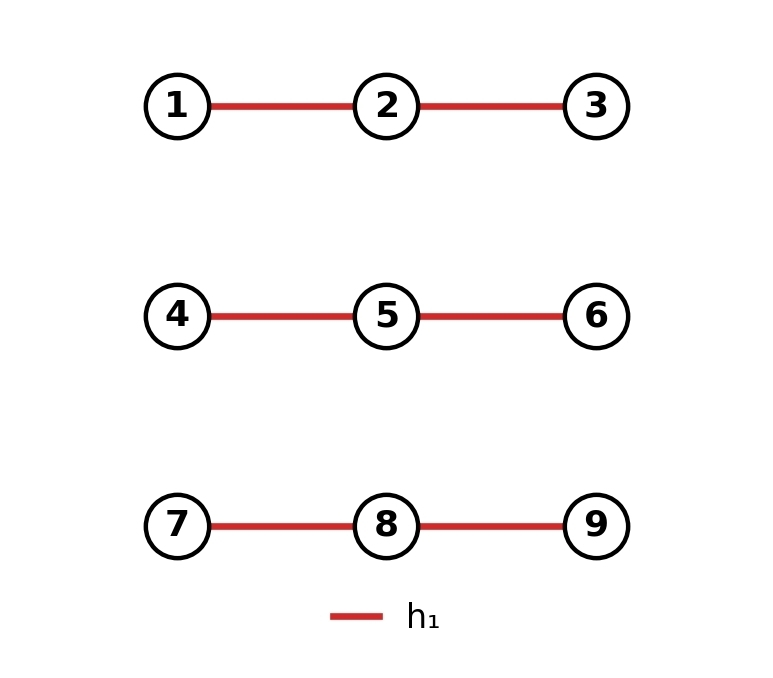
and each line gives a term in \(h_1\):
$$ \begin{align} h_1 &= x_1 \wedge x_2 \wedge x_3 + x_4 \wedge x_5 \wedge x_6 + x_7 \wedge x_8 \wedge x_9 \\ \end{align} $$ See? 123, 456 and 789.
Next draw three vertical parallel lines through these points:
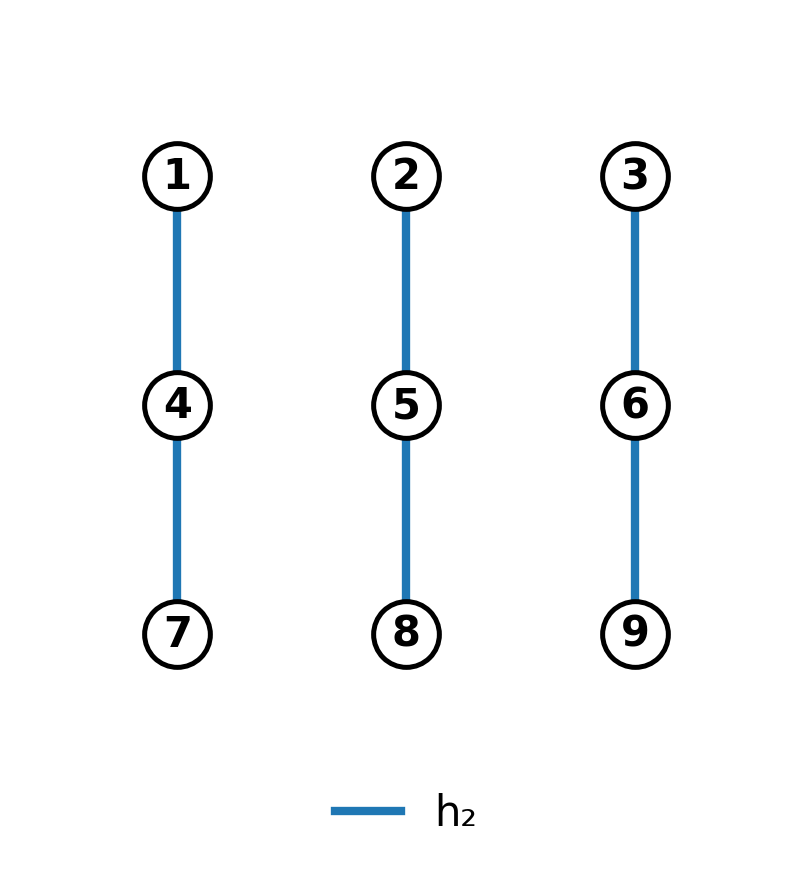
$$ \begin{align} h_2 &= x_1 \wedge x_4 \wedge x_7 + x_2 \wedge x_5 \wedge x_8 + x_3 \wedge x_6 \wedge x_9 \\ \end{align} $$ See? 147, 258 and 369.
There are two other ways to draw three parallel lines through our \(3 \times 3\) grid if we let them 'wrap around'. These lines
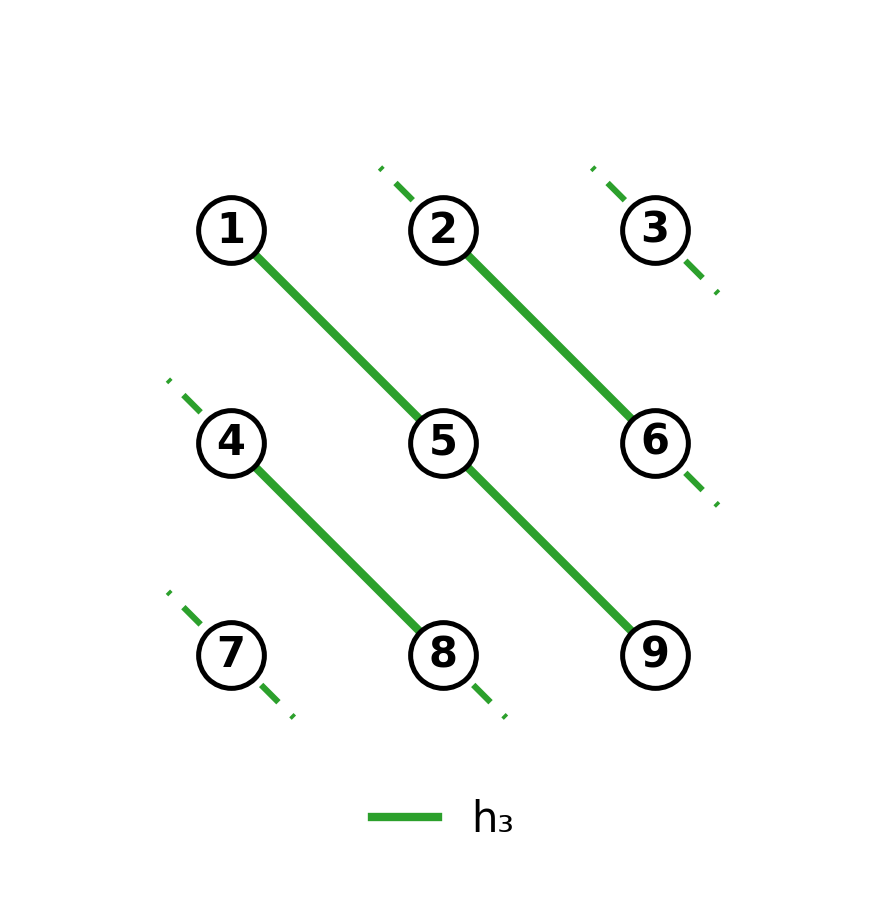
$$ \begin{align} h_3 &= x_1 \wedge x_5 \wedge x_9 + x_2 \wedge x_6 \wedge x_7 + x_3 \wedge x_4 \wedge x_8 \\ \end{align} $$ And these lines:
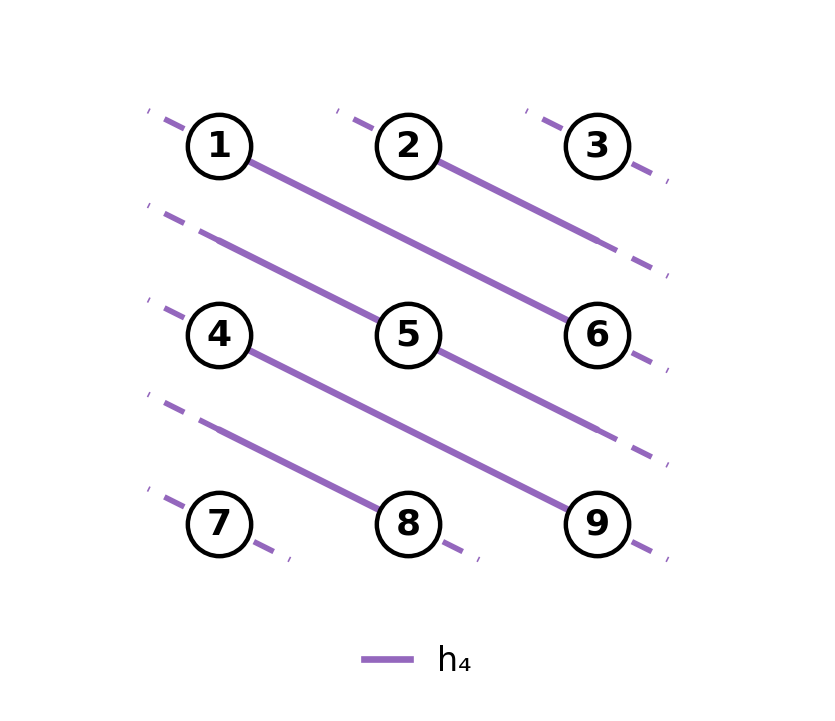
$$ \begin{align} h_4 &= x_1 \wedge x_6 \wedge x_8 + x_2 \wedge x_4 \wedge x_9 + x_3 \wedge x_5 \wedge x_7 \end{align} $$
But what's really going on here???
It's rather deep, and so far I've just scratched the surface. It's connected to the Lie group \(\mathrm{E}_8\). Let me just say a word about how.
The Lie group \(\mathrm{E}_8\) is the biggest of exceptional Lie groups. It's 248-dimensional! So therefore is its Lie algebra \(\mathfrak{e}_8\).. Vinberg showed that you can describe \(\mathfrak{e}_8\) using trivectors in 9 dimensions. It works like this: $$ \mathfrak{e}_8 = \mathfrak{sl}(9) \oplus \Lambda^3 \mathbb{C}^9 \oplus \Lambda (\mathbb{C}^9)^\ast $$ Here \(\mathfrak{sl}(9)\) is the Lie algebra of \(\mathrm{SL}(9)\): it consists of 9×9 complex matrices with trace zero, so its dimension is \(9^2 -1 = 80\). \(\Lambda \mathbb{C}^9\)is the space of trivectors in 9 dimensions: as we've seen, this has dimension 84. \(\Lambda (\mathbb{C}^9)^\ast\) is the dual of the space of trivectors in 9 dimensions, sometimes called the space of 3-forms. This also has dimension 84. Notice $$ 248 = 80 + 84 + 84 $$ so the dimensions work out. But Vinberg showed how to describe the Lie bracket on \(\mathfrak{e}_8\), the operation that makes it into a Lie algebra, using operations you can do with \(\mathfrak{sl}(9\)), trivectors and 3-forms. For example the wedge product of two trivectors is a 6-vector, but the Hodge dual of this is a 3-form — so you can take the Lie bracket of two trivectors and get a 3-form!
This is already amazing, but it takes further strokes of genius to get from here to Vinberg and Elashvili's classification of kinds of trivectors. For example, the 3×3 square I showed you is really the plane over the field with 3 elements! So I'll refer you to these papers for details:
These do the complex case. The real case is harder: